Lyon Park Playground Renovation Update

By David Newman

The Lyon Park Citizens Association (LPCA), Lyon Park Woman’s Club (LPWC), and the Board of Governors of the Lyon Park Community Center, on behalf of the Lyon Park Community Center (LPCC), are jointly announcing a series of community meetings relating to the proposed playground renovation. The goal of this effort is to take the pulse of the community on whether to proceed with the plan proposed by the Playground Committee, established under the auspices of the Lyon Park Community Center’s Board of Governors.

As detailed below, three public meetings will be held in September to discuss the proposed renovation plan. Voting on the proposed plan will take place at three meetings in October.

The specific language to be voted on follows:

Should the Lyon Park Community Center, which is comprised of the membership of the Lyon Park Citizens Association (LPCA) and the Lyon Park Woman’s Club, approve the Playground Committee’s proposed playground redesign, to be funded by the community through donations by residents and community businesses, at an estimated cost of $1.352 million? The design includes replacing the existing ages 2-5 play equipment, adding ages 5-12 equipment, removing the tire swing, adding accessible pathways and child-safe play surfaces, upgrading the picnic tables and trash cans, and fulfilling the corresponding rainwater mitigation requirements of Arlington County. As proposed, the estimated area around the equipment for ages 2-5 and 5-12 would be roughly 4,500 sq. ft., as compared to the approximately 1,200 sq. ft. sandbox around the current equipment for ages 2-5. The total net change in play area, taking into account all proposed changes, is estimated to add roughly 2,200 sq. ft. of play area, after removing the tire swing, but including the rain garden.

All residents of Lyon Park are invited to participate in any of the informational meetings taking place on the September dates listed below, at the Lyon Park Community Center. At these meetings, updated information will be shared followed by interactive Q & A sessions.

Schedule of informational meetings (all meetings are at the Lyon Park Community Center):

– Evening LPCA Meeting, Wednesday September 9th, 7:00–9:00 p.m. The information session will follow the regular monthly business meeting.
– Daytime Woman’s Club luncheon meeting, Thursday, September 17th, 12:00–2:00 p.m. Note: This is the regularly scheduled monthly meeting.
– Weekend LPCC meeting, Sunday September 13th, 4:00–6:00 p.m. This session will be held both in person and remotely.
Join this meeting on your phone or computer via Google Meet: https://meet.google.com/jzm-repm-saj. The link also can be found on the archived version of this newsletter and on upcoming events on the LPCA website, LyonPark.org. To dial in on your phone, call 337-435-0236, and use PIN: 756 684 255#. If this phone number does not work for you, more phone numbers can be found at https://tel.meet/jzm-repm-saj?pin=1113240743113.

Schedule of voting times:

Members of the LPCA and the Woman’s Club who pay their dues are invited to come to the Community Center at any of the times below to vote on whether to move forward with the current playground proposal. Members are entitled to one ballot only per person, either as a member of the LPCA or the LPWC, and a master list will be provided for cross-checking names. These meeting dates are intended to accommodate a variety of availability and scheduling needs:

– Weekend LPCC meeting, Sunday October 4, 4:00–6:00 p.m.
– Evening LPCA Meeting, Wednesday October 14, 6:00–9:00 p.m.(This is the date for the regular monthly LPCA meeting with expanded hours).
– Daytime Woman’s Club meeting, Thursday October 15, 12:00–2:00 p.m. (This is the date and time of the regular LPWC monthly meeting).

We owe thanks to the Lyon Park Playground Committee members for their many hours of hard work and contributions volunteering on behalf of the community. We hope many of you will attend one or more of the information sessions and participate in voting. It takes a village and we have a great one!
Questions & Answers

Q: Why are we doing this project?
A: The Lyon Park playground has served our community for more than two decades and is approaching the end of its useful life. This project is an opportunity not only to replace aging equipment, but also to create a safer, more accessible, and more welcoming space for families. Based on extensive community input, the proposal adds play opportunities for older children, improves accessibility, addresses long-standing stormwater drainage issues, and enhances gathering spaces while striving to preserve the park’s natural character.

Q: How does the size and location of the new playground compare to the existing?
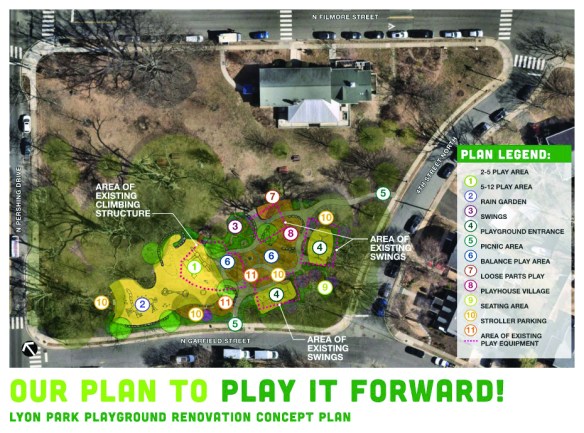
A: The most significant change to the playground equipment is the addition of equipment for ages 5-12, in response to community requests. This equipment will be placed a safe distance from the equipment for ages 2-5. The exact space required depends on the equipment that will be chosen, with community input, if the proposed design is approved. The sandbox area around the current equipment for ages 2-5 is approximately 1,200 sq.ft. The area required for replacement equipment for ages 2-5 and equipment for ages 5-12, plus appropriate space in between for the safety of the young users, is estimated at roughly 4,500 sq.ft. Taking into consideration all of the proposed changes, the proposed design is estimated to expand the activity areas by roughly 2,000 sq. ft, or 20-25% to include: (a) the new area for age 5-12 play equipment, (b) replacing the ages 2-5 play equipment and changing its configuration (both areas to include child-safe play surfaces), (c) adding accessible pathways, (d) upgrading and rearranging the picnic tables and trash cans area, and (e) fulfilling the corresponding rainwater mitigation requirements of Arlington County. Under the proposal, the tire swing would be removed, but all other swing sets would be preserved, until replaced by new swings.
Q: How has the community been involved in developing this proposal?
A: Over the past year, Playground Committee members have met with neighbors through surveys, community meetings, neighborhood events, and informal conversations at the park to listen to ideas and answer questions. Community feedback has directly influenced the proposed layout and design, and if the project is approved, residents will continue to have opportunities to help shape final decisions on color scheme in general, the color of the safety surfaces, signage, plants and trees to be added, and the details of benches and picnic tables.

Q: How will the project be funded?
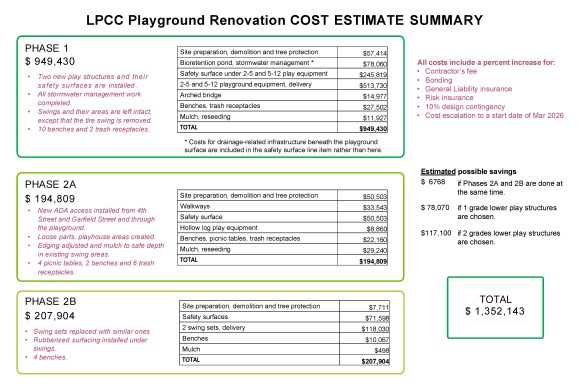
A: A generous private donation has funded all of the design and community engagement work completed to date and will continue to fund preparation of the documents needed for permits and construction administration, if the design is approved. Construction will be funded entirely from donations solicited from the community and local businesses. No loans will be taken. Construction may be broken into three phases, Phases 1, 2A and 2B, phased to accommodate the fundraising pace. No construction will begin until enough money has been raised to fully fund that particular phase of construction. At that time, the funded phase can begin.

Q: How will the vote be conducted?
A: Only LPCA or Woman’s Club members, who have paid their associated dues, will be eligible to vote. Each eligible person gets one vote, even if they belong to both organizations. LPCA family memberships allow for each person in the family, 18 years old or older and residing with the registered member, to vote. Under the current plan, voting will take place at three designated times, spaced to maximize the opportunity for every eligible voter to have an opportunity to vote. Voters will place marked ballots in a sealed envelope and hand it to one of two designated volunteers at a voting table. Those volunteers will have current lists of eligible voters of the LPCA and the Woman’s Club and will put a check mark by the voter’s name on the list, once their vote is received. Sealed envelopes will not be opened until after the end of the final voting session. Votes are anonymous – your name is not recorded on your ballot.

Q: Can people join the LPCA or Woman’s Club and pay their dues when they come to vote? Will there be remote voting?
A: Yes, people can join when they come to vote in person. And no, there is no plan for remote voting at this time. Under the current plan, voters may come to the Community Center to vote at any point during one of the three voting blocks in October.

Q: How will our trees be protected?
A: Preserving the park’s mature trees has been a priority throughout the planning process. The plan preserves all of the existing trees with the sole exception of the small leaning cherry tree, which will be removed. A licensed arborist will advise us on how best to protect all of the existing trees in the vicinity of the playground during and after the construction phase. The current playground plan also includes the addition of six new trees.

Q: How was this design selected and is it finalized?
A: The Playground Committee, working with professional landscape architects, developed initial concept designs based on the results of the community survey they distributed in 2025. The Committee presented those to the Board of Governors, which also provided input into the proposed design. Further changes were made as a result of community feedback at the May 2026 LPCA and Women’s Club meetings. The design work was done by LandDesign Inc, a local, multidisciplinary planning, engineering, and design firm with an extensive portfolio of DMV-area parks, playgrounds, and community projects, offering wide-ranging expertise in sustainability and environmental stewardship. Details, including the color scheme in general, the color of the safety surfaces, signage, plants and trees to be added, and the details of benches and picnic tables, will be selected with further community input, if the proposed design is approved.

Q: Why is the construction broken into phases and what is included in each?
A: The construction does not have to be completed in phases, but can be broken into phases if we have not yet raised the funds for the entire project and want to get started. Each phase is a self-contained construction project, independent of each other. For instance, while Phase 1 is taking place, one half of the playground could remain open; while Phases 2A and 2B are taking place, the other half of the playground could remain open. Below are short descriptions of what each phase includes:

Phase I
– Two new play structures and their safety surfaces are installed, one for ages 2-5 and one for ages 5-12.
– All stormwater management work is completed.
– Swings and their areas are left intact, except that the tire swing is removed.
– 10 benches and 2 trash receptacles are installed.
Phase II
– New ADA access is installed from 4th Street and Garfield Street and through the playground.
– Loose parts and playhouse areas are created.
– Edging is adjusted and mulch is added to a safe depth in the existing swing areas.
– 4 picnic tables, 2 benches and 6 trash receptacles are installed.
Phase III
– Old swing sets are replaced with similar ones.
– Rubberized surfacing is installed under the swings.
– 4 benches are installed.

Q: What is the fundraising strategy?
A: Fundraising, coordinated by the Fundraising Subcommittee of the Playground Committee, will begin with soliciting commitments from local businesses and other potential large donors, and subsequently from community members. Commitments or pledges will be sought, rather than dollars, until we have sufficient commitments to cover the cost of Phase 1. At that time, we will secure the money and move forward with Phase 1. Fundraising for Phases 2A and 2B will be based on a strategy informed by the outcome of Phase 1 fundraising.

Q: What happens to donations collected if the threshold to start construction of Phase 1 is not met?
A: Only commitments (pledges) will be taken until we reach the total needed to complete the first phase of construction. Only then will the donations be collected. This way, if the construction of Phase 1 does not go forward, no return of funds will be required.

Q: What happens if this vote does not result in approval of the proposed design?
A: If a majority of voters do not approve the proposed design, there will be no plan in place to replace the aging playground equipment, which is now approximately 24 years old. The Board of Governors will solicit volunteers from those who engaged during this design cycle to reconstitute the playground committee and develop a new plan. Note that the private donation that has funded the design and community engagement work to date will not be available if a new design is needed.

Q: Can we avoid having to pay for land disturbance/water mitigation improvements?
A: No. A Land Disturbing Activity/Stormwater permit is required by Arlington County for any activities that disturb equal to or greater than 2,500 square feet of land, according to the Erosion and Stormwater Management Ordinance, Chapter 60, and the Virginia Erosion and Sediment Control Program. To obtain this permit, you must submit civil engineering plans showing infrastructure installation to reduce the pollution from sediment runoff and manage stormwater runoff.

“Disturbed land” includes not only the location where the playground will be installed, but also locations where new play equipment and supplies are stored, pathways for machinery access and foot traffic, area for a construction dumpster, etc. Given that the sandbox area around the current play structure for ages 2-5 is approximately 1,172 sq. ft., it is unrealistic to think we could do anything other than remove that structure without disturbing more than 2500 sq. ft. of land.

In addition, many residents are aware of the hazard created by the lack of rainwater management measures and the associated flooding for days after a downpour in the existing playground.

Q: Who developed this proposal and who is on the Playground Committee?
A: After soliciting and analyzing community input, the Playground Committee provided that information to LandDesign Inc., a professional landscape architect and engineering firm, that developed the proposal. The Playground Committee consists of volunteer Lyon Park residents, including principally those listed below.

– Michael Kunkler – Former LPCA ExCom President, LPCC BoG Treasurer, 10 year resident, two children who are frequent users of Lyon Park playground
– Mark Ilich – Founder and co-owner of Procon Consulting, who advise facility owners on design & construction projects such as GSA and NASA, implement modern technologies for project management (like LiDAR and digital twin modeling), and father of 3 children/playground users.
– Paul Showalter – Longtime member of LPCA and Women’s Club ExCom and the LPCC BoG, primary organizer for all children’s events at the LPCC.
– Steve Geiger – Member of the LPCC BoG Ground Committee and tree advocate.
– Sean Kennealy – Retired Superintendent for National Park Service and playground volunteer to lead construction, Logistics, and Operations & Maintenance.
– Niels Poulsen – Committee Co-Chair and active Lyon Park parent of two.
– Tola Atewologun – Committee Safely Officer and active Lyon Park parent of two.
– Ari Portland – Committee Fundraising & Sponsorship Lead and active Lyon Park parent of two.

Q: Will Playground Committee members be able to bid on the project?
A: No. All paid work from the project will be competitively bid out to private general contractors, which will not include any company represented on the Playground Committee. No one from the Playground Committee will be eligible to perform any paid work on the project.

Q: Where can I find the latest updates relating to the playground?
A: There’s a page on the playground renovation on the LPCA website. You can find that at https://lyonpark.org/explore/parks-green-spaces/lyon-park-playground-renovation/

Lyon Park Picnic Recap

By Elizabeth sheehy

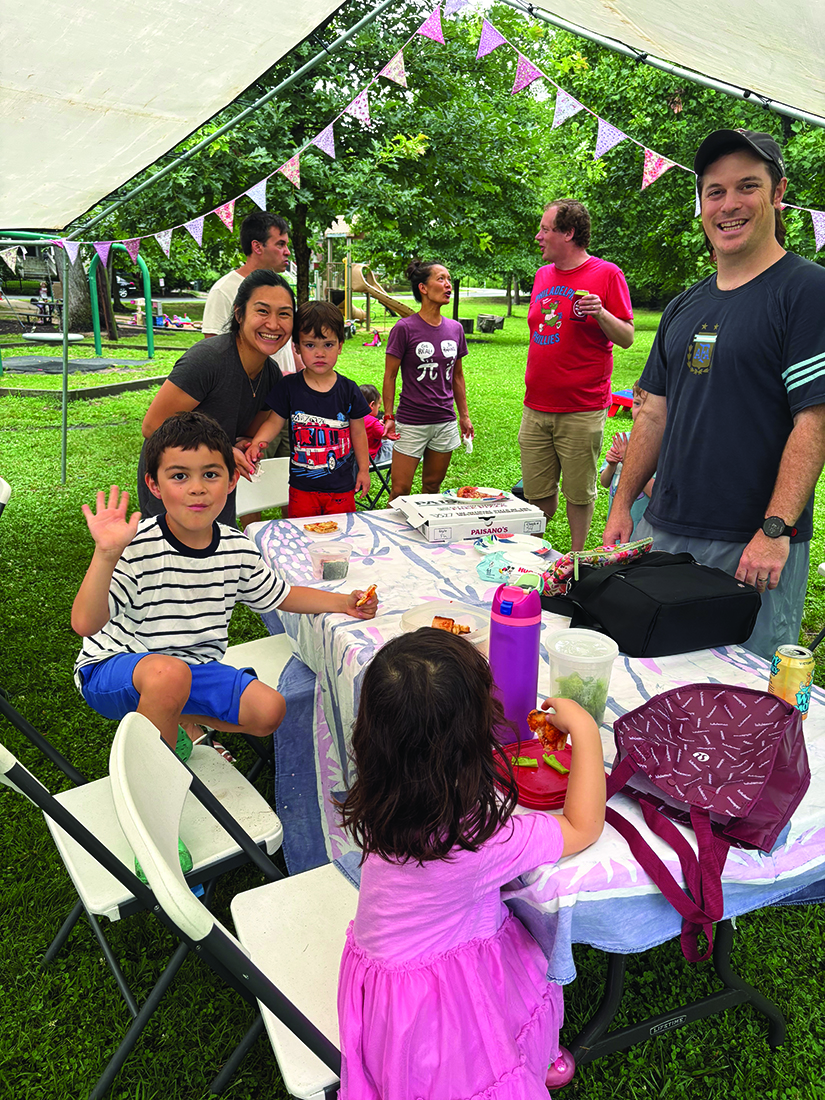
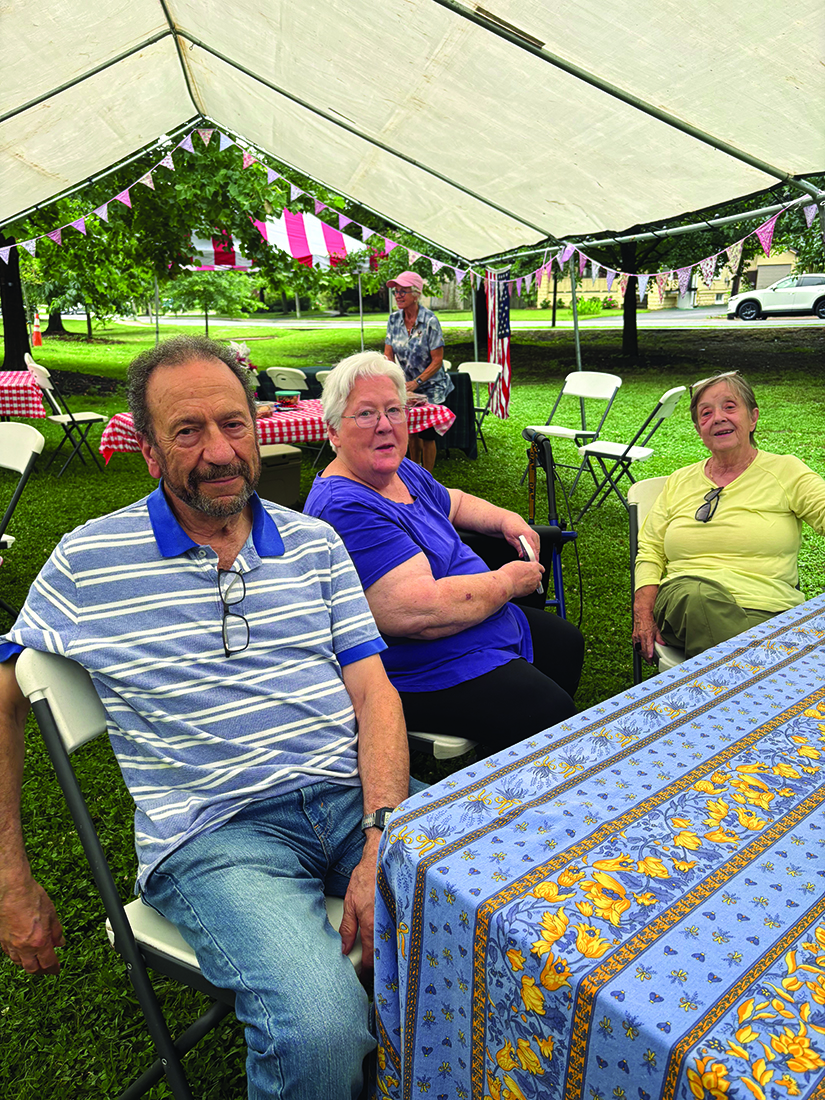
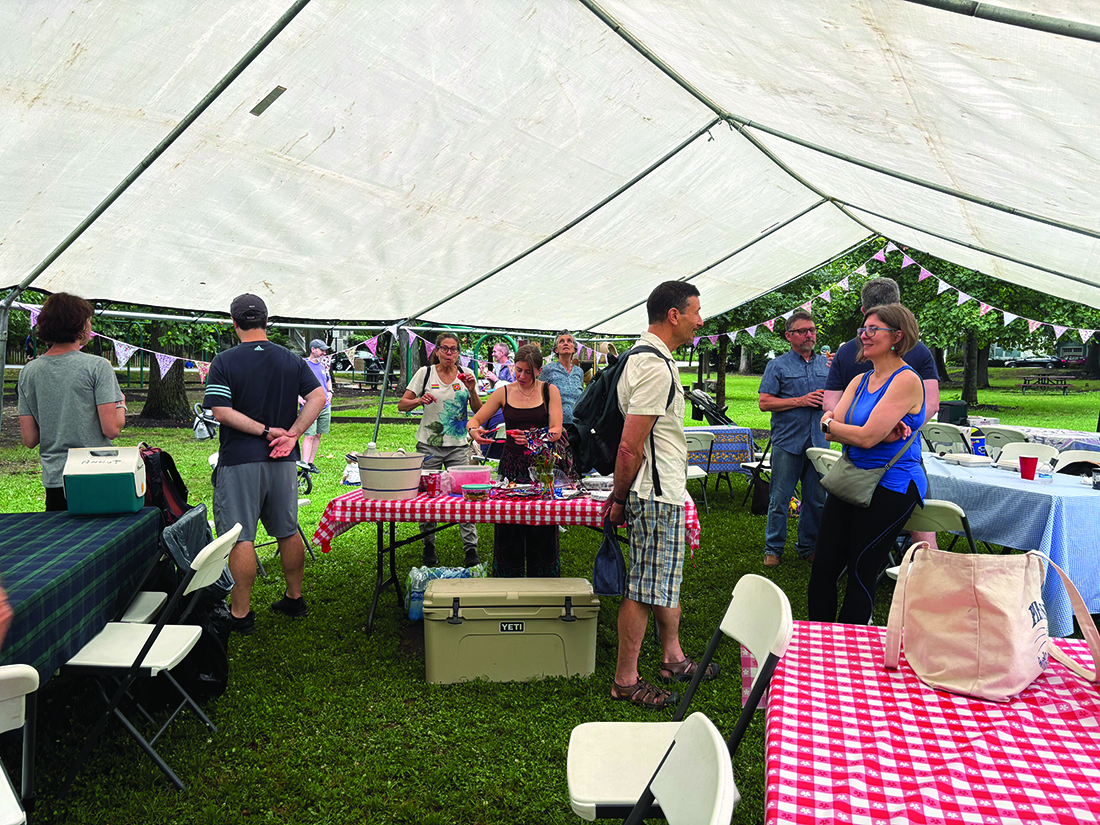
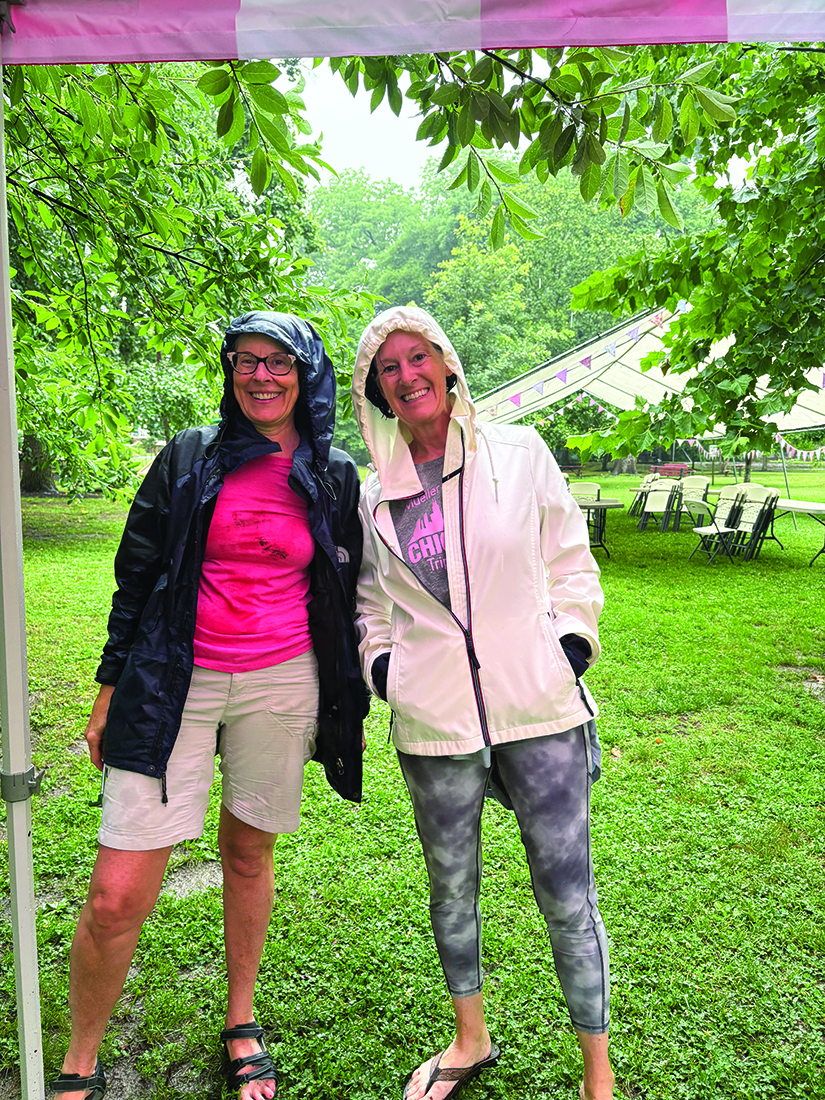
The set up on the morning of June 28 was soggy but thanks to Lynn Shotwell, Trish Montgomery, Rhodri Morgan and Jackson Sheehy, the tent for the Lyon Park & Ashton Heights Pre-250 Picnic was ready when the sun emerged in the afternoon. Lawn games, popsicles and good conversation was enjoyed by young and old. Special thanks to Shelya White for the baked treats! Happy 250, America, and Happy 107th, Lyon Park! 

Playground Quest: A Game Everyone Can Play!

By David Newman

Lyon Park is our shared backyard—a place where children play, neighbors gather, and community happens. Maintaining the park is the responsibility of the Lyon Park Community Center’s Board of Governors (the “BOG”), so when the BOG saw aging playground equipment and picnic tables needing replacement and on-going water drainage issues, the BOG authorized creation of a Playground Committee to gather community input, identify neighborhood priorities, and develop recommendations.

Over the past year, an all-volunteer Committee, led by Mark Illich, has widely distributed a survey, held conversations at community events and meetings, provided updates in this newsletter, delivered flyers throughout the neighborhood, and worked to keep you informed on https://lyonpark.org/explore/parks-green-spaces/lyon-park-playground-renovation/.

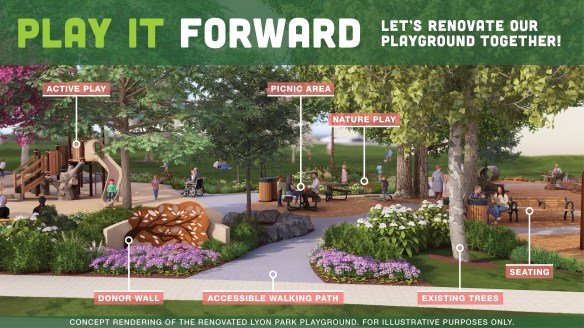
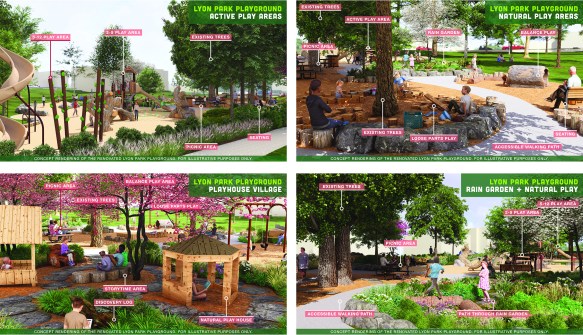
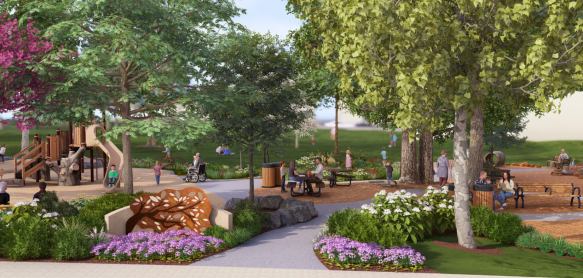
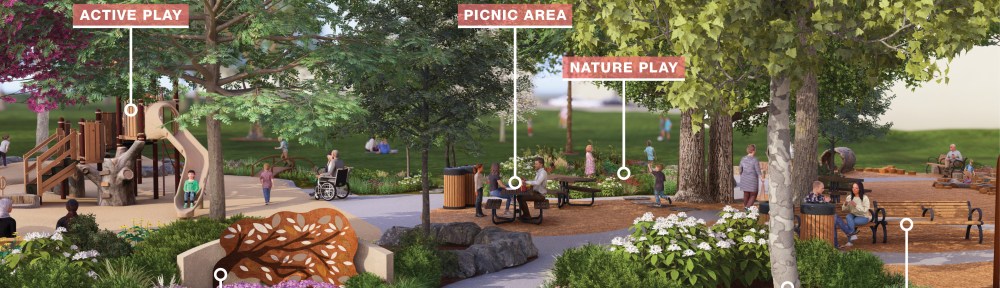
Your collective input guided a playground design expert, whose work was funded by a generous donation. The expert sketches here and on the website reflect the general design plan. Finalizing the plan requires selection of the playground equipment, which happens at a later stage with further opportunity for community input.

What We Heard. Across multiple channels, community members expressed strong support for improving park drainage, replacing aging equipment, upgrading play surfaces, and adding play equipment for children 5–12. At the same time, neighbors emphasized the importance of protecting Lyon Park’s tree canopy, preserving the natural character of the park, and maintaining open play space and picnic areas. The proposed design strives to optimize the playground, while preserving the nature and spirit of Lyon Park. 

Design Elements:
-A rain garden to help capture and treat stormwater runoff
-Replacement of the equipment for children ages 2–5
-Addition of equipment for children ages 5–12
-Upgraded play surfaces to improve accessibility and the health and safety of our children and our trees
-Shifting the ages 2–5 play area away from the existing tree cluster and picnic tables to better protect critical root zones, expand picnic space, and make better use of the northwest portion of the park
-A second accessible entry path from 4th Street to improve access for strollers, wheelchairs, and others who need accommodation
-Preservation of the tree canopy. Only a small leaning cherry tree needs removal; while additional trees and native plantings will be in the project budget.
-If fundraising permits, free-standing play areas, such as a small playhouse village, balance play, or loose-parts play, may be added under existing shade trees.

As the project moves forward, the Committee will keep working with community members and organizations to ensure your priorities remain their priorities.

What Comes Next. The Committee will continue sharing information, answering questions, and gathering feedback at community meetings and events. Updates will be published in this newsletter, on the Lyon Park listserv, and at https://lyonpark.org/explore/parks-green-spaces/lyon-park-playground-renovation.

Eligible community members will have an opportunity to vote on the plan. The results of that vote, and other inputs from engaged community organizations and members, will determine the future of this initiative. Even after this decision point, if the project moves forward, further community input will be welcomed on finer details.

The next step will be fundraising, likely beginning with local businesses and potential institutional or corporate supporters, followed by outreach to neighbors seeking participation at a meaningful level.

Selection of playground equipment and plantings, with further community input, occurs after funding is in place.
Comments, questions, and concerns about the overall plan can be sent to Playground Committee Chair Mark Illich at milich@mkdevelopmentllc.com and to David Newman and Ann Pitts at LPCCGovernors@gmail.com.

A Bee-utiful Outcome for the Bees in Our Tree

By Anne Bodine

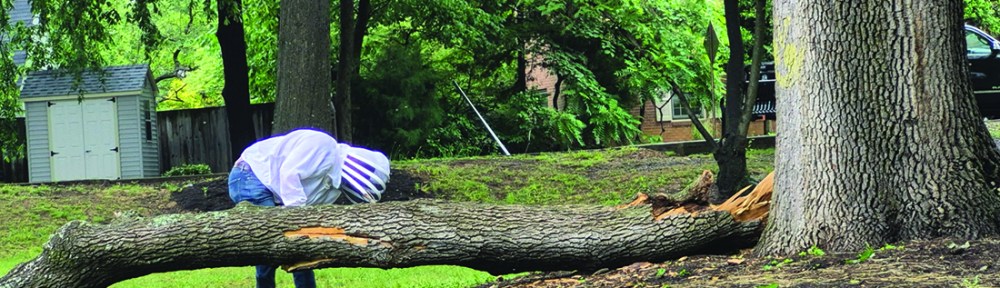
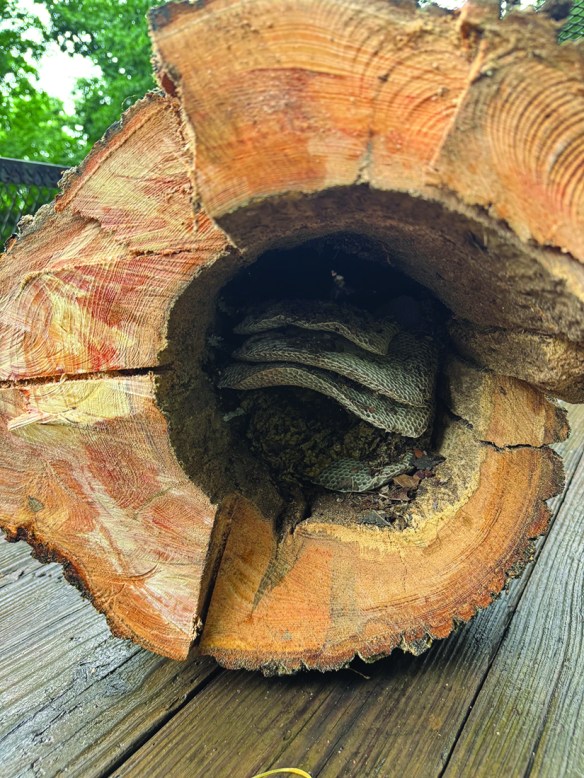
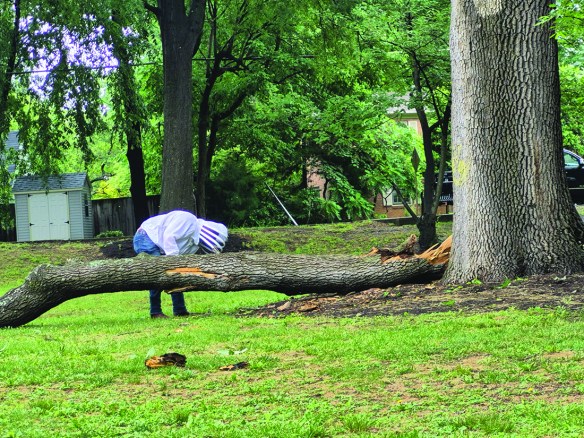
On May 23, a huge branch fell from our large Ash tree during a storm in Lyon Park. We discovered the branch housed a large nest of honeybees (Apis Mellifera or European honeybees). As Virginia has recently experienced major colony collapses—and the European honeybee is our official “state pollinator”—we decided to try save the bees. We called in NoVa Beekeepers. Beekeeper Brad Gamon assessed we would need a chainsaw and put the word out to beekeeper Scott Reid, who turned out the next day with saw and a trailer. Reid impressed us by sawing out the log containing the nest and bees, sawing it into quarters, reassembling it, and loading it for transport, while preserving the honeycombs and the all-important queen bee!! Reid assessed the nest contained 10,000–30,000 bees; he will relocate them into hives and help them recover.

I learned a lot about bees from Operation Save the Bees:
– Almost 90% of plant species require pollination by animals; bees are among the most important pollinators;
– Arlington Del. Patrick Hope is the one who got the bees designated as “state pollinator;”
– Bees need two things: a place to nest (like our huge Ash tree!) and flowers for food;
– 70% of species nest underground, the rest in hollow centers of shrubs/trees;
– Female bees spend their whole lives foraging on flowers, making them more fertile;
– Bees sleep several hours a night, and older bees need more sleep than young ones. They often pair off head-to-foot, both to say warm and to keep from falling from honeycombs or flowers while they are sleeping;
– Bees navigate back home initially using the sun and Earth’s magnetic field. As they near the nest, they use memorized landmarks, and finally use scent to zoom in on pheromone markers;
– Bees do not like wild temperature swings;
If threatened or harmed, the colony may “abscond” and abandon the nest;
– When any British monarch dies, royal bees are notified. Upon the death of Queen Elizabeth II, head beekeeper John Chapple said: “You knock on each hive and say, ‘The mistress is dead, but don’t you go. Your master will be a good master to you.”

Lyon Park residents no longer get to host this large bee colony, but in our own way, we respected the bees in similar fashion, finding them a new home so they can continue their mission to sustain Virginia crops and plants. And we learned to appreciate our own trees even more, discovering how they shelter the literal worker bees of our planet. 

Lyon Park Playground Renovation

By David Newman

Have you been to the playground at Lyon Park after a good rain?  The high tide stems from a stream running under the park.  Years ago there was a pond in the park!  Recognizing that our playground is well-loved and well-used, but aging, a Playground Committee, under the auspices of the Lyon Park Community Center’s Board of Governors and the Lyon Park Citizens Association, is working on a plan to address the water issues, add child-and environment-friendly play surfaces, and upgrade the aging playground equipment and picnic areas.

The Committee’s work is led by our neighbor Mark Ilich.  New committee members are still welcome, as the Committee continues to seek community input and begin fundraising.  Fundamental principles of this project include: (1) we want to protect our tree canopy, (2) any new gardens must be low maintenance, focusing on resilient native plants, (3) we want to protect open areas of the park, as much as possible, (4) we want community input, but there will be a cutoff, allowing plans to move forward; (5) funding will come from donations or perhaps some small grants; and (6) no phase of work will begin until we have funds to cover the cost.  For more information about the project, check out our website at https://lyonpark.org/explore/parks-green-spaces/lyon-park-playground-renovation/.  You also can look for information tables at some Lyon Park community events, watch for future articles in the Lyon Park and Ashton Heights newsletters, and keep an eye on the LP and AH community list servs.  To get involved, send an email to Mark Illich at milich@mkdevelopmentllc.com.  You also can contact the Lyon Park Board of Governors at LPCCGovernors@gmail.com, if you have questions.

Lyon Park Loses a Landmark

By Elizabeth Sheehy

On the afternoon of December 11, Lyon Park lost a beloved member of its arboreal family, the Japanese zelkova tree (zelkova serrata) that for many years stood guard near the southeast corner of Lyon Park. In the summer it offered shade, and its fall leaves were brilliant. The tree’s demise highlights two community concerns that Arlington County leadership must address: bureaucratic inflexibility and poor communication.

There is little doubt that Lyon Park is facing a tree crisis. The prevalence of aging trees (many 100+ years old), disease and development has reduced the tree canopy throughout our area. As a community, we value trees for their cooling shade, and role in cleaning the air and absorbing water runoff. After decades of neglect, the County is finally engaged, implementing the Circuit Tree Maintenance program in 2024, “proactively inspecting and scheduling maintenance to all street trees under [the County’s] care on a five-year cycle” to protect Arlington’s tree canopy. 

https://www.arlingtonva.us/Government/Programs/Sustainability/Trees/Tree-Maintenance-and-Health/Public-Trees/Circuit-Tree-Maintenance

Lyon Park certainly appreciates the County’s intentions, yet there is a right way and a wrong way to go about tree maintenance, and the treatment of this tree sure looks like the wrong way.

During this past summer, the County started working on Lyon Park’s trees. Communication was underwhelming, with a single notification about scheduled tree maintenance sent via email to the LPCA (which then distributed it to the list serve) in mid-August. This information was not sent to individual homes, so it came as a shock to many in mid-October when signs were nailed to a dozen trees, stating their removal was imminent. Residents were angry and confused, and it was two days later that the LPCA President received a County email stating the number of trees slated for pruning and/or removal.

Questioning why this important and seemingly healthy tree was being cut down, the community gathered at the site on October 25, inviting County leaders to join them for a “treeside chat.” No County employees attended, but residents who were present agreed that the tree appeared healthy and requested a second opinion on its viability. Communication went back-and-forth between the LPCA and County officials, with Lyon Park asking for time to review options to rehabilitate the tree, which serves as a focal point on N Fillmore Street. Responses were slow, but the LPCA believed it was still in conversation with its government representatives when, on December 11, the chainsaws arrived. 

Knowing this tree was a priority for the Lyon Park community, the County could have held off its irreversible actions until the community was convinced of its necessity. After decades of tree neglect, postponing this tree’s removal so alternate options could be considered was a reasonable request. Instead, Lyon Park’s concerns were ignored. Once the tree was removed, it was clear that there was no internal rot, and, having survived the recent derecho and various hurricanes, there was no reason to believe its limbs would fail any time soon. Residents’ sense of betrayal will not fade quickly, and the County’s actions highlight distrust in Arlington between elected officials and residents.  

Lyon Park deserves an explanation.

UPDATE: LPCA President Natalie Roy addressed this issue at the December 13 County Board meeting. The Board promised to look into the issue and get back to her. Stay tuned. 

Grounds Committee

By Steve Geiger

The LPCC Board of Governors has created a new Grounds Committee to oversee the natural environment of the park exclusive of the playground areas and the community center.  The committee is currently composed of Bill Anhut, Deborah Barber, Ann Bodine, and myself, but we are looking for others within the community who would wish to join and help us maintain the park.  Please let me know (miscsteve@comcast.net) if you would like to be a part of this committee.

The Grounds Committee performs various functions:  

We apply mulch to the trees every spring, supervise a professional arborist to check the health of the trees, conduct tree pruning when necessary, provide for emerald ash borer treatment of the two Arlington County Champion White Ash trees located in the center of the park, and oversee the mowing of the lawn.  

Deborah is doing a fantastic job in creating and maintaining the extensive gardens surrounding the community center, maintaining the rain garden located to the south of the community center, and preparing plants for the annual Lyon Park Plant Sale.  She currently is looking for volunteers to help with these tasks.  Please contact Deborah (deborah.barber@gmail.com) if you wish to help keep the gardens looking great. 

Let’s Renovate Our Playground Together!

The Lyon Park Playground Committee is excited to be working with the community to develop a plan for renovating the playground at Lyon Park. We are a group of volunteers spearheaded by resident Mark Ilich and began meeting in February to discuss the project and how we can “Play It Forward!”

The basic intent is to: replace the equipment, address the current drainage problems, respect the park’s natural tree canopy, and install new surfacing. However, other details and what it will look like exactly is still an open question. Throughout the spring we will be at several community events to help raise awareness of the project and hear from the community. Last month we launched a survey to better understand the community’s preferences and priorities. If you have not already shared your feedback, please follow the link below to provide your input and make sure your voice is heard! Your input is very valuable in guiding the renovation and design process, and we want to hear from as many residents as possible. Please share with your neighbors and help spread the word!

We also invite you to come to our tent at the Lyon Park Spring Fair (5/17) where we will have an activity table for kids to build their dream playground and volunteers will be available to speak with you more about the project. 

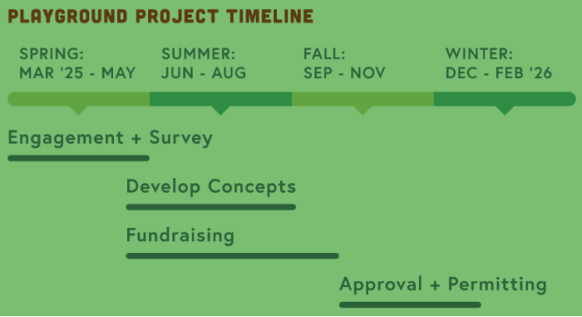
In June, based on all the input collected in our Survey, we will launch the next phase of conceptual design and begin fundraising in earnest. A generous donation has allowed us to engage a local design firm to help us shepherd the project through these initial engagement and conceptual design phases; however ongoing volunteer efforts and fundraising will be critical to turning this vital need into a reality. Please be on the lookout for ways that you can participate in and donate to the efforts and help us PLAY IT FORWARD!

https://www.surveymonkey.com/r/LP-Playground-Renovation 

Lyon Park (and Ashton Heights) Tree Canopy Update

By Anne Bodine

The County’s Urban Forester Vincent Verweij reported in our March meeting that Lyon Park’s tree canopy had grown—per the County’s newest survey of comparing tree canopy countywide from 2014 to 2023—from 29% to 33%.  LPCA members expressed some skepticism about the data and the county’s overall stewardship; many felt Arlington wasn’t doing enough to save mature trees.  Brooke Alexander, tree canopy coordinator for Ashton Heights, presented maps showing trends for mature trees (those 40’ or taller, compared to the County’s survey which measures canopy at the 12’ level).  

Lyon Park’s tall trees (40’ or taller) grew only 1% and Ashton Heights’ grew only 4%, these numbers would be much higher but for the impact of development (disease/invasives/age/owner convenience) also causing tree loss). One block of N. Edgewood (just north of LPCA) illustrates the problem.  Google Earth shows the teardowns in real time; the survey shows loss (orange), new growth (lime green) and dark green (no change).  

Alexander pressed Verweij to help us set goals—and I pressed for county support to achieve them—so Lyon Park and Ashton Heights could help us make the overall county goal of 40% canopy (NOTE:  Rosslyn is only 19%).  He followed up after our meeting to suggest a standard for low-density residential areas set by the Metropolitan Washington Council of Governments (MWCOG) of 55%.  LPCA and AHCA will continue to work with the Forestry office—please pitch in to water, care for, and plant trees (especially oaks as a keystone species) so we get from 33% to 55%!    

Join Us March 12th: Urban Forester will Discuss “Is Our Tree Canopy Growing?”

By Anne Bodine, VP of Development

Arlington covers approximately 26 square miles and the county’s Forestry and Natural Resources Plan (FNRP) calls for a total tree canopy of 40%.  Lyon Park covers about 300 acres, so a 40% goal gets us to 120 acres of canopy (think of it as how much area is covered by shade). But that’s not the whole story.

That Was Then.  Prior to 2024, we relied on data from four canopy surveys.  Three were done by the county (2008, 2011, 2016) and one was done in 2021 by the private company Green Infrastructure Center or GIC.   In the 2016 survey, the county noted that “Lyon Park, Yorktown, and Tara-Leeway Heights have seen the largest drops…of -11%, -8%, and -7% respectively.”  Below are the 3 most recent results for Lyon Park’s total canopy; if trends from these surveys continued, we’d have only 15% by 2031.  

201145%
201634%
202128%

This is Now.  Fast forward to 2023, when the County contracted a new survey and also reached back to incorporate existing surveys done by the U.S. Department of Agriculture for Virginia.  Arlington is now using only these studies (from 2014, 2018, and 2023) to document our canopy, and says they use more reliable measuring techniques (LIDAR which uses aerial imaging).  These studies show that Lyon Park’s canopy grew from 29% to 33% from 2014 to 2023, i.e. a net growth vs. net loss.  (NOTE:  This also contrasts with the GIC data above showing our canopy at 28% in 2023.)

To clear up any confusion, Arlington senior Urban Forester Vincent Verweij will be our featured speaker at our LPCA meeting on March 12, at 7:30 in Lyon Park Community Center.  You can also explore the new findings at https://geocortex.arlingtonva.us/Html5Viewer/index.html?viewer=ACMaps.HTML5#.  Add “trees” in dropdown box called “layers” and then enter “tree canopy change 2014-2023” to see the whole county.  You can also search for a specific address; it will show areas of loss in orange, areas with no change in dark green and areas with growth in light green.  Please join the discussion March 12, our trees are a key resource for the entire county!