By Brooke Alexander
This is a saga about the first AH Greenway section, and I wish it had a better ending. The first Greenway section came to be with the granting of Use Permit U-1794-68-4 on R-6 zoned properties at 930 Irving Street and 927 Ivy Street.
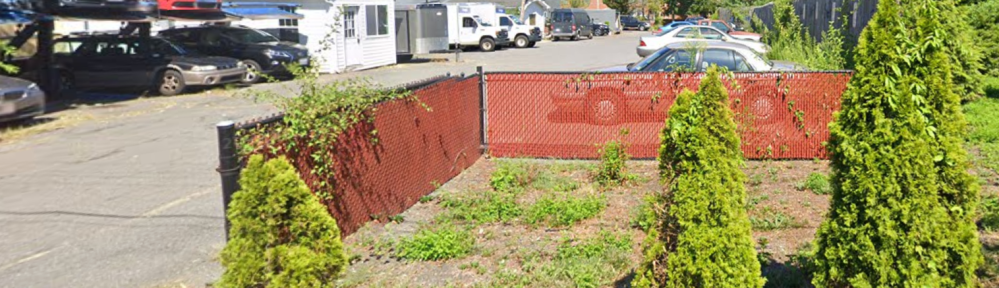
Where is this located? It’s on the neighborhood side of the businesses along 10th Street (Vespa, WBM used cars, and Budget Rental) between Ivy and Irving Street.
A little history. I got involved because of the landscaping.
In the summer of 2023, the County was pressing for the landscaping to be re-installed; most of it had died. I approached the tenant to ask if he would be interested in installing native plants, relying heavily on canopy trees with an understory of perennials for pollinators. The land is owned by Edmunds Motors. The tenant, Ali Nezam, was enthusiastic in his support for this idea.
He asked me if I would make him a plan. I agreed. He asked me to source and price the material, to which I also agreed. I developed a landscape plan which was cheaper than re-installing the plants that are called for in a 1982 County landscaping plan.
The plan I developed had the additional benefits of adding to the neighborhood tree canopy and feeding the local ecosystem, and complying with the Ashton Heights Tree Canopy and Native Plant Principles.
To change landscape plans required an application to the County. Mr. Nezam asked me to fill out the form, which I did, including the proper sized graphics, and thumb drive requirements. I also spoke with the county staff on the owner’s behalf to affirm that the Administrative Change would be positively reviewed.
I obtained 6 free trees that I kept alive on my driveway, awaiting planting; offered my member discount on native perennials from Earth Sangha and to deliver the plants; and arranged a free Tree Canopy Fund tree which was planted. Mr. Nezam asked me to oversee his landscape crew in planting the 6 trees. But on May 2 the landscaper (and I) discovered that there is 7 inches of packed gravel on this site. This is inhospitable to plants and likely contributed to the previous plants’ demise.
When I looked more deeply into the 193 pages of County records on the permit, I found that in 2012, the fence along the Greenway had been removed, and the Greenway paved over with these 7 inches of packed gravel, in order to enlarge the parking lot. The County subsequently required the plantings to be re-installed, and that was done in 2014. Unfortunately, the County did not require that the paving be removed at that point.
Current status: After all this elapsed time, and work, the owner and tenant installed plantings on Dec. 4.. Unfortunately they used the 1982 plan. They did not apply for an Administrative Change for permission to use the native plants. This is disappointing on several fronts, but they have the right to do just that. The 7 inches of packed gravel remain. Oh, and the plants on the Ivy Street frontage were planted in the wrong place.
Before this occurred, the AHCA wrote to Arlington officials about the landscaping and other compliance issues.
“We request that if the landowner does not wish to pursue the alternative plan developed by Brooke Alexander, that the landowner be required to bring the property up to Arlington’s current code for landscaping for parking lots as a condition of renewing the Use Permit,” the letter states.
From 1968 until 1996, the County reviewed this Use Permit every 6-36 months. The County has not reviewed this Use Permit since 1996. AH named 15 compliance issues, in addition to the landscaping issues, in this recent letter to the Board. The County is moving to examine these now. I will be able to update you next month. Stay tuned!