The LPCC Board of Governors has created a new Grounds Committee to oversee the natural environment of the park exclusive of the playground areas and the community center. The committee is currently composed of Bill Anhut, Deborah Barber, Ann Bodine, and myself, but we are looking for others within the community who would wish to join and help us maintain the park. Please let me know (miscsteve@comcast.net) if you would like to be a part of this committee.
The Grounds Committee performs various functions:
We apply mulch to the trees every spring, supervise a professional arborist to check the health of the trees, conduct tree pruning when necessary, provide for emerald ash borer treatment of the two Arlington County Champion White Ash trees located in the center of the park, and oversee the mowing of the lawn.
Deborah is doing a fantastic job in creating and maintaining the extensive gardens surrounding the community center, maintaining the rain garden located to the south of the community center, and preparing plants for the annual Lyon Park Plant Sale. She currently is looking for volunteers to help with these tasks. Please contact Deborah (deborah.barber@gmail.com) if you wish to help keep the gardens looking great.
The Lyon Park Playground Committee is excited to be working with the community to develop a plan for renovating the playground at Lyon Park. We are a group of volunteers spearheaded by resident Mark Ilich and began meeting in February to discuss the project and how we can “Play It Forward!”
The basic intent is to: replace the equipment, address the current drainage problems, respect the park’s natural tree canopy, and install new surfacing. However, other details and what it will look like exactly is still an open question. Throughout the spring we will be at several community events to help raise awareness of the project and hear from the community. Last month we launched a survey to better understand the community’s preferences and priorities. If you have not already shared your feedback, please follow the link below to provide your input and make sure your voice is heard! Your input is very valuable in guiding the renovation and design process, and we want to hear from as many residents as possible. Please share with your neighbors and help spread the word!
We also invite you to come to our tent at the Lyon Park Spring Fair (5/17) where we will have an activity table for kids to build their dream playground and volunteers will be available to speak with you more about the project.
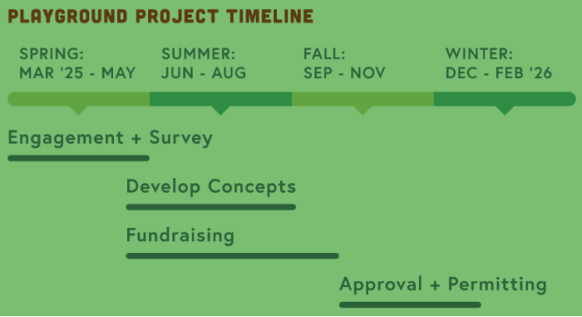
In June, based on all the input collected in our Survey, we will launch the next phase of conceptual design and begin fundraising in earnest. A generous donation has allowed us to engage a local design firm to help us shepherd the project through these initial engagement and conceptual design phases; however ongoing volunteer efforts and fundraising will be critical to turning this vital need into a reality. Please be on the lookout for ways that you can participate in and donate to the efforts and help us PLAY IT FORWARD!
The County’s Urban Forester Vincent Verweij reported in our March meeting that Lyon Park’s tree canopy had grown—per the County’s newest survey of comparing tree canopy countywide from 2014 to 2023—from 29% to 33%. LPCA members expressed some skepticism about the data and the county’s overall stewardship; many felt Arlington wasn’t doing enough to save mature trees. Brooke Alexander, tree canopy coordinator for Ashton Heights, presented maps showing trends for mature trees (those 40’ or taller, compared to the County’s survey which measures canopy at the 12’ level).
Lyon Park’s tall trees (40’ or taller) grew only 1% and Ashton Heights’ grew only 4%, these numbers would be much higher but for the impact of development (disease/invasives/age/owner convenience) also causing tree loss). One block of N. Edgewood (just north of LPCA) illustrates the problem. Google Earth shows the teardowns in real time; the survey shows loss (orange), new growth (lime green) and dark green (no change).
Alexander pressed Verweij to help us set goals—and I pressed for county support to achieve them—so Lyon Park and Ashton Heights could help us make the overall county goal of 40% canopy (NOTE: Rosslyn is only 19%). He followed up after our meeting to suggest a standard for low-density residential areas set by the Metropolitan Washington Council of Governments (MWCOG) of 55%. LPCA and AHCA will continue to work with the Forestry office—please pitch in to water, care for, and plant trees (especially oaks as a keystone species) so we get from 33% to 55%!
Arlington covers approximately 26 square miles and the county’s Forestry and Natural Resources Plan (FNRP) calls for a total tree canopy of 40%. Lyon Park covers about 300 acres, so a 40% goal gets us to 120 acres of canopy (think of it as how much area is covered by shade). But that’s not the whole story.
That Was Then. Prior to 2024, we relied on data from four canopy surveys. Three were done by the county (2008, 2011, 2016) and one was done in 2021 by the private company Green Infrastructure Center or GIC. In the 2016 survey, the county noted that “Lyon Park, Yorktown, and Tara-Leeway Heights have seen the largest drops…of -11%, -8%, and -7% respectively.” Below are the 3 most recent results for Lyon Park’s total canopy; if trends from these surveys continued, we’d have only 15% by 2031.
2011
45%
2016
34%
2021
28%
This is Now. Fast forward to 2023, when the County contracted a new survey and also reached back to incorporate existing surveys done by the U.S. Department of Agriculture for Virginia. Arlington is now using only these studies (from 2014, 2018, and 2023) to document our canopy, and says they use more reliable measuring techniques (LIDAR which uses aerial imaging). These studies show that Lyon Park’s canopy grew from 29% to 33% from 2014 to 2023, i.e. a net growth vs. net loss. (NOTE: This also contrasts with the GIC data above showing our canopy at 28% in 2023.)
To clear up any confusion, Arlington senior Urban Forester Vincent Verweij will be our featured speaker at our LPCA meeting on March 12, at 7:30 in Lyon Park Community Center. You can also explore the new findings at https://geocortex.arlingtonva.us/Html5Viewer/index.html?viewer=ACMaps.HTML5#. Add “trees” in dropdown box called “layers” and then enter “tree canopy change 2014-2023” to see the whole county. You can also search for a specific address; it will show areas of loss in orange, areas with no change in dark green and areas with growth in light green. Please join the discussion March 12, our trees are a key resource for the entire county!
This is a saga about the first AH Greenway section, and I wish it had a better ending. The first Greenway section came to be with the granting of Use Permit U-1794-68-4 on R-6 zoned properties at 930 Irving Street and 927 Ivy Street.
Where is this located? It’s on the neighborhood side of the businesses along 10th Street (Vespa, WBM used cars, and Budget Rental) between Ivy and Irving Street.
A little history. I got involved because of the landscaping.
In the summer of 2023, the County was pressing for the landscaping to be re-installed; most of it had died. I approached the tenant to ask if he would be interested in installing native plants, relying heavily on canopy trees with an understory of perennials for pollinators. The land is owned by Edmunds Motors. The tenant, Ali Nezam, was enthusiastic in his support for this idea.
He asked me if I would make him a plan. I agreed. He asked me to source and price the material, to which I also agreed. I developed a landscape plan which was cheaper than re-installing the plants that are called for in a 1982 County landscaping plan.
The plan I developed had the additional benefits of adding to the neighborhood tree canopy and feeding the local ecosystem, and complying with the Ashton Heights Tree Canopy and Native Plant Principles.
To change landscape plans required an application to the County. Mr. Nezam asked me to fill out the form, which I did, including the proper sized graphics, and thumb drive requirements. I also spoke with the county staff on the owner’s behalf to affirm that the Administrative Change would be positively reviewed.
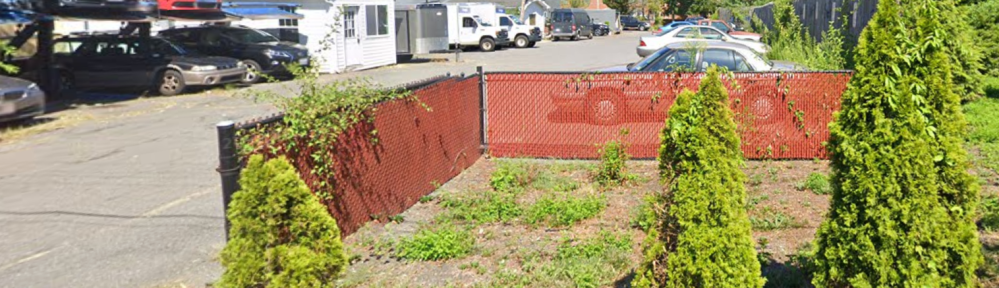
I obtained 6 free trees that I kept alive on my driveway, awaiting planting; offered my member discount on native perennials from Earth Sangha and to deliver the plants; and arranged a free Tree Canopy Fund tree which was planted. Mr. Nezam asked me to oversee his landscape crew in planting the 6 trees. But on May 2 the landscaper (and I) discovered that there is 7 inches of packed gravel on this site. This is inhospitable to plants and likely contributed to the previous plants’ demise.
When I looked more deeply into the 193 pages of County records on the permit, I found that in 2012, the fence along the Greenway had been removed, and the Greenway paved over with these 7 inches of packed gravel, in order to enlarge the parking lot. The County subsequently required the plantings to be re-installed, and that was done in 2014. Unfortunately, the County did not require that the paving be removed at that point.
Current status: After all this elapsed time, and work, the owner and tenant installed plantings on Dec. 4.. Unfortunately they used the 1982 plan. They did not apply for an Administrative Change for permission to use the native plants. This is disappointing on several fronts, but they have the right to do just that. The 7 inches of packed gravel remain. Oh, and the plants on the Ivy Street frontage were planted in the wrong place.
Before this occurred, the AHCA wrote to Arlington officials about the landscaping and other compliance issues.
“We request that if the landowner does not wish to pursue the alternative plan developed by Brooke Alexander, that the landowner be required to bring the property up to Arlington’s current code for landscaping for parking lots as a condition of renewing the Use Permit,” the letter states.
From 1968 until 1996, the County reviewed this Use Permit every 6-36 months. The County has not reviewed this Use Permit since 1996. AH named 15 compliance issues, in addition to the landscaping issues, in this recent letter to the Board. The County is moving to examine these now. I will be able to update you next month. Stay tuned!
Jeannette Wick has been a part of the Lyon Park Community Center’s Board of Governors for more than 20 years, and has served as Chair for the past 15. She will step away from the role at the end of the year. Jeannette’s sense of civic duty and commitment to her position have translated to volunteering an average of 10 hours each week handling issues with building and park maintenance, taxes, non-profit requirements, County policy, rentals, neighbors, and legal matters. Much went unnoticed, some was criticized, all has helped keep our park and Center in great shape.
Jeannette moved into Lyon Park in 1987 and since that time has worked with the not-just-for-Woman’s Club to bake and sell hundreds of thousands of cupcakes to support the LPCC. She organized the annual Craft Fair for more than 20 years and prepared this newsletter for many years. For about seven years before, during, and after the LPCC renovation, Jeannette organized substantial fundraising efforts (thanks to many of you for responding!), and found, coordinated, appealed and eventually secured a historic tax credit that delivered $163,000 to pay down the renovation loan. These efforts helped ensure the LPCC’s solvency, retiring the loan six years ahead of schedule and just ahead of when the pandemic decimated rental income and would have challenged our ability to make loan payments.
And when it rains, it pours. Cindy Stroup and Bill Short have also chosen to step down at year’s end. Bill has been a Jack-of-all-trades for the Community Center for over a decade, frequently coming in late at night so the space is clean and looks great for the next renter or community user. Bill always goes above and beyond as he deals with excess messes and even damage from renters (he has many gross stories to share…not all are bathroom based!). As LPCC’s caretaker, he addressed many issues to keep the Center looking great.
Cindy has been the rental agent for more than 10 years, starting just before the renovation. During her tenure, Cindy created the online rental process and structured a clear framework for renters to follow. She has supervised roughly 1,200 rentals, more than half from residents like you. In order to maximize rental income to ensure there are sufficient funds for building maintenance and improvements, she proactively recruited more unconventional clients (funerals, classes, business meetings, etc.) to use the center more on previously slow weekdays, instead of relying solely on larger parties that create more stress on the building and the neighborhood.
During Cindy’s tenure, annual rental income has increased from the tens of thousands to well over $100K annually. Cindy’s very clear rental contracts and checklists have helped reduce, though regretfully not eliminate, violations and misunderstandings (many people simply don’t read what they sign), but she consistently followed up on each with frequent visits to the community center at all hours, and weathered rude treatment from some renters. In addition to being the rental agent, Cindy often schedules maintenance and inspections, maintains supplies, and ensures that all of the building logistics and needs are addressed. Her vigilant oversight, availability, and passion for the community have been essential to minimizing the negative impacts of having a rental event hall in our neighborhood. We’ve all benefited from her commitment.
Jeannette, Cindy, and Bill all deserve our thanks and gratitude. They set an example of hard work and concern for our community.
Replace isn’t the word for what’s next. We won’t find people like them, and may need to change some processes to adapt. But hiring a rental agent who is diligent and thorough is a priority. We need someone who can reliably handle rentals, tax documents, financial records, trash contracts, and legal matters. We need people to safeguard this community asset as it prepares to celebrate its 100th year in our park.
Please consider contributing to help ensure the smooth operation of our park and Center. We have been deliberately light on appeals in the last few years following the renovation and Covid, but the Center relies on donations from the community to thrive. Tax deductible donations (one time or monthly) are easy to do here: https://lyonpark.info/donate/.
A new monthly feature, looking back through the archives to better see the future.
In August 1934, with little fanfare (or notice to Lyon Park Community Center membership), the Board of Governors approved “the building of a tennis court, croquet court, and horseshoe courts.” They stipulated that a committee would need to raise the funds and maintain the facilities, and agreed it would be removed if interest waned. A committee immediately set to work raising funds. By September, opposition to the plan was in full force. A “Mass Meeting” was scheduled to hear both the pros and cons, asking members three questions:
Do you favor the construction of a tennis court on our Park?
Would you agree to have trees felled to make room for a court?
Will you actually use the court if established?
A petition was circulated, signed almost exclusively by those living along the park edge, which compared the scheme to the establishment of an amusement park, likely to become a public nuisance and damaging the park’s natural beauty. Some, in favor of the proposal, suggested that the four trees slated for removal were endangering the Community House. Ultimately, the BoG leadership decided not to move forward with the proposal, resulting in a few resignations.
It seems the lesson here is that one neighbor’s recreational vision is another’s nightmare, and that consensus in developing community space is important. That concept came into play during the planning of the Lyon Park Community House renovation, completed in 2015, as all decisions of the renovation committee were made by consensus rather than majority rule. Consensus requires more give-and-take, and a concerted effort to avoid winners and losers. The end result was a beautiful and functional building that works by all accounts for everyone. Just as in 1934, neighbors listened to each other, worked together to find suitable solutions to various concerns, and approved a plan that met the communities needs. And sometimes the correct strategy is to not move forward, as with the tennis courts. Perhaps in another 100 years, Lyon Parkers will look back on the renovation process of the early 21st century, as we can look back on the 1934 membership, to find lessons about building community.
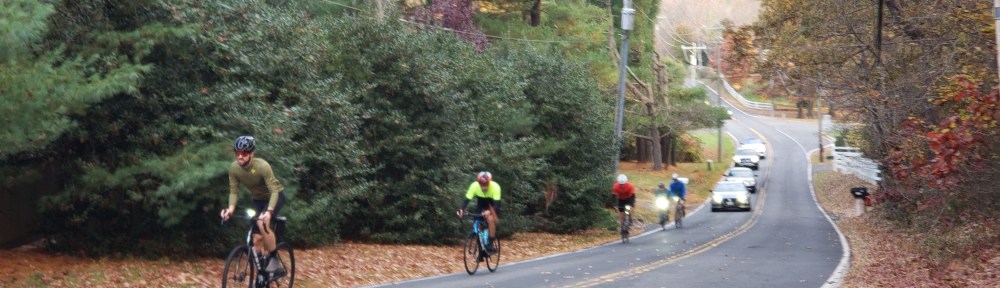
I am a biker. My health and the planet’s health are two reasons I choose to cycle. And it isn’t just for my physical health. Psychologically, it is a great way to start my day by commuting to work. If the day goes poorly, I hop on my bike and not only get to work out the stress on the ride home, but I get an endorphin hit, fresh air in my lungs, and time to reflect and de-stress before I’m home.
I want to share with you why it’s so awesome to be on a bike in this area—for commuting and recreation — and why you should do it, too! When we drive, we’re sealed inside a box with limited visibility, focused on quickly reaching our destination. When we walk, we’ve got full visibility, we experience the weather, and we can enjoy the beautiful houses, trees, and gardens of our neighborhoods but we cover less ground. Cycling is the sweet spot between these two. Instead of exploring a few new blocks while out walking, you can explore entire neighborhoods. You decide when to roll slowly, and when to push yourself on a climb. Those with electric assist get even more choices in how much they want to sweat.
During the pandemic, I rode 2/3 of all streets in Arlington, and 1/3 of all streets in DC. I found some ridiculous hills, very odd homes, amazing views, surprising history, and a great diversity of neighborhoods. Biking has helped me appreciate how wonderful it is to live in the DC area.
Though I love solo explorations, in the past year I’ve begun riding with some neighbors. This is not only fun but also motivating! It pushes us all to do more and explore more. We love riding in the hills of North Arlington and heading across the river for popular routes like MacArthur Blvd out to Great Falls, Rock Creek Park, Beach Drive, Sligo Creek and Anacostia Trail. We have biked the ever-popular Custis, Mt. Vernon, W&OD, C&O, and Capital Crescent trails. Beautiful tree-covered trails, iconic views, and robust exercise keep us pedaling through all four seasons.
Looking for support or inspiration? Arlington has some great resources.
Bike Arlington (bikearlington.com has some nice route suggestions and tools, including a “Bicycle Comfort Map” that helps you find routes appropriate for you and your family to get around Arlington.
The Washington Area Bicycle Association (waba.org) is a great education and advocacy group, and organizer of big rides. Many bike shops in the area organize group rides for various levels.
Capital Bikeshare is a great way to start. We have 3 stations in Lyon Park, and their e-bikes are really easy to use.
Our new bike shop, Vélocity Bike Co-op, on Pershing Drive can help get your bike back in shape, or help you find a new one.
I recently joined the county’s Bicycle Advisory Committee to encourage the county to make cycling safer and more accessible for residents, and because I would like to see more bike infrastructure in Arlington County. If you have suggestions or improvements you would like to see made, please reach out to me and I will submit them for discussion at a meeting. And if you want encouragement, ideas, or are interested in joining me for a weekend ride, email me at ajschuetz@yahoo.com. You can also follow me on Strava.
I hope to see more neighbors biking around the community on these beautiful fall days. And if you drive, thanks for sharing the road! Cycle on!
The LPCA History Committee is excited to share that Lyon Park has been awarded a $25,000 Historic Preservation Fund (HPF) grant through Arlington County’s Historic Preservation Program. The funds will support the “Lyon Park History Preservation and Education Centennial Project.”
This project has three primary goals:
digitizing Lyon Park historical documents and installing a display case at the Community House
designing and fabricating exterior historical markers in Lyon Park
supporting educational research and QR code signage in Zitkála-Šá Park
We are pleased to be partnering with the Arlington Historical Society and Arlington Library’s Center for Local History. They will provide guidance with best practices to safeguard Lyon Park’s artifacts and documents once they are scanned. We will also benefit from the expertise of the Historic Preservation Fund team, which will provide advice as we move forward. The HPF supports the Lyon Park project as it “will help strengthen the community’s understanding of historic preservation, Arlington’s history, built environment and/or cultural heritage….it will contribute to a stronger community by providing a link to the past, present, and future.”
The project is intended to be completed within 12 months, just in time for the launch of the Centennial Celebration of the Lyon Park Community House, which opened in 1925. From the start, the vision for the Community House was to create “A social, civic, and recreative center; so democratic as to attract the humblest; so wholesome as to appeal to the exclusive; so broad in scope as to bring youth, maturity and old age into closer companionship to the benefit of all.” That’s an inspiring mission to guide Lyon Park for the next hundred years.
And a big THANK YOU to Thora Colot and Toby McIntosh who have been instrumental in moving this project forward. This project provides wonderful opportunities for community participation. Some tasks require just a few hours to complete, while others are more detailed. If you are interested in volunteering to help, please contact me at elizabeth.r.sheehy@gmail.com. There is something for everyone!
As Arlington County increases its density of buildings and residents, more people can access our many benefits. However, growth also increases the possibility of the phenomenon known as the urban heat island effect: cities experience higher air temperatures than non-urban areas.
On average, cities tend to be 1–7°F warmer than non-urban areas around them during the daytime and
as much as 5°F warmer at night. On a summer day, the sun can heat buildings, roofs, and cars to temperatures 50 degrees higher than the surrounding air. Urban air quality also suffers since more pollutants are pumped into the air in densely populated areas, and stagnant air conditions during heat waves can trap pollutants near the ground.
Natural surfaces like trees and plants have cooling effects from shade and “evaporative cooling,” whereby evaporating water from vegetation absorbs heat (much like sweat cools the human body). Artificial surfaces such as roads and buildings that replace vegetation typically lack those cooling effects and instead absorb and re-emit more heat, which makes their surroundings warmer too.
As the planet warms, urban heat islands will only intensify higher temperatures. To cope with higher temperatures, cars and buildings consume more energy for cooling—frequently via fossil fuels—which worsens air pollution and contributes to climate change.
An important way to fight the urban heat island effect is to reintroduce vegetation. This includes planting trees, expanding parkland, and installing “green roofs” designed to support plants. Building cool roofs and pavements—which have bright coatings that reflect more sunlight and, therefore, absorb less heat—also can reduce the urban heat island effect. A model by the MIT Concrete Sustainability Hub estimated that, if widely implemented, cool pavements could reduce the frequency of heatwaves by 41% across all US urban areas.
As residents, a key thing we can do is plant and properly care for tough native shade trees (like oaks, sycamores, hickories, tulip trees). Those of us with shady yards know that tree cover makes a HUGE difference in how hot it feels. A friend in McLean with lots of shade trees has measured a 10-degree difference in his yard compared to nearby exposed areas. Next time you venture out, notice how much better streets and sidewalks with tall tree overhang feel and look compared to those that are sun-beaten. To get a free tree, including installation, contact the Tree Canopy Fund established by Ecoaction Arlington. You may also register for a free tree on Arlington County’s Urban Forestry Dept web page. Or visit your local garden center.