Neighbors Making a Difference: Tabitha Ricketts

By Kathleen McSweeney

San Diego native Tabitha Ricketts moved around a lot growing up, which for a child of a Navy dad wasn’t unusual. After graduating from Notre Dame, she took a job as a tech consultant which gave her a list of cities to choose from. With a preference for living on the East Coast, she selected the Washington, D.C. area as her new home. 

She rented in Rosslyn and Courthouse for the first few years. Her younger sister moved to the area when she became a Federal employee and rented a house in Lyon Park. During one of Tabitha’s first visits to Lyon Park, she met Paul Showalter, who invited her to a Danville Street block party. Drawn by the sense of community in Lyon Park and wanting to be nearer her sister, she began renting in Bedford Park. She attended a Woman’s Club lunch and volunteered to help. “I figured I can bake cupcakes—it wasn’t a scary commitment.” She heard that assistance was needed for the Halloween bonfire and has coordinated it for the past two years. Next, when she learned there were openings on the LPCA Board, she volunteered and was elected to represent our community on the Arlington Neighborhood Advisory Committee (ArNAC) and as a representative to the Board of Governors. In 2023, she saw a listserv post from a departing neighbor and is now a Lyon Park homeowner.

Tabitha has enjoyed playing a role in continuing our treasured community traditions. Lyon Park is a perfect blend of big city amenities (for instance, she appreciates the availability of good take-out food options) with a small-town feel. She spoke a bit about her work on the ArNAC, and in the two years she has served has seen a shuffling in County staff working with the committee. She observed that new staff brings new leadership, varied experiences, and fresh perspectives—all positive changes in Tabitha’s view. The ArNAC representatives have been discussing a more equitable point system and prioritization process for project approvals. They look forward to reviewing more art and beautification projects for neighborhoods, along with the more traditional streetlight, signage, and sidewalk fixes which have been staples of neighborhood conservation projects. In this month’s article about the LPCA Neighborhood Tabitha invites neighbors to contact her about priorities and ideas for projects. Although Tabitha has not lived here long, she has emerged as a generous volunteer and leader in our community. 

Neighbors Making a Difference: Paul and Sharon Showalter

By Kathleen McSweeney

If you have attended any event in Lyon Park, you’ve seen Paul and Sharon Showalter. They are involved with nearly every event that delights our neighborhood’s children. In 2020 when the pandemic prevented our annual holiday party and visit from Santa, Paul and Sharon brought Santa to the kids in a sleigh fashioned from their truck. After wending their way through Lyon Park and Ashton Heights, they traversed the neighborhoods along Columbia Pike to spread holiday cheer. It is a newer tradition that will be repeated again this year on December 10th.

Their story began in 1982, when Sharon was a freshman at Dartmouth and met Paul, who was living nearby. They were friends, but after Sharon graduated, she moved away, and they lost touch. In 1995, Sharon moved to Arlington, was recruited to join the Jaycees, and encountered Paul again who had started volunteering with the Jaycees the previous year. Through the Jaycees—a national organization that has been active for more than 100 years and provides young professionals with leadership training through community service—Paul and Sharon learned more about Arlington, made friends at the local, State, and National levels, and found that they had a common purpose in community volunteering. They married in 2000 and Sharon moved into another of Paul’s projects—updating the Lyon Park “fixer-upper” he purchased in 1993. 

Paul chuckled when he noted that he and Sharon have definitely “aged out” of the target demographic for the Jaycees, but they have continued to be involved with the organization. Their support of the families and staff at Carlin Springs Elementary, which began when they reconnected via the Jaycees in 1995, continues to this day. Paul coordinates service opportunities for older Arlington teens and Sharon continues her volunteer work with AHC’s College Readiness program to assist students who live in affordable housing. 

When I asked why they spend so much time volunteering, Paul replied that they share the same belief, that you must “do what you can with the time that you’ve got to make a difference in someone’s life.” Our community has been enriched by their example.

The Empathy Project

By Eriko Kennedy

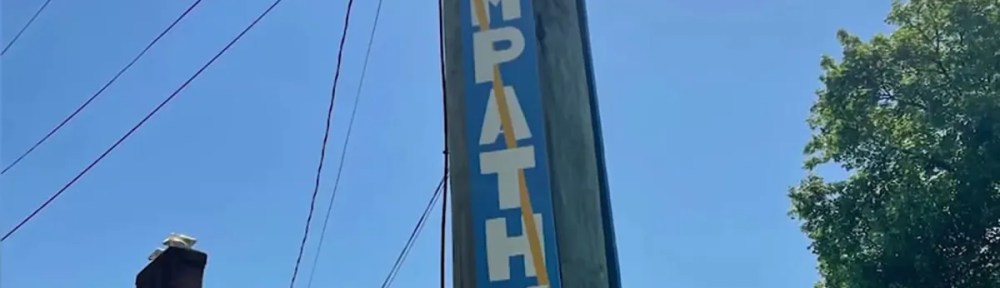
Have you noticed the “empathy” signs popping up on street poles throughout the area?  There are now more than 500 in the D.C. area. I spoke with the one-man operation behind these signs. This Empathy Project is to encourage all who see his signs to try and understand others’ situations and perspectives. 

He wishes to remain anonymous and mentioned that empathy is different from sympathy. According to Wikipedia, empathy may be defined as “…the capacity to understand or feel what another person is experiencing from within their frame of reference, that is, the capacity to place oneself in another’s position.”  

He began the project two years ago as a response to the divisiveness in our society. The signs are to remind us to step out of our intellectual silos and to work together and solve interpersonal, local, national, and even global problems. He believes to find solutions we must first “stretch our minds to imagine how and why the other thinks and acts as they do.”  To accomplish this, we must put away our immediate pre-suppositions and stop and listen, to hear and understand one other. We must lead with empathy.

The empathy signs are put up in pairs—one on either side of a pole to represent an empathetic connection between two people. Each pair is the mirror image of the other. No pairs are replicated.  The primary design concept is simple, but the imagery can become complicated. He uses five colors – light blue, white, yellow, orange and red – and each holds significance. Light blue and white are the constants. As the founder describes it, “White represents the self, and blue is for reality or, for those who are religious, God. The other three colors (red, orange, and yellow) represent the other person.”

I believe the thought put into the design of each graphic qualifies it as art. Each time I drive by an empathy sign, or spot a new one, I smile and am reminded there is good in each of us, and sometimes it takes a simple reminder to be a better person, friend, colleague, and neighbor.

Neighbors Making a Difference: Sara Cakici is Inspiring Lyon Park Residents with a Recycling Parade

By Tatiana Baquero Cakici

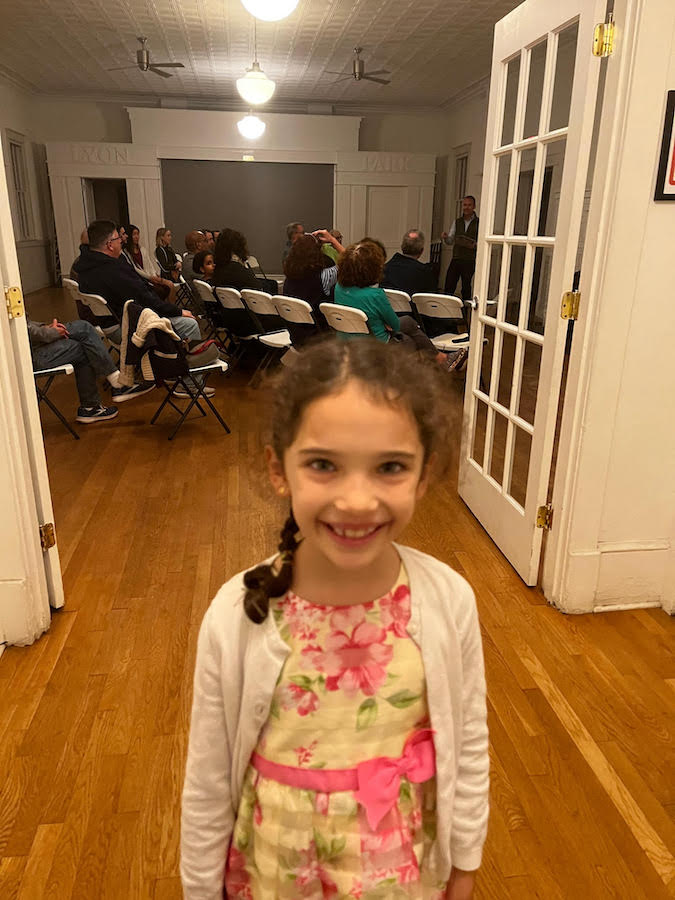
Dreaming of an inspiring display of youthful enthusiasm for environmental conservation, seven-year-old Sara Cakici has taken the initiative to organize a neighborhood parade with a heartfelt mission. Sara, a resident of Lyon Park and a first-grade student at the Arlington Traditional School (ATS), has a desire to motivate her community to recycle and protect the Earth. Sara presented her idea at the October LPCA meeting, and this idea has captured the hearts of neighbors
and is already inspiring others to make a difference.

Sara’s inspiration came from her deep concern for the environment. Her idea is simple yet powerful: gather the community for a lively parade that celebrates recycling and emphasizes the importance of preserving the planet. She has spent days planning the event, designing colorful recycling-themed banners and writing eco-friendly messages. The event will consist of inviting kids and adults alike to design their own signs/banners with recyclable/recycled materials brought from home, followed by a parade, marching through the streets of Lyon Park with enthusiasm, holding their signs advocating for recycling, and sharing their commitment to sustainable living.

Sara hopes the impact will extend beyond the event itself, with many residents moved to become more conscious of their own recycling habits. Sara’s initiative is an example of how young voices can lead to significant change and inspire a community to come together for a common cause: protecting the Earth for future generations.

Save the date! Join us for this exciting recycling parade in proximity to Earth Day, on Saturday, April 20, 2024 at
10:30 a.m. at Lyon Park. You can start now by gathering a couple of recyclable materials from home to make
your own recycling-themed banners and bring your young eco-enthusiasts to participate in this eco-friendly event
that celebrates the importance of preserving the planet!. 

Neighbors Making A Difference: Nick Ruge and the We See You Foundation

“A nonprofit is as strong as the community that holds it up. Together, we can do more than we can do alone.” This quote is on the website of the We See You Foundation, the brainchild of 19-year-old Nick Ruge, a resident of Lyon Park.

When thinking about what inspired him, Nick recalls this incident as the catalyst for the creation of the Foundation: “During a visit to New York City, I was affected by a homeless gentleman sitting on the sidewalk with a sign that read “I feel invisible.” I crouched down so I’d be on his eye level, so he knew I saw him, and offered some food, chatted for just a moment, and touched his shoulder. I wanted him to know that he matters. After that and other similar encounters, I knew we needed to do something to make the homeless feel valued, and the We See You Foundation was born.”

Nick’s concern led him to begin volunteering with local non-profit PathForward (formerly Arlington Street People’s Assistance Network) serving meals on Sunday evenings for several years while he was in middle school and high school. At 17, he decided to create a non-profit to continue the work. He still collaborates with PathForward, often partnering with them to make bagged meals and bed bundles for distribution to people who need them. 

The effort is a family affair—Nick’s brother Jake serves as the President; his mom, Lisa, is the Treasurer; and his dad, Andy, is one of the Board members. Lisa notes that she loves the work because it is another way the family can spend time together. “The Foundation really is about being kind and showing respect. That’s something everyone can do.”

If you would like to support the Foundation, you can see their Amazon Wish List, make donations, and more by visiting the website: https://weseeyoufoundation.org.

Business Spotlight: Vélocity Bike Co-op

On June 10, 2023, Alexandria-based non-profit Vélocity Bike Co-op cut the ribbon on their new Lyon Park location at 2647 N. Pershing Drive. They replaced the Old Bike Shop, which had operated out of that space for at least 10 years before closing their doors earlier this year. 

The co-founder of Vélocity, Christian Meyers, thanked the Old Bike Shop owner, Larry Behery, for “…providing a home for quality used bike service and sales. Vélocity will build on this legacy and make safe, reliable bicycles more affordable to everyone.”

“Opening our second location provides a unique opportunity to realize our mission to grow and empower an inclusive biking community through education and affordability,” noted Joe Davison, the organization’s Board Chair. “We are honored to carry on and serve the biking community at this location while seeking continued synergy among the area’s cycling organizations, including Arlington-based non-profit Phoenix Bikes.”

While the two volunteer-driven organizations have similarities, volunteer John McClanahan differentiated the services between his non-profit and the work of Phoenix Bikes and emphasized they are not trying to compete but rather complement the work that Phoenix Bikes does in the community. Both organizations give away bikes to kids and adults, accept bike donations, and recycle and resell donated bikes and bike parts. The main difference is that while Phoenix works primarily with youth to build skills while earning a bike, Vélocity focuses chiefly on bike education and repair. They host public do-it-yourself repair workshops, offer bike repair services, and run a bicycle scholarship program to provide a safe and reliable means of transportation to low-income individuals.

Mike Pattisall, shop manager, will introduce himself at our September 13th LPCA meeting. Vélocity is always looking for volunteers. Visit their website for store hours and volunteer opportunities at https://velocitycoop.org

Business Spotlight: Thai Treasure

By Michelle McMahon

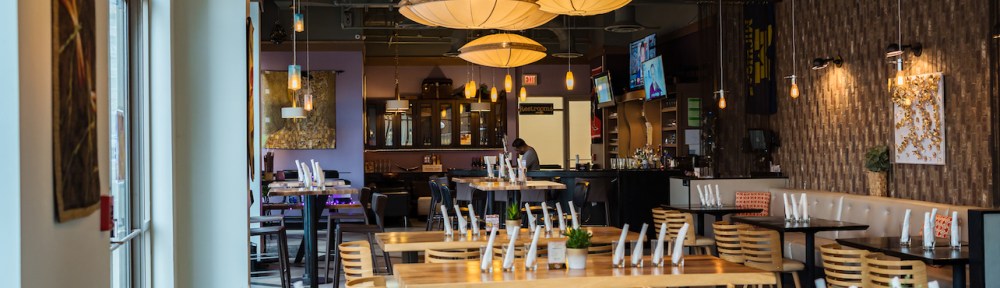
If you’ve been looking for a local restaurant to try, there is a hidden gem you may not have noticed on Fairfax Drive in Virginia Square. Thai Treasure opened Feb 2019 with proprietor Piyarat Bumrungsiri (Nui to us) realizing her dream of owning a Thai restaurant—a dream she’d held since immigrating to the US from Bangkok in 1997. 

After weathering the long Covid slog by pivoting to primarily take-out and delivery—including spicy Thai cocktails—Nui is welcoming diners back to indoor and street-side dining (with expanded outdoor seating coming soon). Nowadays, it’s a family affair with Nui (a single mom) and her two college student daughters, Alex and Blaine, typically working at the restaurant.

Thai Treasure offers a variety of menu options from the traditional to the creative. The traditional Pad Thai is, of course, among the most ordered items, but the specialty Thai Treasure Pad Thai offers a twist on the old favorite and includes shrimp, crabmeat, and gouda cheese. Other crowd pleasers include the drunken noodles, stir fried selections, clay pot steak and egg and a variety of curries. And Nui still offers a three-course lunch for under $15. 

Looking ahead, Nui is developing a menu that shares with customers the regional flavors of Thailand. Regional cuisines are influenced by neighbor countries, such as Laos and Cambodia, and even China and India. She’s also building a new signature cocktail menu and wine list to feature in her daily happy hour specials. 

Despite all the challenges running a restaurant, especially during the pandemic, Nui feels fortunate and says, “We have built a strong community with many regular customers who continue to come in and support us.” Next time you’re looking for a new international dining destination, check out Thai Treasure (located at 3811 Fairfax Drive)! 

Zitkála-Šá to Be Featured on a Quarter

By Toby McIntosh

Zitkála-Šá’s face will be on a quarter, the U.S. Mint recently announced, one of the five 2024 honorees for the American Women Quarters Program. It’s just a part of the continuing attention being given to the Native-American writer, musician and activist who lived in Lyon Park.

Gertrude Simmons Bonnin, a Yankton Sioux, lived on Barton Street in Lyon Park from 1926 until her death in 1938. She used the Lakota name Zitkála-Šá (pronounced: Zit-kah-la-sha). In 2020, Arlington County renamed the park at the corner of 7th and N. Highland streets in her honor.

In Minnesota, an opera about her was produced in 2022, an appropriate tribute, since she co-composed an opera in 1913 considered to be the first Native-American opera. “We are showing that Zitkála-Šá’s story is not a frozen moment in time—that she has continued to shape and inspire and evolve current society, specifically [that of] Indigenous peoples in North America, to this day,” said one composer. Recently, her music was the inspiration for a collection of 13 pieces by Pulitzer Prize winning composer Raven Chacon.

Native News Online included her on a list created for Native American Heritage Month, Five More Native Americans Who Shaped Culture, calling her “one of the most influential prominent Native activists of the 20th century.”

If you’d like to learn more about Zitkála-Šá, there’s a PBS show on her from 2020. The Arlington Public Library has several of her books, and a number about her, including one for younger children (“Red Bird Sings”).

Frank Lyon and Racist Covenants in Lyon Park (Part II)

By John Ausink

Frank Lyon, our namesake, considered by some to be a suburban visionary, encouraged residents to become engaged in neighborhood affairs by donating land for our private park and contributing to the construction of the community center. But “Lyon’s Legacy,” a 2021 advocacy piece for Missing Middle initiatives published by Arlington Now says:

Frank Lyon, by pen and by brick, would succeed where [Robert E] Lee by sword had failed. The developers and planners of Lyon’s day embedded white supremacy so deeply in the foundation of our county that it has not yet today been driven out. 

Part of this claim is based on the existence of racially restrictive covenants for the sale of homes, but this and other sources reference the same 1976 article that cited one county deed with Frank Lyon’s name on it as the seller in a tract called Moore’s Addition. As a long-time resident of Lyon Park with an interest in local history, I decided to see if there were more such deeds from other parts of Lyon Park.

First some background:  Lyon’s ancestors came to Virginia in the 1730s. His grandfather was a general contractor in Petersburg who enslaved Black workers. Lyon’s father was a “distinguished and scholarly lawyer” who raised a company at Petersburg for the Confederate army. Lyon had three children who survived to adulthood; his son John was killed in WWI. While working as a stenographer Lyon attended Georgetown Law School’s night sessions, receiving a Master of Laws degree in 1890. In about 1902 he started practicing law in Alexandria (now Arlington) County, and became a partner with R. W. Moore, who was making real estate investments near Clarendon. 

We’ll focus now on Lyon’s covenants in land deeds. The map below marks the current boundaries of Lyon Park with a black dotted line to orient you to the numbered areas discussed below. 

Lyon was involved in real estate as early as 1904. In a “deed of dedication” from that year, in which Lyon proposes to subdivide an area he called Lyon’s Addition to Clarendon (the triangle labeled number 1 in the map), the parties agree that:

Liquor shall never be sold or dispensed from any building built on the property

The property won’t be used for any business that constitutes a nuisance to others (I was amused that he mentions a soap factory as an example)

There is nothing in this deed that mentions race. However, things get ugly after that. 

Lyon, Moore and others purchased a large tract of land that became known as Moore’s Addition to Clarendon. Section 2 of Moore’s addition, labeled 2 and bounded by red in the map, was subdivided in 1910. The subdivision deed makes no mention of race; however, when Lyon sold a lot in Moore’s Addition in 1919, the deed includes the liquor and soap factory restrictions above, but also adds:

…neither said property nor any part thereof nor any interest therein shall be sold or leased to any one not of the Caucasian race

Nor shall any house costing less than $2,000, other than an outbuilding, be erected thereon.

This is the deed cited by so many, but I wanted to see if there are more. I started with a home on N. Edgewood St. in Lyon Park Section 7 (labeled 7 in the map). The 1922 deed includes the racist covenant. It also states that no dwelling of value less than $4,000 can be built—but this restriction expires in 1930. I don’t know if the financial constraint was added to exclude lower-income Whites or was an additional barrier to Blacks. 

Next, I looked across Washington Blvd in the area labeled 5 on the map (section 5 of Moore’s Addition), where a 1922 deed for a plot on N. Cleveland St. disallows liquor, requires $4,000 buildings, includes the racist restriction, but adds that no two-family houses or apartments shall be erected prior to 1930.

Finally, I checked our own home on 2nd St N. in Lyon Park Section 6. A 1926 deed for the property includes the racist restriction but for some reason limits it, “for a period of 99 years from September 1, 1923.” This deed also forbids two-family houses or apartments but does not include the alcohol exclusion—for which we are grateful.

At this point I wondered if Ashton C. Jones, who created Ashton Heights in 1921, also barred Black residents. The 1921 deed of dedication for the sub-division does not include any restrictions, but a 1923 deed for land for a house on N. Kenmore St. includes the racist covenant without the 99-year expiration and makes it explicit that violation of this restriction will immediately result in a reversion of the property to Ashton’s company. 

When it comes to racist covenants, then, Frank Lyon was not alone in Arlington. I found it puzzling, though, that the Lyon’s Addition deed of 1904 did not include the racial covenant, so I did more research. I learned that there were many racist attempts to block Black residents, not just via housing deeds.

In 1912 the Virginia General Assembly passed legislation permitting all cities and towns to adopt residential segregation ordinances. However, in 1917 the U.S. Supreme Court ruled (based on a Kentucky case) that such residential segregation ordinances were unconstitutional. I haven’t found documentation, but I assume Lyon’s 1904 deed didn’t have the racial exclusion clause because he could legally exclude Blacks via other means. After 1917, since local government could not designate a neighborhood as Whites-only, an exclusionary clause for an individual plot could serve the same purpose. 

In 1924 Virginia passed the Racial Integrity Act, which prohibited interracial marriage, and in 1929, the city of Richmond used the Act to prohibit a person from living in a neighborhood where he or she was not permitted to marry any member of the majority population—thus excluding Blacks from White neighborhoods. In a short time, however, the U.S. Fourth Circuit Court of Appeals found the ordinance unconstitutional.

It wasn’t until 1948 that the U.S. Supreme court in Shelley v. Kraemer (a case from Missouri) ruled unanimously that restrictive covenants couldn’t be legally enforced by state or federal courts because of the Equal Protection Clause of the 14th Amendment. However, this ruling applied only to government enforcement of these covenants, and as private agreements such covenants could still be used. Thus, restrictive covenants would continue to be broadly used across the U.S. until they were outlawed with the passage of the 1968 Fair Housing Act. This is reflected in the 1944 and 1960 deeds for our house, which include the phrase, “This conveyance is made subject to the restrictive covenants included in the chain of title to this property.” 

As a land developer, Frank Lyon exploited the racist housing restrictions of his time, incorporating the exclusionary covenants allowed in Virginia and other states, which constrained where Black citizens could live, go to school, and build wealth. How should we react to this history?
 

Who is the “Langston” of Langston Boulevard?

By Lauren Farrell Gardiner

Contrary to popular belief, Arlington’s Langston Boulevard is not named for the poet Langston Hughes. Rather, the former Lee Highway is named for Langston Hughes’ great uncle John Mercer Langston, an abolitionist, lawyer, and the first Black man to represent Virginia in Congress.

John Mercer Langston was born in Louisa, Virginia in 1829 to Lucy Langston, a Native American and former enslaved woman. His father was Ralph Quarles, a celebrated Revolutionary soldier, wealthy landowner, and Lucy’s enslaver, with whom Lucy had four children. Quarles emancipated Lucy and their first child in 1806, then Lucy left him and had 3 children with another man. She later returned to Quarles, lived with him as his common law wife (since interracial marriage was illegal), and they had three more children together, the youngest of whom was John Langston. 

Langston’s parents died in 1834, when he was only four years old. At the time, he moved to Ohio, where he was raised by family friends, and later, his older brothers. While living in Ohio, Langston was exposed to the strong anti-slavery rhetoric of the North. Langston graduated from Oberlin College in Ohio and married fellow abolitionist Caroline Wall. Langston hoped to become a lawyer, but in the early 1850s, only three Black men nationwide had been admitted to law school. After two law school rejections, Langston studied under local abolitionists in Ohio and was only admitted to the Ohio bar in 1854 after a bar committee deemed him “nearer white than black.” He thus became the first Black lawyer in Ohio.

He and Caroline moved to Brownhelm, Ohio, where he won election to the post of Town Clerk. Some sources speculate that he was the first African American elected to public office in the United States. About a decade later, Langston served as Inspector General of the Freedmen’s Bureau, touring the postwar South, and encouraging freedmen to seek educational opportunities. In 1868, Langston went to Washington, DC, where he established the law department at Howard University and later served as dean of the University. He also served as Minister to Haiti. 
In 1889, after moving back to Virginia, Langston became the first Black person in Virginia to serve in the US House of Representatives. He had run as a Republican and lost to his Democratic opponent but contested the results of the election because of voter intimidation and fraud. After 18 months, the Congressional elections committee declared Langston the winner, and he took his seat in the U.S. Congress for the remaining six months of the term. He lost his bid for reelection because conservative White Democrats had regained political control of Virginia. It would be over a century before Virginia sent another Black representative to Congress. Following his time in Congress, Langston exited the political arena and wrote his autobiography, From the Virginia Plantation to the National Capitol.