When Your Windows Are A Pane

By Heidi Ananthakrishnan

Have you ever accidentally bumped into a glass door? You’re not the only one.

Bird collisions with glass kill up to a billion birds a year in the United States. After such an impact, birds usually die or face life-threatening injuries. These collisions mainly affect songbirds during their spring and fall migrations, when they are exhausted and hungry. We often do not see dead birds near windows because scavengers quickly consume them. According to the American Bird Conservancy (ABC), the only thing more lethal than window collisions are habitat loss and domestic cats. While we may imagine glass-covered skyscrapers to be the worst death traps for birds, half of all collisions occur on homes and buildings up to three stories in height. The other half mostly occur on buildings up to 11 stories. The reason birds collide closer to the ground is because they feed there. Glass that reflects vegetation is the most dangerous, as birds think they are flying toward trees or bushes. This often happens at windows located across from bird feeders, baths, or fruiting trees.

Thankfully, this is one conservation issue we can easily do something about. ABC identifies cost-effective retrofits to glass that do not impede the view from inside. One of the easiest fixes is the most common: window screens. Others run the gamut from decorative decals to frosted tape to stencil-rolled paint to stained glass. Even having your first-grader make pat- terns with a window crayon on the outside of the glass could save lives. The company Acopian Birdsavers sells cords that hang outside windows and sway in the breeze, adding an element of calming movement to an outdoor view.

Lyon Park sits in the path of the Atlantic Flyway, a major migratory bird route connecting Canadian Arctic breeding grounds with South America. The Audubon Society estimates 500 species of birds ply this aerial freeway. Birds have lost much habitat along this route due to development and deforestation, which has decimated their populations. North America has lost 29% of its birds since 1970. That is more than one in every four birds. With such battered populations, every bird we save is a feather in our cap.
Know the Basic Rules of Recycling

By Elaine Simmons

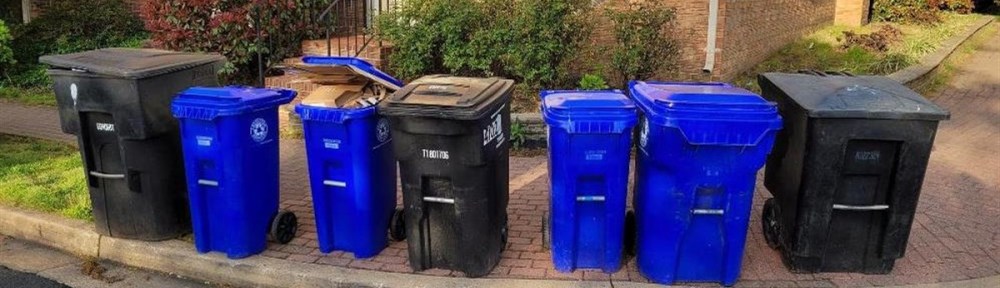
If you stroll around the neighborhood on collection day, you will unfortunately see many blue recycling bins filled with items that will not be recycled. A major problem is that people put plastic bags full of plastic or metal containers directly in the bin. The County has made clear that any item in a plastic bag will be treated as trash. So if you collect your plastic and metal containers in a plastic bag, remove these items from the bag on collection day and place the items directly in your blue recycling bin. Then put the plastic bag in your trash can or reuse it as a trash bag. Never put plastic bags of any kind in your blue recycle bin.

This rule also applies to the County’s impressive new composting program, where you can place any food item in your green yard waste bin and it will be “cooked” and turned into loam. You can use the light green compostable bags to collect food waste or you can put food items directly in the bin. You can also collect food waste in a paper bag. Compostable bags and paper bags can go in your yard waste bin. Do not put plastic bags of any kind in your yard waste bin. You can buy compostable bags on-line or at the nearby MOM’s Organic Market on Lee Highway.

Finally, if you rake more leaves than your yard waste bin can hold, put the leaves in paper yard waste bags. This way the leaves will be turned into mulch. Do not collect leaves in plastic bags. The County provides free paper yard waste bags at various locations such as Thomas Jefferson Middle School. Home Depot and COSTCO sell paper yard waste bags.

The theme: limit use of plastic bags to collecting garbage. Environmentally speaking, the fewer plastic bags you use, the better.

Environmentally Safe Ways to Control Mosquitoes

By Elaine Simmons

With hot, humid weather comes a plague of mosquitos. We can take steps to reduce mosquito populations without harming “good” critters like bees and butterflies.

  1. Eliminate standing water. Unfortunately, mosquito larvae can live in as little as one teaspoon of water. Black, ribbed, flexible downspout extenders hold water and are thus a prime culprit, even if they are sloped downhill. Blocked gutters are also a major problem, as are tarps (like on pools or cars), toys, bird baths, trash and recycling bins, watering cans and wheelbarrows, and pots and saucers. Check and empty these sources every two to three days.
  2. Treat your rain barrel. Rain barrels are great for saving on water, but they are major mosquito breeding grounds. To avoid this, buy mosquito “donuts” or dunks, which last for months, or add ¼ cup of any type of cooking oil to your barrel per week, or secure fine mesh netting to the top with bungee cord.
  3. Avoid mosquito spraying that harms other bugs. Many companies claim that their insecticide treatments for your yard only harm mosquitoes, but critics disagree, saying that chemicals typically used to cause paralysis and death in mosquitoes (pyrethrins or pyrethroids) kill monarch caterpillars (even weeks after spraying), bees, and fireflies. These chemicals can also kill arthropods, such as spiders and centipedes. Losing these critters means reducing a food source for some birds. Finally, critics claim these insecticides are toxic to certain earthworms.
  4. Try natural sprays to repel mosquitoes in your yard. Alternatives to insecticides are products such as Garlic Barrier, with its considerable amount of natural sulfur providing a repellent. According to reviews, Garlic Barrier smells extremely strong for 30-60 minutes but then the smell goes away; the repellent lasts several weeks.
  5. To avoid being bit while outside, cover up and spray yourself with mosquito repellent. The EPA has approved DEET; it’s been around for decades and breaks down quickly, so does not harm the environment. Alternatives to DEET include plant-based products that contain oil of lemon eucalyptus (OLE).
  6. Finally, use a fan at your outdoor gathering. The fan disperses the carbon dioxide you exhale, so fewer mosquitoes are attracted to you in the first place. Also, mosquitoes are weak fliers and can’t compete with the “wind” from the fan.