The LPCA plans to sign two letters in response to a Special GLUP proposal in Lyon Village. In addition, we will be weighing in on a proposal within our neighborhood at Highland and 10th.
Letter opposing Special GLUP proposal: The LPCA President intends to sign a letter to the County Board opposing the proposal by Clarendon Presbyterian Church and a non-profit housing developer to change land use and zoning for a parcel in Lyon Village that currently holds the church and a small park. Lyon Park is one of five civic associations allowed to weigh in on this project in recognition that higher density zoning and land use in Clarendon would have spillover effects. This position aligns with Lyon Park’s Neighborhood Conservation Plan and was discussed at the January LPCA meeting.
Special General Land Use Plan: The Lyon Village project sparked interest by all five participating civic associations (including LPCA) in a separate letter to the County Board, addressing flaws in the Special GLUP process writ-large. This letter addresses strategic process problems without specifically addressing the church project. (NOTE: Special GLUPs are one-off revisions to land use and zoning being applied/approved outside the framework of approved area and sector plans. Those area and sector plans are done to stimulate more growth, and they allow developers to pursue site plan development in these areas, whereas other locations may be developed only by-right.). In the view of our five civic associations, who have seen a moderate share of the Special GLUP activity recently, the standards for approval have become less clear. This letter therefore asks the County Board to:
1. Clarify standards for advancing a Special GLUP application;
2. Consider higher and broader levels of community benefits relative to existing zoning regulations;
3. Not use a Special GLUP Study to substantiate follow-on Special GLUPs nor create a precedent for county-wide policy changes;
4. Establish follow-up procedures to track Special GLUP projects that are approved.
N. Highland and 10th St: At the March LPCA meeting, we will discuss the request for rooftop use by the owner of the apartments at N. Highland and 10th St. (where Kaldi’s Coffee house is). Neighbors adjacent to the property have mixed opinions, and we are still clarifying what the access and usage will entail (i.e. open to non-residents or not). We will take a vote on this at our March meeting, and the County Board will be making its decision in April.
If you are interested in this issue, please join us at the next meeting on March 13, when members can weigh in on the issue.
At the December County Board meeting, the Board adopted an ordinance to establish a Stormwater Utility, adopted a resolution regarding Stormwater fee relief, and set the Stormwater Utility Equivalent Residential Unit annual rate. The Board’s action also repeals the current Sanitary District Tax, effective December 31, 2023.
The County’s Stormwater Management Fund is currently supported by the Sanitary District Tax, which generates funding based on property assessments. The tax is currently set at $0.017 per one hundred dollars of assessed valuation of all taxable real estate. This ordinance proposes replacing the Sanitary District Tax formula with a $258 per Equivalent Residential Unit (ERU) Rate. An ERU in Arlington County is calculated to be 2,400 square feet of impervious area. The rationale for using the amount of impervious area on each property, rather than all taxable real estate, is that it directly correlates with stormwater runoff that contributes to the County’s stormwater system. Basing the rate structure on the amount of impervious area provides a nexus between the fee charged to each property and the amount of services provided by the County.
The approved Stormwater fee relief program will provide 100 percent fee relief for senior and disabled residential property owners, and disabled veterans and surviving spouses, that currently qualify for real estate tax exemptions and deferrals.
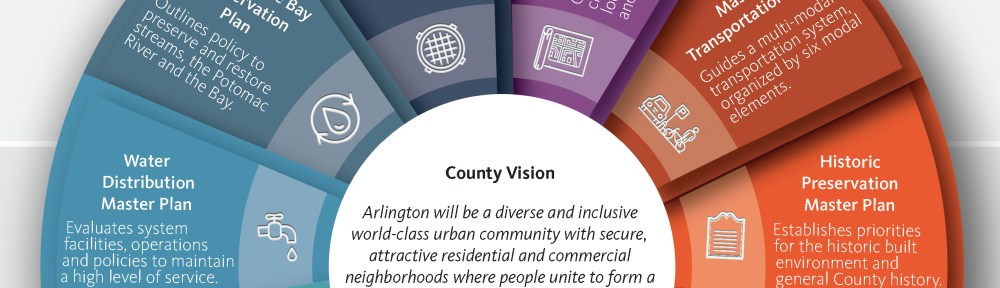
Did you know that every jurisdiction is required to have a comprehensive plan to guide its current and long-range development? According to Article 3, Section 15.2-2223 of the Virginia code, the Planning Commission in each jurisdiction has the duty to prepare and recommend the comprehensive plan elements, and the governing body—in our case, the Arlington County Board—has the responsibility of adopting the plan for the County. Sections of the code define the required plan elements and outline guidelines for a Transportation Plan that designates a system of transportation infrastructure, and “…shall include, as appropriate, but not be limited to, roadways, bicycle accommodations, pedestrian accommodations, railways, bridges, waterways, airports, ports, freight corridors, and public transportation facilities.” (Source: Code of Virginia, Section 15.2-2223.B.1.) The code also mandates specific elements be included, such as a zoning ordinance, public and private development (including commercial, general residential, and affordable housing development), community services and facilities, historic areas, groundwater and sewer treatment, and consider strategies to address social well-being, health, the economy, and the environment.
Comprehensive Plan elements are publicly reviewed and updated at least every five years. Prior to December 2023, Arlington’s Comprehensive Plan contained eleven elements: the General Land Use Plan (GLUP), Master Transportation Plan, Historic Preservation Master Plan, Affordable Housing Master Plan, Sanitary Sewer Master Plan, Recycling Program Master Plan, Community Energy Plan, Public Spaces Master Plan (which included three sub-plans: the Urban Forest, Public Arts, and Natural Resources Master Plans), Water Distribution Master Plan, Chesapeake Bay Preservation Master Plan, and the Stormwater Master Plan. Each plan element has a network of commissions and interested citizen advocates that contribute to updates and revisions during the plans’ scheduled public update cycle.
At the December 2023 Board meeting, the Forestry and Natural Resource Plan (FNRP) became the 12th element of the County’s Comprehensive Plan. This was the result of a three-year process. In 2020, a joint citizen advisory group was formed (with representatives from the Energy commissions) to review and update the Urban Forestry and Natural Resources plan elements. The Advisory Group recommended that the two plans be combined into a single Forestry and Natural Resource Plan (FNRP), the Planning Commission endorsed it, and approval of the FNRP was added to the County Board’s December meeting agenda. Upon approval, the Board commented that “The FNRP is intended to be a holistic long-term planning tool that outlines over 80 policy recommendations organized into four interconnected Strategic Directions: Conservation; Climate Mitigation, Adaption, and Resilience; Biodiversity; and Operations.”
By Tabitha Ricketts, Lyon Park’s Arlington Neighborhood Advisory Committee Representative
In 2019, a group of dedicated Lyon Park Citizens Association members compiled a 210-page document covering our neighborhood’s history, goals for the future, and areas of both interest and concern directly impacting our residents. This document is the 2019 Lyon Park Neighborhood Conservation Plan.
What is a Neighborhood Conservation Plan? It’s both a snapshot in time and a roadmap for the future, refreshed every 10 years by and for neighborhoods—like Lyon Park—that are members of the Arlington Neighborhood Program (formerly the Neighborhood Conservation Program). These Neighborhood Plans provide the framework for improvement projects neighborhood representatives submit for approval from the Arlington Neighborhood Advisory Committee (ArNAC). Once approved, these projects are put forward to the Arlington County Board for funding. The plan drives the projects, and the projects receive County funding to achieve the neighborhood’s goals—like increasing pedestrian safety measures, improving a County park, or planting more trees.
Lyon Park’s 2019 Neighborhood Plan covers 9 areas of interest to Lyon Park residents, as reported in a 2016 resident survey: Land Use and Zoning, Street Conditions, Transportation and Traffic Management, Housing, Public Facilities and Services, Commercial and Business Areas, Historic Preservation, Urban Forestry, and Schools. These areas roll up to 3 neighborhood goals:
Adapting to growth and change.
Dealing with the challenges that come with density.
Getting Arlington County support for neighborhood initiatives such as traffic management and commercial development.
For a more in-depth breakdown of each of these topics, check out the slide deck I shared on the Lyon Park listserv. For full details, check out the plan itself, available on the Arlington Neighborhood Program website.
There are a number of aspirations laid out in Lyon Park’s plan—for improved drainage, holistic traffic planning, increased street lighting—that would make perfect projects for the County to execute on our behalf. But to get from plan to action we must: 1) break down ideas into tangible projects, with a target, a location, and a design; and 2) gather neighborhood support to send our top priorities for ArNAC review and Board funding.
Based purely on our Neighborhood Plan, a few things stand out to me as priorities already. But I’m just a representative of the neighborhood—your neighborhood. A lot has changed since the Plan was created in 2019, and certainly since the 2016 survey data. So, what matters to you? What projects would you like to improve which enhance our neighborhood today? Reach out to let me know, and let’s get started!
By Jane Seigel, former Arlington County Planning Commissioner and Aurora Highlands resident
Following Amazon’s selection of Pentagon and Crystal City for their new headquarters in 2018, and prior to the advent of the Pentagon City Sector Plan, three neighborhood civic associations—Aurora Highlands, Arlington Ridge, and Crystal City—came together to create a document that detailed shared values and goals to achieve a better, more livable neighborhood. The resulting Livability 22202 framework, published in 2019 and shared with Arlington County planners, has influenced the County’s approach to the area’s large-scale development. The framework strongly recommended prioritizing public needs including open and green spaces, walkability, tree canopy, housing affordability, and other public goods. All completed in one year, a record for the process.
When the County went out with an RFP for the consultant to help manage the development process, it included the Livability 22202 program in the RFP. The Livability priorities influenced the negotiations with the County and the company and formed the basis of the Plan. More than a year after the authorization of the Plan, the County returned to the Livability 22202 creators to request a new read on citizen priorities. At an October 2023 meeting, the three civic associations met to provide input, consider progress under the plan, and focus on which priorities require additional attention.
Amazon’s HQ2 in Metropolitan Park, and the follow-on process, are successful examples of the much vaunted and criticized “Arlington Way.” To effectively exert citizen influence with the County, these neighborhoods first created consensus among themselves, articulated in some detail what is desired, developed contacts among stakeholders, and publicly presented their proposals.
The Action Plan focuses on specific objectives and outcomes outlined to accommodate the expected growth over the next decades. Key priorities and recommended actions are summarized under the following topics:
– Address Housing Affordability
– Provide Essential Services Across the Community
– Foster Environmental Sustainability
– Encourage Engagement, Arts and Culture
– Extend the Multimodal Transportation Network
The issues and the politics may vary across Arlington, but the Arlington Way requires constructive citizen engagement, consensus building, leadership, and follow-through. The Livability 22202 framework and ongoing update process is a recent example of how civic associations can work together with the County to highlight shared priorities and positively influence planning outcomes.
Communities across the country have been experiencing issues with youth substance use and mental health issues, and Arlington can learn from their actions. One action is harm-reduction, which aims to stop or reduce the worst outcomes. Examples of this include conducting training on the use of naloxone (commonly known as Narcan) to reverse the effects of an opioid overdose, and providing fentanyl test strips so a substance may be tested for the existence of fentanyl in a variety of drugs and drug forms (pill, powder, and serums). Interventions to prevent substance abuse is another approach that must include the entire community – families, schools, and community-based organizations. A public service campaign to provide education and facts about the dangers of substance use, and to assist families in understanding the risk factors for substance use, and establishing healthy communication, rule-setting, and monitoring is an important first step. Likewise, community services that offer trauma-informed counseling programs, and activities widely available to youth as an alternative to drug use, are all elements of responsive community action.
The Arlington Schools Hispanic Parent Association (ASPHPA) has been advocating for action since last year. After a 9th grader died in February 2023, they held a march and sent letters to the County and the School Board to demand action. The County Council of PTAs held an expert forum in March to explore the breadth of the issue and suggested actions. ASHPA circulated a survey and received over 180 responses from immigrant and refugee families to identify the barriers to participation in Parks and Recreation programs. Following more overdoses in schools and the death of another student in September, an advocacy group—comprised of ASHPA, the County Council of PTAs (CCPTA), the local chapter of the League of United Latin American Citizens (LULAC), Virginians Organized for Interfaith Community Engagement (VOICE), and the Arlington Branch of the National Association for the Advancement of Colored People (NAACP)—have been engaging Arlington County (especially human services, parks and recreation staff and the police) and Arlington Public Schools on this issue. This coalition has requested action on dropping barriers to participation in sports and recreation activities (in terms of costs, program limits, and web-based sign-ups), increased supervision at local community centers, and a drop-in teen center with programmed activities, skill-building, and sufficient transportation to and from neighborhood schools.
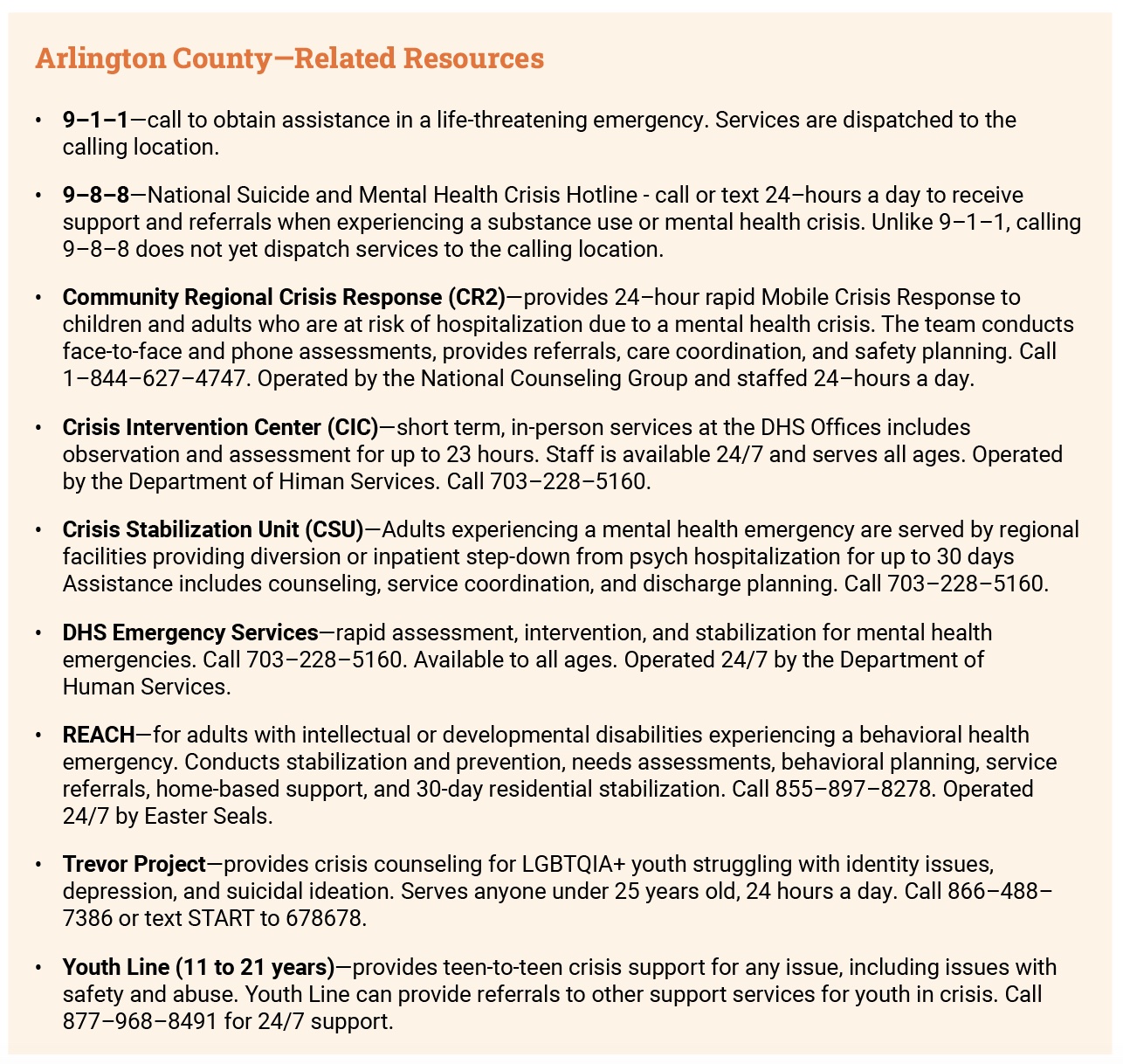
How has Arlington responded so far? The County’s Arlington Addiction Recovery Initiative (AARI) has been busy providing free training and distributing naloxone supplies throughout the community over the past year. This summer, Arlington Public Schools (APS) made naloxone doses and training available to teachers and staff. Narcan is available in the school nurses’ offices in our middle and high schools. In summer 2023, the School Board changed APS’ policy to allow students to carry naloxone in school. Also this summer, the Department of Human Services (DHS) on Washington Blvd opened and staffs a 24–hour drop-in Crisis Intervention Center to stabilize children and adults who are experiencing a substance use or mental health crisis. And at the County Board meeting held on November 14, 2023, the Board dedicated $750,000 in end-of-year closeout funds to fund some of the prevention ideas being suggested by advocates—including extending Parks and Recreation after-school programming to students and starting a public awareness campaign. These actions have been important first steps in addressing this growing crisis in our community.
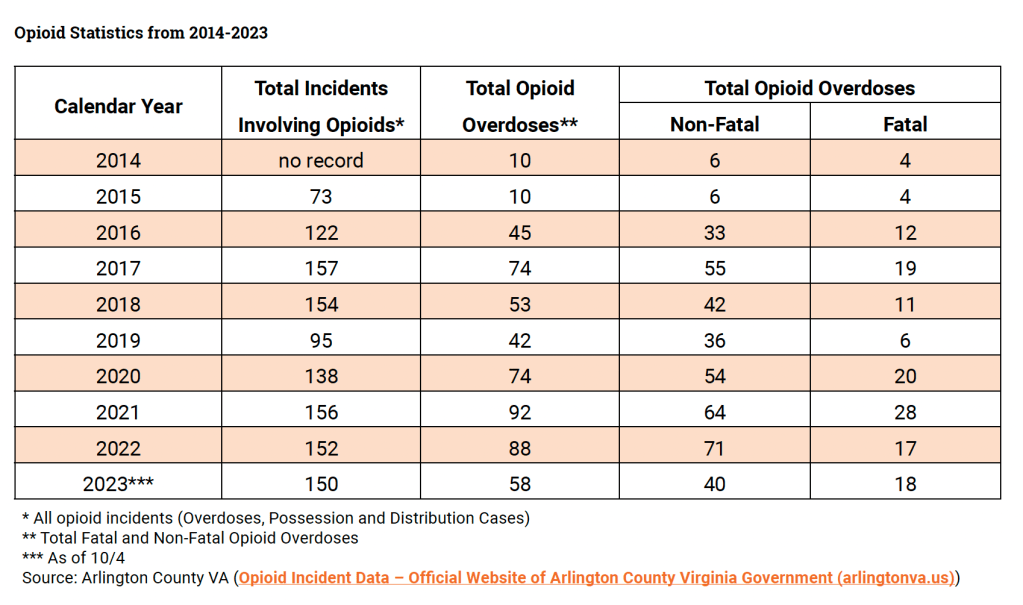
Arlington County is seeing an increase in the use of illegal substances among people under 20. The issue is not new to Arlington. It did not begin during COVID, though the rise in mental health issues related to the pandemic may well be a contributing factor in the increase of substance use. It is not isolated to a single school or neighborhood, though reports of at least seven overdose incidents and two student deaths in 2023 at one high school could give that impression.
I remember drug issues discussed by PTAs and communities in 2009, when our oldest son began at W-L. When drug-related arrests of students escalated in 2017, a public forum with County Police, the Commonwealth Attorney’s Office, the Behavioral Health Chief, and two parents whose high-school students had become addicted to opioids was held that October.1 In November of the same year, the Arlington Partnership for Children, Youth, and Families (APCYF) held a community forum to discuss the latest results of their Youth Risk and Behavior Survey (YRBS) which was administered in APS schools to 6th, 8th, 10th, and 12th graders between 2001 and 2017.2 The 2017 results noted an upswing in cases of kids being bullied, increased rates of depression, higher rates of self-harm, and high rates of marijuana and prescription drug use. The increase in the number of 6th grade students reporting the use of pills to get high increased from 2% In 2013 to over 11% in 2017. After 2017, the County switched to using the Virginia Youth Survey to allow for better comparison of future results across the Commonwealth. The 2019 data revealed an increase in Arlington students feeling physically unsafe and reported relatively the same level of alcohol, marijuana, and drug use as in 2017.
While opioid addiction has been a serious, nationwide issue for a couple of decades, the rise in the manufacturing and use of fentanyl since 2015 has led to a sharp increase in deaths. According to a CDC report, “U.S. drug overdose deaths increased 30% from 2019 to 2020 and 15% in 2021, resulting in an estimated 108,000 deaths in 2021. Among persons aged 14–18 years, overdose deaths increased 94% from 2019 to 2020 and 20% from 2020 to 2021 … among persons aged 10–19 years … from July–December 2019 to July–December 2021, median monthly overdose deaths increased 109%, and deaths involving IMFs [fentanyl] increased 182%.”
In Arlington, it is hard to gauge the extent and level of substance use by teens other than what they report on surveys. One key indicator would be the crime statistics reported by the Arlington County Police Department but they do not differentiate between adults and adolescents in their reporting.
After the death of Wakefield freshman Sergio Flores in February of this year, education and harm-reduction initiatives became a focus locally, and especially an increase in NARCAN administration training. The Arlington County Council of PTAs (CCPTA) hosted a forum on March 13th featuring several experts who discussed the increase in overdoses and made recommendations regarding trauma-informed responses to this epidemic. At the April LPCA meeting, the LPCA took advantage of County training efforts by hosting a representative of the Arlington Addiction Recovery Initiative (AARI). LPCA meeting attendees received details on how fentanyl users become addicted, and training on the administration of NARCAN.
In September, the second student death, that of high school student Jorge Chavarría Rodríguez, was reported. The Arlington Schools Hispanic Parent Association (ASHPA), and the local chapters of League of United Latin American Citizens (LULAC), and the NAACP have written letters and issued press releases, calling on school and county leaders to take action to address this growing crisis.
The causes of adolescent substance use are complex. The Centers for Disease Control and Prevention (CDC) lists several risk factors that substantially increase the likelihood that a young person will use substances and become addicted. Parents and caregivers should assess their child’s risk factors against the list below:
• Family history of substance use
• Favorable parental attitudes towards the behavior
• Poor parental monitoring
• Parental substance use
• Family rejection of sexual orientation or gender identity
• Association with delinquent or substance using peers
• Lack of school connectedness
• Low academic achievement
• Childhood sexual abuse
• Mental health issues
An adolescent’s level of connectedness to and support from their family, schools, and community is often cited as a protective factor in avoiding substance use.7 Parents and caregivers should openly discuss the facts about drug use with their children. If you don’t know the facts, then seek out sources with your child so you can learn together. The Drug Enforcement Agency (DEA) has a series of publications in English and Spanish, including Growing Up Drug Free: A Parent’s Guide to Substance Use Prevention. The Arlington CCPTA has also compiled a list of national and local resources. Visit their Substance Abuse Resources and Treatment Locators page for more information.
This is Part 1 of a two-part series on adolescent drug use in our community. Part 2 will focus on the actions taken to date by APS and Arlington County to combat the rise in adolescent substance use, feedback from Arlington students on what they have to say about what could help, and ways non-profit groups, advocacy organizations, and concerned neighbors can engage to combat this growing crisis.
Earlier this year, the Arlington County Board voted to implement a new Stormwater Utility Tax that will become effective in May 2024. The new tax is based on the amount of hard surfaces on a property such as buildings, roofs, driveways, and patios—anything that prevents water from seeping into the ground and creates runoff. The additional funds raised will pay for the maintenance of over 200 miles of sewer pipes, increases to system capacity, restoration projects, management of flood plains, and other needed improvements.
This new tax will replace the Sanitary District tax, which has been bundled within the County’s real estate taxes. The cost of this tax is $.017 for every $100 of assessed value. The new stormwater taxes will be listed separately on real estate tax bills after next May.
How can you tell what you may owe? The County used GIS-mapping to estimate that an average single-family home in Arlington has 2,400 square feet of impervious surface. This represents one ERU, or Equivalent Residential Unit, and there is a scaled system of billable units (see chart below) used to calculate the tax for each property. Initial estimates are that an ERU has a sample value of $230–250, though the rate will not be set until the County Board votes this Fall, and is dependent on the adopted budget.
Why is the County moving to this new tax structure? There have been additional demands on the stormwater system, and the County needs to raise additional revenue to pay for planned improvements, The shift to the Stormwater Utility tax is considered to be a fairer way to assess cost because it is based on the amount of impervious lot coverage, rather than a property’s value. The new fee is demand-based: the larger a property’s impervious surfaces, the more that property contributes to runoff and puts pressure on the system. There are some properties (places of worship, non-profits, and Federal buildings) that currently don’t pay the sanitary district tax. Those properties will likely be impacted by this new stormwater tax.
The County acknowledges that property owners will be paying more under this tax structure, but there is a way owners can qualify for credits. Between November 1, 2023 and January 15, 2024, property owners are able to reduce the tax amount by making specific improvements to their properties in 2023 that reduce runoff. Additional information on the credit program, a (not-very-user-friendly) fee estimator by property, and FAQs may be found on the County’s Stormwater Utility Implementation page (go to https://www.arlingtonva.us and search for stormwater utility).
On March 22, 2023, the County Board voted 5–0 to change Arlington’s Zoning Code and General Land Use Plan (GLUP) to allow “Missing Middle” (MM) or “Expanded Housing Options” for duplexes up to six-plexes on most lots in residential zones that until now have allowed only single-family construction (i.e., zones R-5, R-6, R-8, and R-20). This policy begins July 1, 2023 and changes our existing mixed (old and new, single- and multi-family) neighborhoods to multi-family new home neighborhoods.
First, let’s look at our current housing stock. You might be surprised to learn that in terms of types of dwelling units, Lyon Park is diverse, with single-family homes less than one-third of our existing stock:
Single Family Detached Homes: 926
Apartments – Garden: 1,120
Apartments – Mid-rise: 502
Garden style condos: 175
Duplexes / Side-by-sides: 125
Stacked condos: 120
Townhomes: 27
Total: 2,995
Now let’s discuss what the County Board decided on the new Missing Middle plan. Most of Lyon Park is zoned R-6; countywide, R-6 makes up 66% of the areas that were “rezoned.” The county will now allow property owners in all rezoned areas to:
– build up to 6 units on lots “by-right” (i.e., no County Board review);
– build new MM or convert an existing single-family home into MM units, with an annual cap of 58 permits per year for 5 years, of which 30 may be in R-6;
– erect structures with the same setbacks and height restrictions as single-family homes, but with a 5% “bonus” lot coverage above single-family home projects;
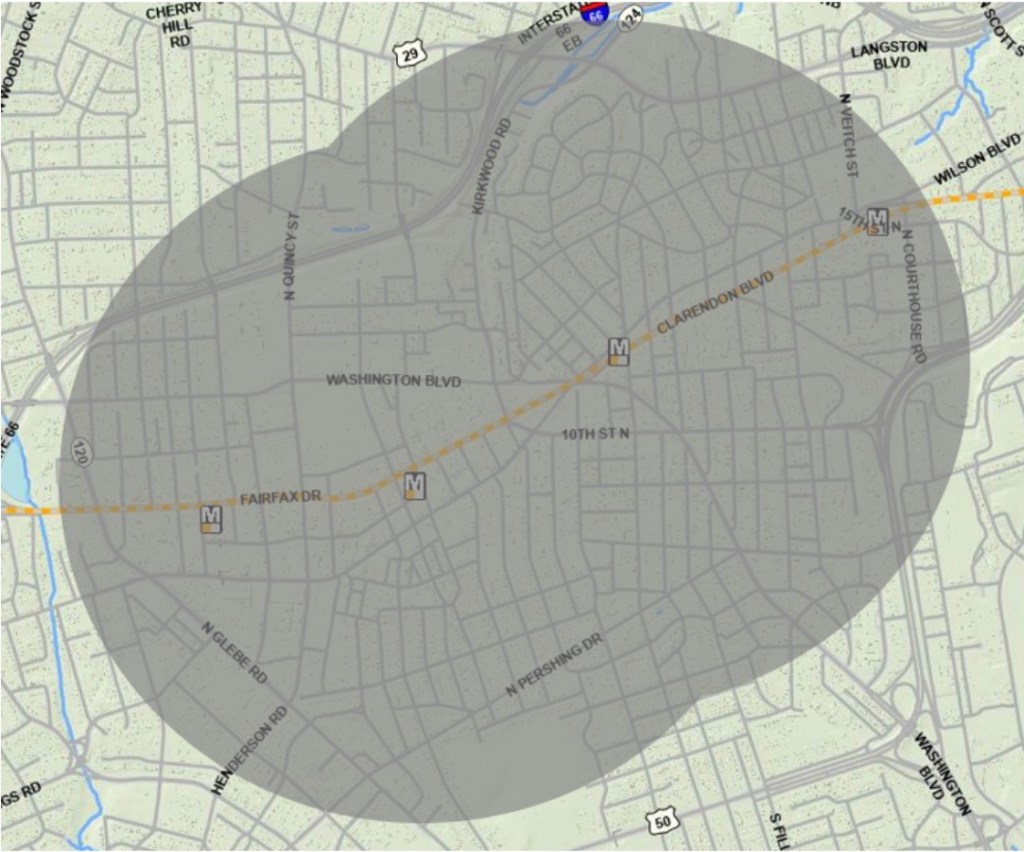
– provide a minimum 0.5 parking spaces per unit if the home is 3/4–mile from a Metro station entrance (shown on the map below) or 1/2–mile from a stop on the Premium Transit Network along Columbia Pike, and provide at least 1 space per unit (the current standard) for other locations and for all lots on a cul-de-sac;
– preserve or plant at least 4 shade trees on properties with new 2–4 unit buildings and at least 8 shade trees for 5- and 6-plexes;
– cap maximum floor area within a range of 4,800 square feet for the smallest MM structure (a combined stacked duplex) up to 8,000 square feet for the largest (5- to 6-plexes);
– add interior accessory dwellings only for the side-by-side two- or three-unit semi-detached homes (e.g., a 3-unit townhome becomes a 6-plex if each townhome adds an accessory dwelling);
– provide zero onsite parking on streets (such as the 100 block of North Edgewood St.) that currently lack onsite parking, meaning that all parking in those blocks spills over to the street.
National Geographic, The Atlantic, and NPR recently ran stories that claimed only 5% of plastic is actually recycled in the US. How does this comport with Arlington’s much-touted recycling program?
In my skeptic mode, I called the county’s expert, Adam Riedel, and peppered him with questions. He was adamant that Arlington does collect plastic marked 1–7 (marked in a triangle) and sells it in bundles for processing in states like Alabama. He acknowledged that plastic marked 1, 2, and 5 may be the only types ultimately getting recycled (3/4/6/7 likely go to the landfill or are incinerated) but the 1/2/5 designations account for most of the plastic collected.
Adam also mentioned things that people put in blue recycling bins that don’t belong there:
“Paper” coffee cups (they are plastic lined) and plastic tops from coffee shops: put in trash
Plastic bags and Amazon bubble wrap envelopes: can be recycled at grocery stores that collect plastic bags (e.g., Giant near Virginia Square and Hyde Park Harris Teeter near Ballston Common)
While it’s good to hear what Arlington is doing with recycling, for many reasons, we should still cut down on plastic, especially single use plastic, such as water bottles, cutlery, take-out containers, and plastic bags. An easy way to reduce is to get reusable cups/bottles for coffee and water and reusable or paper bags for groceries.







 lyonpark.org