Placing Two Bronze Stumbling Stone Plaques

Please come celebrate the placing of two bronze stumbling stone plaques (like the one shown here) honoring Orville and Jackson, enslaved by Bushrod Hunter on his Brookdale Estate, a part of which is modern day Lyon Park. On Saturday, November 15, the dedication begins at 10:00 a.m. at the corner of North Garfield and 4th Street North, and will be followed by an outdoor reception. All are welcome!

“The Board of Governors of the Lyon Park Community Center applauds the “Memorializing Enslaved in Arlington” initiative, a project sponsored by the Arlington Historical Society and the Black Heritage Museum of Arlington, and the marking with bronze plaques of locations where enslavement occurred, described as “stumbling stones,” placed in public rights of way. The Board is honored to recognize the placement of two stumbling stones at the southwest corner of our park, at the intersection of N. Garfield and 4th Street North.”  

—Official BOG proclamation 

ArNAC Part Two: Let’s Beautify Our Neighborhood!

By Tabitha Ricketts

Last month I wrote about ArNAC — the Arlington Neighborhoods Advisory Committee — and the types of projects it has funded for the Lyon Park neighborhood and others around Arlington. There have been great examples of beautification and pedestrian safety improvements all across the County. As your neighborhood representative, it’s my job to support project ideas from Lyon Park, see them grow from ideas into plans, and shepherd them through the process of review and selection by ArNAC. But where do those project ideas come from in the first place? That’s where you come in!

We, the members of the Lyon Park community, get to decide what projects we want to pursue for the good of the neighborhood. That’s one of the best things about the ArNAC program — it’s neighborhood-driven. But it also puts the burden of responsibility on us. If we want to make use of this program and its funding, we have to put forward ideas and be willing to do the follow-up work to turn them into plans. ArNAC has County staff standing ready to help us, but the work begins with us.

Fortunately, several of our wonderful neighbors have begun a fair amount of this work already. The Lyon Park Neighborhood Plan, filed with ArNAC in 2019, lays out a 10-year plan for the community, describing the neighborhood we want to create and maintain over this period. It highlights goals, preferences, and areas for improvement, based on significant surveying done at the time. ArNAC prioritizes funding for projects that align with a neighborhood’s plan — this is a great place to start. 

ArNAC follows a specific rules and pointing system to weight project ideas across the various neighborhoods, so we’ve adopted a similar set of criteria to help us prioritize ideas for Lyon Park:

Size, scope, and cost of the project — priority to ideas with less effort required

Level of impact — priority to ideas benefitting the highest number of neighbors 

Proposed champion — priority to ideas with a “block champion,” a neighbor ready to lead the charge and champion the project with me

Neighbor support — priority to ideas that already have significant support or goodwill from the neighbors most directly impacted

Additional funding sources — priority to ideas that can tap into multiple funding sources

Sidewalk or park project — priority to ideas for pedestrian safety or County park improvement. (Note that Lyon Park and our community center are owned by us, the neighborhood; that is not a County-owned or maintained park.)

These criteria are guidelines, not limits. They will help us prioritize our time and energy to be efficient within the ArNAC system. But all ideas are welcome!

Are you ready to get started? Reach out to me at tabitharicketts@gmail.com with your thoughts on how we can better our neighborhood, and let’s turn our dreams into actions! 

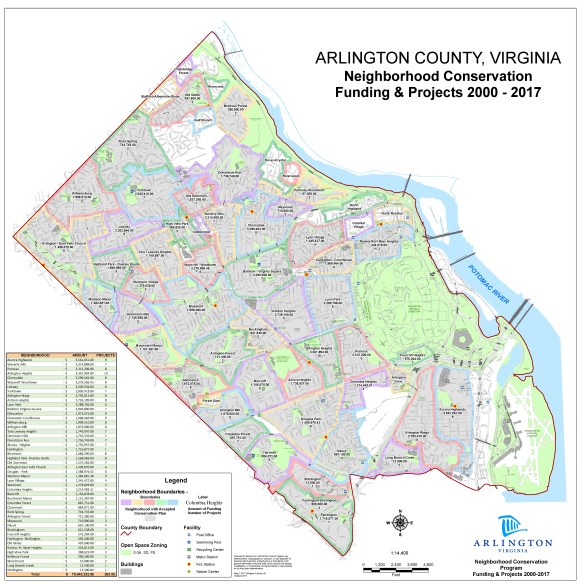
ArNAC Part One: Overview of Lyon Park Projects

By Tabitha Ricketts

The Arlington Neighborhoods Advisory Committee (ArNAC) advises the Arlington Neighborhoods Program, which allows the neighborhoods of Arlington to leverage Arlington County funding for self-chosen projects to benefit our communities. These projects can be capital improvements such as updates to streets, streetlights, sidewalks, and other pedestrian safety measures. There are also an increasing number of beautification projects, especially to improve the appeal and usefulness of County-owned parks and to add green space where concrete would otherwise prevail.

As a participating member of ArNAC, Lyon Park has actively benefitted from neighborhood projects supported and funded through ANP. The Lyon Park Neighborhood Plan filed with ArNAC lays out Lyon Park’s 10-year plan, describing the neighborhood we want to create and maintain for ourselves and our community.

Between 2000 and 2017 alone, Lyon Park received $2.3m in funding across different neighborhood projects. Each project went through several rounds of design and review within ArNAC and the neighborhood itself, building up points in the ArNAC system based on completeness, breadth of impact, and other factors. Twice a year, once in the spring and once in the fall, ArNAC votes on projects that are fully designed and ready for execution. The projects that pass vote in the ArNAC funding rounds are put forward to the Arlington County Board for final approval.

In the fall 2016 funding round, Lyon Park was funded for a street improvement project. To improve pedestrian safety on North Highland Street between Arlington Boulevard and 1st Road North, a 4-foot continuous sidewalk was added on the west side of the street, with ADA-compliant ramps at each intersection, and connection to the existing asphalt trail alongside Arlington Boulevard. A 3-foot utility strip was added next to the new sidewalk along with curbs and gutters on both sides of the street. On-street parking was maintained on both sides of the 28-foot-wide street.

In the fall 2020 funding round, sidewalk improvements were approved for the stretch of North Oakland Street from North Pershing Drive to Arlington Boulevard. A new 5-foot sidewalk was constructed along the east side of the street, with a utility (grass) strip located adjacent. Stormwater drainage improvements were added as part of this project as well, including some bioretention areas at two locations within the project limits. The street was narrowed slightly to facilitate these additions but maintained on-street parking on both sides. While not in the Lyon Park neighborhood directly, this project benefits Lyon Park residents through increased pedestrian safety and improved walkability of our interconnected community.

Lyon Park residents also benefit from the recent 11th Street park renovation put forward by the Clarendon-Courthouse Civic Association ArNAC representatives. This project, approved in the spring 2021 funding round, includes updated gravel walkways to ADA-compliant concrete paths, adding new site furnishings and trees as well as path lighting and signage, and general renovation and improvement of existing lawn areas. The park is now open to the community in its new and improved state – only the installation of new birdhouses is still pending.

Neighborhood associations across Arlington are continuing to identify, propose, and define improvement projects across a range of areas. Many are focused on safety, adding street lights and traffic calming measures to busy areas with a high amount of foot traffic, such as near bus stops and crosswalks beside school pickup zones. Lyon Park has benefited from similar improvements in the past, but I’m sure there’s more to be done – more ways to increase safety for pedestrians and cars alike, to add beauty and function to our streets and paths, and to support neighborhood connectivity and utility. It’s up to us to identify any and all of those ways and to drive the changes we want to see! Let me know what thoughts you have already and keep an eye out for the next newsletter update, where I’ll share the consideration criteria and the next steps to take a project from idea to success.. 

The Changing Community Landscape: Green Valley Edition

By Anne Bodine, VP of Development

In the mid-1970’s Arlington was one of the first places in the U.S. to adopt “Transit-Oriented Development;” increasing zoning and land use to allow major additions of housing, withing the two new rapid transit corridors for Metrorail. It worked out. Arlington grew, but in ways that kept the county semi-urban with low residential areas, while expanding along the corridors. A balance of commercial and residential space kept a pretty even keel to balance budgets. Since then, the county has added two new transit corridors, Columbia Pike and Langston Blvd., significantly increasing the carrying capacity for development. Budgets haven’t been as rosy, as commercial tenancy has declined in years since COVID-19. 

Inside the transit corridors, developers regularly “bargain” with the county, usually via staff, and neighborhoods, usually through civic associations, pursuant to the site planning process. Recently, however, areas that had never seen site planning are encountering them, including ours, via the Courthouse Clarendon amended sector plan, and special GLUPs (one-off changes to the land use on a site) that bring higher density in small areas, such as the Days Inn at Pershing and Rt. 50 in Lyon Park.

Now, however, the county is expanding site planning and higher density—and with some projects a departure from transit-corridor incentives—beyond these defined areas. The April 9 approval by the County Board of a 531-unit housing complex at S. Glebe Rd. and I-395, in Green Valley sets a precedent I find troubling. The vote defied wishes of African-American leaders, the Civic Association, neighbors, churches, the Arlington Civic Federation, among others, seemingly in a push to elevate housing production over other county goals. 

For example, the vote defied County goals on equity and housing affordability (most 2-bedroom units will not be affordable to the 42% of Green Valley residents who are Black or Hispanic). Fewer than 2% of the new units will be committed affordable units provided by the developer. I believe that number did not correspond to what was truly possible under current zoning and land use law and policy. The site plan process governing community benefits was also extremely warped as the county granted so many exemptions as to boosting the future yield on the property perhaps six to eight-fold. 

These critically important land use and zoning issues were not fully fleshed out—or done so only in a way they could not be challenged as the county attorney took the Board into a backroom during one of the Board meetings. That meant we may have left more affordable units on the table. The Board also failed to require a full VDOT analysis of the S. Glebe Rd. impacts (a road VDOT manages), allowing the developer to preempt traffic design here to maximize profit. While that is expected from for-profit entities, I believe in this case the County was not deeply committed to forging the best deal for a historic Black church next to the site, for Green Valley, or for the people who live here NOW. 

The development offers 91% 2-bedroom units or smaller, thus failing to deliver family-sized units Arlington needs. It adds to the surplus of small, expensive housing and will also be 100% rentals, meaning no opportunities for tenants to build generational wealth. And 98% of units will be at market rates where the County admits it has a surplus of supply.

The project will add 23% of existing housing stock in the census tract, but the only infrastructure and “community facility” improvements designed will mainly benefit the new tenants (a new access road, new green space) and not current residents or the church; some of the benefits may never be realized (a cut through to allow a second egress point for all the new traffic depends on owners of an adjacent site!). Minimal benefits were secured by AME Lomax Zion Church and Green Valley Civic Association, although one benefit, LEED design specifications, is significant and contributes to broad county goals. Several board members behaved as if they had no other choice. This sets awful precedents for site planning across Arlington; it guarantees further gentrification of one of Arlington’s most diverse neighborhoods. I hope this project will encourage you to get involved in long-term growth policy of our county and consider how we can also be better informed about these kinds of projects within our own Lyon Park. 

Civic Federation Looks at Big Picture Development Issues and Passes Climate Change Resolution

By Anne Bodine

On November 12, the Civic Federation discussed a host of items that the county is working on as part of its overall development agenda, including rezoning public lands, Special GLUP projects (adding density outside of the existing transit corridors), Expanded Housing Options or Missing Middle, and minor vs. major site plan amendments at Virginia Hospital Center. CivFed also indicated that the county is revising the introduction to Arlington’s Comprehensive Plan, which likely will affect/alter Arlington’s decades-old planning paradigm that limits higher density development to the transit corridors. You may want to watch the meeting or join in CivFed’s efforts through LPCA’s delegates (see newsletter p.2 for names). The Civic Federation also approved a resolution that asks the county to elevate climate change in its overall planning process, you can read the new resolution. LPCA’s delegate voted in favor of this resolution. 

Big Changes Afoot for Arlington Boulevard (Route 50)

By Natalie U. Roy

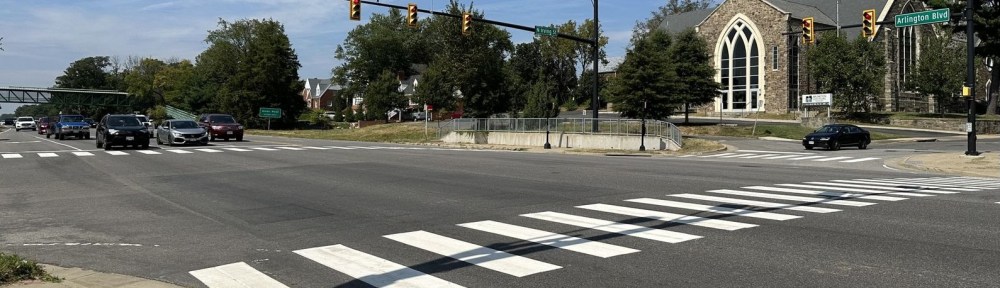
The Virginia Department of Transportation (VDOT) is planning major safety improvements along a section of Arlington Boulevard (Rt. 50), between Glebe Road (Rt. 120) and Fillmore Street. The Department recently held public listening sessions where members of the affected communities, including from Lyon Park and Ashton Heights, commented on these proposed significant changes.

Specifically, the project proposes a raised median to separate eastbound and westbound Arlington Boulevard traffic. This is an improvement that many residents in the community have been asking VDOT to consider for years. This highly trafficked portion of Route 50 does not have any safety barriers (median strip or jersey barrier) dividing fast moving east and west traffic. 

As a result of the proposed median, left turns will only be accommodated at the traffic signals at Irving Street and Fillmore Street. The project also proposes to add dedicated left turn lanes, on Arlington Boulevard, at the Irving Street intersection and extend existing left turn lanes, on Arlington Boulevard, at the Fillmore Street intersection. Additionally, the project proposes to extend the existing service roads on the south and north side of Arlington Boulevard to improve safety. This project may involve changes and/or breaks in limited access control.

At the design public hearing, residents asked questions and expressed concerns over bike lane safety, the access road extensions, the loss of trees on the pedestrian and bike path, cut through traffic into the neighborhoods, and the timing. Additional information can be found on the project webpage (www.vdot.virginia.gov/ArlingtonBlvd). For more information please email mark.vanzandt@vdot.virginia.gov.

The full presentation from VDOT can be viewed here

Share Your Ideas for Projects that Benefit Lyon Park

By Tabitha Ricketts

As Vice President of Neighborhood Conservation, I serve as Lyon Park’s representative to the Arlington Neighborhoods Advisory Committee—ArNAC, for short. ArNAC is a program through which the neighborhoods of Arlington can leverage Arlington County government funding for projects that benefit our community. 

These projects can be capital improvements—updates to streets, streetlights, sidewalks, and other pedestrian safety measures, for example. There is also an increasing number of beautification projects in the works, which can help to improve the appeal and usefulness of County-owned parks and add green space where concrete would otherwise prevail. You can learn more about neighborhood-driven projects by visiting www.arlingtonva.us/Government/Projects/Arlington-Neighborhoods-Program/Capital-Improvement-Projects or explore a broader range of County-funded projects at www.arlingtonva.us/Government/Projects/Project-Types

What does this mean for Lyon Park? We, the members of the community, get to decide! As you look around our neighborhood, what stands out to you as an area that could use improvement? The first step is to have an idea. From there, we can start working through the steps to turn an idea into a project proposal. 

When determining priority projects for Lyon Park, I’ll consider the following factors:

– Size, scope, and cost of the project—the effort required

– Level of impact—the number of neighbors benefitting

– Proposed champion—a neighbor ready to lead the charge and champion the project with me

– Neighbor support—sentiment of the neighbors directly impacted by the proposed project

– Additional funding sources

– Bonus for sidewalk or park project

Priority will go to projects that are lower in effort, positively impact the greatest number of neighbors, have a dedicated champion ready to work through the process, have general support from impacted neighbors, have additional funding sources to supplement County funding, and address sidewalks or County park locations. (Note that Lyon Park and our community center are owned by us, the neighborhood; that is not a County park.)

These criteria align closely with the ArNAC points system, in which points are awarded to neighborhood projects in the Committee’s queue (projects with the highest point value determine which projects are considered for approval first by ArNAC and then by the County). The ArNAC points system awards additional points for projects with supplemental funding sources and sidewalk or park projects, so our priority measurement takes that into account.

Are you ready to get started? Reach out to me via email at Tabitharicketts@gmail.com with your ideas, keeping in mind the factors listed above, and let’s turn our dreams into actions!. 

Development Corner

By Anne Bodine

The County Board in July advertised a proposed zoning code amendment (the gist of which is contained in the Board report for the county board meeting) to allow recovery homes in Arlington. The policy will be up for final approval in October. The proposed policy change includes several revisions to policy and code:

– re-definition of “recovery residences;”

– allowing recovery residences:

– by-right in single-family detached dwellings for up to 8 unrelated persons; and

– by special exception use permit approval for either more than 8 persons, or in a dwelling unit other than a detached single-family dwelling;

– modifying “residential use classification” to categorize recovery residences as an example of Household Living

The proposal was on tap for a final Board vote September 14, but Board Chair Garvey deferred action to an October 7 Planning Commission meeting with a final vote by the Board October 19.  If you have concerns about the new proposals, you need to weigh in with one or both of these groups. More background follows:

The first of the proposed changes aligns Arlington’s definition of “recovery residence” with that of Virginia (Code §37.2-461.1), namely

“a housing facility…certified by the Department [of Behavioral Health and Developmental Services or BHDS]…and provides alcohol-free and illicit-drug-free housing to individuals with substance abuse disorders and individuals with co-occurring mental illnesses and substance abuse disorders that does not include clinical treatment services.”

The second change increases the number of residents in single-family detached homes from four to eight (with no use permit), and increases the numbers in multifamily areas from four to “more than eight persons” through a use permit.

Background. In 2023, Oxford House, Inc. which operates nationally asked the county to allow it to “operate” recovery residences in single-family detached homes and cited persons in drug and/or alcohol recovery as “handicapped individuals” per the 1988 amendments to the Federal Fair Housing Act. Oxford requested that the recovery residence receive equal treatment to single-family dwellings under the zoning regulations.

Currently, Arlington zoning code is silent on the issue of recovery residences, which means they are not “explicitly permitted.”  County staff notes the “closest cognate is group homes for persons with developmental disabilities.”  Staff also reported that recovery homes are not required to follow regulations the same regulations that apply to group homes for those with developmental disabilities, including:

licensing by State Authorities (instead recovery residences are “certified” by VA BHDS as complying with the standards in Code of Virginia §37.2-431.1 but there are no penalties because the facilities are self-regulating);

Operation via a non-profit or government organizations (instead they operate independently);

Onsite resident care or services.

Current zoning allows up to 4 unrelated adults to live in a home together; it also allows 8 unrelated individuals with developmental or intellectual disabilities to occupy one home, including detached single-family homes. Arlington also requires that such homes be licensed by the State which means recovery homes have not been permitted. (Note:  The Virginia House of Delegates will carry over House Bill 646 from the 2024 legislative session that would require jurisdictions to govern recovery homes by the same standard, notwithstanding this State Licensing provision. If this were to be enacted next year, Arlington would have to allow the recovery homes in the same manner as it currently is proposing with this zoning amendment in October.

While not mentioned in the Board report, Arlington apparently already has eight recovery residences, some in single-family homes, some run by Oxford Houses, all of which are apparently illegal since our zoning code does not recognize this as a legal use of property yet. Only four of them are currently “certified” as required by the state. At a minimum this is very complex as it intertwines federal, state, and local law. It’s worth noting there has been documented fraud with recovery homes in other states, and some states are trying to better regulate such homes, which are also often owned by investors unrelated to Oxford House or other recovery home “managers.”  If you would like more information, please contact me at annebodine@yahoo.com. I recommend you also read and watch the Board report and the resources listed below:

Staff presentation to county board July 22, 2024

Planning Commission Meeting September 4, 2024. 

Land Use Decisions by Arlington County Board

By Anne Bodine, VP of Development

On June 18, the County Board voted 4-0 to approve a conditional use permit for Tyndale Christian School on the site owned by Bloss Free Will Baptist Church at 716 N. Barton St. The school will be operating pursuant to conditions laid out in the Board report of June 14 (and revised on June 18). This allows the school to operate for six months with up to 40 students (elementary through 8th grade), using four onsite parking spots (vs. six to seven spots required by code) and waiving the code requirement for a loading area. The church use at this site has been discontinued.

The approved use permit was a revision from the original request to enroll up to 80 students this year (with a larger onsite parking requirement). LPCA requested that the Board pursue a one-month deferral to let the applicant secure a permanent fix for the parking and get more clarity on the pick-up/drop-off (PUDO) plans. As the school aims for an eventual enrollment of`135, the parking and transportation issues present a quandary. Many public speakers supported the school, but the majority expressed concerns about these two issues. LPCA welcomes the school and will stay engaged as things advance onsite. Contact annebodine@yahoo.com if you have comments on the school as it gears up to welcome its first class. 

On July 22, the County Board approved a site plan amendment (SP#465) for the Joyce Motors project, an 11-story mixed-use residential building with 231 units planned for development at 1020 North Irving Street. The LPCA is one of five civic associations permitted to comment on the project, as we were involved in the 2022 update to the Clarendon Sector Plan. The applicant received an additional 1,629 square feet of gross floor area, a slight revision to the window design, a reduction of 10 residential units, and the elimination of 37 below-grade parking spaces. According to Ashton Heights, which lobbied for better parking during the initial site plan review, the developer will now have a parking ratio of .52 spaces per residential unit—less than the developer’s original 2021 request for a .57 ratio, which Ashton Heights opposed, and significantly less than the .64 ratio that was originally approved by the Board. While the county indicated in July that “this [revised] parking ratio is consistent with adopted County guidance,” it nonetheless requires a variance from the zoning code. The county further justified the reduction by noting that Clarendon is very transit-accessible. The LPCA objected to the parking reduction while agreeing to the other requests. We pointed out that this project was the first to be approved under the more developer-friendly sector plan revisions and that such significant reductions were not supported by the parking experience from other recent high-density constructions. We requested a parking study and the return of the 10th St. Park, which had originally been promised as a community benefit for this development.

Perhaps most troubling is that both of these cases exposed severe flaws with the process of our community engagement. In the Tyndale case, the county staff failed to notify LPCA of a substantive change in the parking elements that severely affected community consensus. Staff admitted as much at the Board meeting, but this practice undercuts the very idea of proper engagement. Additionally, the Board rearranged the regular order of the meeting, allowing Board Chair Garvey to miss the extensive public comment, and only hearing positions of the applicant and staff. This would be like a judge absenting him/herself from the courtroom for part of a trial. LPCA also believes the county violated the State Freedom of Information Act, which requires local jurisdictions to make board materials available to the public at the same time they make them available to the County Board. In the case of Joyce Motors, we were excluded entirely from the negotiation with the developer to agree on additional community benefits. In this case, the developer will add funds to the Affordable Housing Investment Fund, but the site plan review process is supposed to ensure the affected neighborhoods remain part of the process throughout. LPCA believes we need to address the exclusions that are apparently taking place if/when applicants pursue site plan amendments. The seat at the table is not negotiable. We may take this to the Civic Federation for broader consideration next year.

Come to the September 11 LPCA meeting at 7 p.m. at the Community Center if you want to hear more or ask questions. If you are interested in getting involved in future discussions, please contact Michael Kunkler at LyonParkPresident@gmail.com

Arlington 2050 Kick-off Recap

By Michael P. Kunkler

Representing the LPCA, I recently attended the Arlington 2050 “visioning” event held at Amazon HQ2 (a beautiful building and conference room).  County Board Chair Libby Garvey hosted the event, the crowd consisting of Arlington illuminati from civic and interest groups, scions of local businesses, and a lively group of high schoolers. The idea was not for the County to tell the audience what Arlington should be in 2050 (a welcome approach), but for the audience to consider what Arlington should be and to share udeas.  To stimulate discussion and reflection, four speakers presented their thoughts:  

Jason Samenow warned of “heat islands,” essentially the removal of trees and green space for any reason.  Heat islands can lead to temperature differences of up to 10 degrees Celcius between urban jungles, and well, regular jungles…  If you haven’t heard Bill Anhut say it enough, “go plant a tree!”  

Hamilton Lombard, a demographer from UVa, had some interesting comments.  He stated that “up to 50% of DC area jobs are now or will become remote” meaning much less demand for Arlington housing due simply to proximity to DC (not to say other reasons for demand will reduce, like governance, walkability, etc…).  He opined on the expectation gap created when apartment production far out-paced sufficient creation/retention of larger-sized housing units in the Orangeline building boom of the early-2000’s.  He even suggested rural VA is competing with Arlington for residents! 

Steve Hartell, representing Amazon, confirmed that the company (among others) plans to bring approximately 18,000 more high paying tech jobs to HQ2 (though the timeline is unspecified).  He believes Arlington would turn into a true tech hub like Silicon Valley, Austin, and others… 

Dr. Washington, President of George Mason University, stole the show, hyping Arlington as the “home of GMU.”  He took all liberties to cast GMU as Virginia’s premier university.  He focused on the importance of internships at these new tech jobs in Arlington.  

For anyone interested in providing their own personal “vision” for Arlington 2050, I can share with you one of the paper “postcards,” but recommend you visit the Arlington County website instead; electronic text is much easier to search…  https://publicinput.com/arlington2050