Celebrating the Community since 1924

By Elizabeth Sheehy

For those of us living in Lyon Park, it is easy to take for granted the lush park at the center of our neighborhood. The park and the Lyon Park Community House are unique within the county. With sixty neighborhood civic and citizens associations, ours is the only one that owns both its community center and surrounding greenspace. That is quite an honor, and with it comes responsibility.

One way to fulfill the responsibility to support Lyon Park is to volunteer at a community event—Mulch Day (April), Pancake Breakfast (January), and the Spring Fair (May) are just a few examples. Please consider a donation to the Lyon Park Foundation to support long-term upkeep of the historic Community House. Or you can represent Lyon Park at the Arlington County Civic Federation (ACCF).

Neighborhood associations have a long history in Arlington County, many of them pre-dating the establishment of the county itself. The Glencarlyn Civic Association, for example, traces its roots to 1887 and the LPCA was established in 1924. The neighborhood associations amplify their voices by joining with other Arlington interest groups, such as the Arlington Arts Alliance and Encore Stage & Studio, under the umbrella of the ACCF (also known as CivFed). Together, members of the ACCF discuss critical issues affecting all Arlingtonians, including schools, zoning, government oversight, and sewers. The LPCA elects four members to represent the community at the monthly meetings (usually 7 p.m. on the 2nd Tuesday of the month) and it’s a great opportunity to have your voice heard, and share the ACCF’s priority with the LPCA membership. Please consider joining the team.

You can also share your opinion by participating in the Arlington 2050 project. Launched in January 2024 by County Board Chairwoman Libby Garvey, Arlington 2050 solicits citizen input online at 

https://publicinput.com/arlington2050

It is unclear when the results of this initiative will be tallied, so offer your input now!

Finally, a fun way to get involved in community life is to join the Centennial Committee, as Lyon Park celebrates the 100th anniversary of the Lyon Park Community Center. We need volunteers to serve as party organizers, researchers, publicity people and worker bees. Contact elizabeth.r.sheehy@gmail.com, with “Centennial” in the subject line, if you are interested. The committee continues to seek documents, photographs, and sundry items related to Lyon Park’s past. 

SAVE THESE DATES!

Sunday, November 17, 2024: Celebrating 100 years since the first meeting of the stakeholders of the Lyon Park Community House in 1924.

Wednesday, July 25, 2025 (or thereabouts): Marking a century since the laying of the cornerstone of the Community House in 1925

Wednesday, September 10, 2025: 100th anniversary of the first meeting of the Lyon Park Board of Governors in the new (not quite completed) Community House.


The End of an Era for the Lyon Park Neighborhood and Community Center—And the Beginning of a New One!

By Aaron Schuetz

Jeannette Wick has been a part of the Lyon Park Community Center’s Board of Governors for more than 20 years, and has served as Chair for the past 15. She will step away from the role at the end of the year. Jeannette’s sense of civic duty and commitment to her position have translated to volunteering an average of 10 hours each week handling issues with building and park maintenance, taxes, non-profit requirements, County policy, rentals, neighbors, and legal matters. Much went  unnoticed, some was criticized, all has helped keep our park and Center in great shape.

Jeannette moved into Lyon Park in 1987 and since that time has worked with the not-just-for-Woman’s Club to bake and sell hundreds of thousands of cupcakes to support the LPCC. She organized the annual Craft Fair for more than 20 years and prepared this newsletter for many years. For about seven years before, during, and after the LPCC renovation, Jeannette organized substantial fundraising efforts (thanks to many of you for responding!), and found, coordinated, appealed and eventually secured a historic tax credit that delivered $163,000 to pay down the renovation loan. These efforts helped ensure the LPCC’s solvency, retiring the loan six years ahead of schedule and just ahead of when the pandemic decimated rental income and would have challenged our ability to make loan payments.

And when it rains, it pours. Cindy Stroup and Bill Short have also chosen to step down at year’s end. Bill has been a Jack-of-all-trades for the Community Center for over a decade, frequently coming in late at night so the space is clean and looks great for the next renter or community user. Bill always goes above and beyond as he deals with excess messes and even damage from renters (he has many gross stories to share…not all are bathroom based!). As LPCC’s caretaker, he addressed many issues to keep the Center looking great.

Cindy has been the rental agent for more than 10 years, starting just before the renovation. During her tenure, Cindy created the online rental process and structured a clear framework for renters to follow. She has supervised roughly 1,200 rentals, more than half from residents like you. In order to maximize rental income to ensure there are sufficient funds for building maintenance and improvements, she proactively recruited more unconventional clients (funerals, classes, business meetings, etc.) to use the center more on previously slow weekdays, instead of relying solely on larger parties that create more stress on the building and the neighborhood. 

During Cindy’s tenure, annual rental income has increased from the tens of thousands to well over $100K annually. Cindy’s very clear rental contracts and checklists have helped reduce, though regretfully not eliminate, violations and misunderstandings (many people simply don’t read what they sign), but she consistently followed up on each with frequent visits to the community center at all hours, and weathered rude treatment from some renters. In addition to being the rental agent, Cindy often schedules maintenance and inspections, maintains supplies, and ensures that all of the building logistics and needs are addressed. Her vigilant oversight, availability, and passion for the community have been essential to minimizing the negative impacts of having a rental event hall in our neighborhood. We’ve all benefited from her commitment. 

Jeannette, Cindy, and Bill all deserve our thanks and gratitude. They set an example of hard work and concern for our community. 

Replace isn’t the word for what’s next. We won’t find people like them, and may need to change some processes to adapt. But hiring a rental agent who is diligent and thorough is a priority. We need someone who can reliably handle rentals, tax documents, financial records, trash contracts, and legal matters. We need people to safeguard this community asset as it prepares to celebrate its 100th year in our park. 

Please consider contributing to help ensure the smooth operation of our park and Center. We have been deliberately light on appeals in the last few years following the renovation and Covid, but the Center relies on donations from the community to thrive. Tax deductible donations (one time or monthly) are easy to do here: https://lyonpark.info/donate/

A Rose by Any Other Name—Naming the Newsletter

By David Newman

Did you notice the name of this newsletter? It’s Lyon Park Bulletin; however, before October 2022, it was Lyon Park Citizen. We’re planning to revert to the original name, created at the newsletter’s inception in 1976, and want you to know why. If you have concerns about changing the name, please let us know!

The main reason we want to revert to the original, Lyon Park Citizen, is to remind everyone residing in Lyon Park that you are citizens of Lyon Park—and that means something!  As citizens of Lyon Park, you enjoy some privileges and opportunities—including receiving this newsletter with lots of information you may want and some information you may need. Also, all residents or owners of homes in Lyon Park are eligible for special residential rental rates when booking the Community Center for their own event. (Ashton Heights residents get special rates, too!)  And finally, you are invited to all of the community events hosted at the Lyon Park Community Center, including the Lyon Park Spring fair, the pancake breakfast, chili cook-off, the egg roll, the food truck fest, the community yard-sale, and tons more, all of which will be posted in the newsletter.

“Citizen” is defined as an inhabitant of a town or city; citizenship has benefits, and also carries responsibilities. We hope that, as Lyon Park citizens, you will be welcoming neighbors and go one step beyond, by finding time to volunteer at community events and with community organizations to help keep the Lyon Park community strong. Through local committees, you can make a difference, because they help shape and preserve our community. We hope you’ll become a member ($10/year) of the Lyon Park Citizens Association (LPCA) and vote for capable neighbors to fill positions in the LPCA and other neighborhood organizations. When you’re ready, maybe you’ll serve as an officer of one of those organizations!  Those opportunities are published in this newsletter, so keep your eyes on this space!

Another reason for reverting to the original name is to highlight the connection between this newsletter and the Lyon Park Citizens Association. One important role of the LPCA is to distribute information on issues of concern to the community. This newsletter is an important channel for distributing that information—and we want readers to know that the people putting together and distributing the newsletter have no agenda or interests other than keeping Lyon Park residents informed and promoting community and connection.

I expect some of you are wondering why the name was changed in in 2022 to Lyon Park Bulletin. In President’s Messages in the newsletters published in October 2021 and September 2022, leadership noted that they wanted to make communications from the LPCA Board to Lyon Park residents more inclusive and welcoming, during a period when immigration was highly politicized. We believe returning to Lyon Park Citizen advances the goal of inclusiveness and hope you agree. Please email us at LyonParkEditor@gmail.com if you want to share views on the impending name change.  

Centennial Reflections: Let’s Raise a Glass to Lyon Park!

By Elizabeth Sheehy

When a corner of Lyon Park was given over to the community in 1925, a gift from the developer Lyon
& Fitch for the sole purpose of building a community center, there were a number of restrictions applied to the deed. Some of these “specifications” would positively impact the community and remain part of our best practices today. The restriction against activities on the site causing a nuisance to the neighborhood, and the commitment to maintaining a quality building (which, in 1925, demanded a building costing at least $4,000) ensure the neighborhood and the community house can co-exist peacefully. Of course, today we are appalled by the racial restrictions that were included on the deed, common to many deeds throughout Virginia in the 1920s. The covenants were ruled unenforceable by the Supreme Court in 1948 (Shelley v Kramer) and are prohibited by Virginia’s Fair Housing Law. 

One final specification for transferring the land to the Lyon Park Community Center trustees in 1925 was a strict alcohol prohibition. This restriction was superfluous, as the Eighteenth Amendment to the Constitution was ratified in 1919, and alcohol was prohibited everywhere. It seems that Frank Lyon, a temperance activist, was taking no chances and layered on the restriction regardless. Sure enough, by the 1930s, the nation had had enough and Prohibition ended with the Twenty-first Amendment in 1933.

There was definitely an adjustment period in Lyon Park once alcohol was publicly permitted again. At the May 27, 1935 Board of Governors meeting, the viability of holding dances was brought up. “It was reported that two persons had apparently imbibed too much “joy water” at the last dance and were rather hard to deal with.” It was decided that a chaperone would be required at all dances in the future. Still, on paper the restriction of alcohol in the Lyon Park Community House remained. It would take another four decades until action was taken. On May 14, 1974, the Board of Governors informed the three LPCC trustees that they had voted to officially rescind the “prohibition of intoxicants” in the Lyon Park Community House.

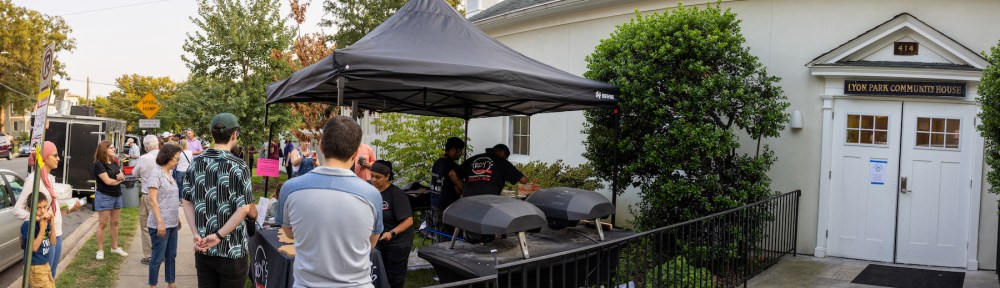
As we celebrate the annual Lyon Park Spring Fair on May 18, we will also gather together as a community to enjoy the Food Truck Festival. And while we are celebrating, we can soberly and joyfully raise a glass to this wonderful and inclusive neighborhood of Lyon Park, celebrating fifty years since the end of the LPCC’s prohibition. Please drink your joy-water responsibly!

Thank you to Laureen Daly for finding this wonderful joy-water note in the Lyon Park archives during a recent document sorting party!  

Centennial Reflections: Building Community Through Consensus

By Elizabeth Sheehy

A new monthly feature, looking back through the archives to better see the future.

In August 1934, with little fanfare (or notice to Lyon Park Community Center membership), the Board of Governors approved “the building of a tennis court, croquet court, and horseshoe courts.” They stipulated that a committee would need to raise the funds and maintain the facilities, and agreed it would be removed if interest waned. A committee immediately set to work raising funds.  By September, opposition to the plan was in full force. A “Mass Meeting” was scheduled to hear both the pros and cons, asking members three questions:

  1. Do you favor the construction of a tennis court on our Park?
  2. Would you agree to have trees felled to make room for a court?
  3. Will you actually use the court if established?

A petition was circulated, signed almost exclusively by those living along the park edge, which compared the scheme to the establishment of an amusement park, likely to become a public nuisance and damaging the park’s natural beauty. Some, in favor of the proposal, suggested that the four trees slated for removal were endangering the Community House. Ultimately, the BoG leadership decided not to move forward with the proposal, resulting in a few resignations.

It seems the lesson here is that one neighbor’s recreational vision is another’s nightmare, and that consensus in developing community space is important. That concept came into play during the planning of the Lyon Park Community House renovation, completed in 2015, as all decisions of the renovation committee were made by consensus rather than majority rule. Consensus requires more give-and-take, and a concerted effort to avoid winners and losers. The end result was a beautiful and functional building that works by all accounts for everyone. Just as in 1934, neighbors listened to each other, worked together to find suitable solutions to various concerns, and approved a plan that met the communities needs. And sometimes the correct strategy is to not move forward, as with the tennis courts. Perhaps in another 100 years, Lyon Parkers will look back on the renovation process of the early 21st century, as we can look back on the 1934 membership, to find lessons about building community.

Lyon Park’s Neighborhood Conservation Plan

By Tabitha Ricketts, Lyon Park’s Arlington Neighborhood Advisory Committee Representative

In 2019, a group of dedicated Lyon Park Citizens Association members compiled a 210-page document covering our neighborhood’s history, goals for the future, and areas of both interest and concern directly impacting our residents. This document is the 2019 Lyon Park Neighborhood Conservation Plan.

What is a Neighborhood Conservation Plan? It’s both a snapshot in time and a roadmap for the future, refreshed every 10 years by and for neighborhoods—like Lyon Park—that are members of the Arlington Neighborhood Program (formerly the Neighborhood Conservation Program). These Neighborhood Plans provide the framework for improvement projects neighborhood representatives submit for approval from the Arlington Neighborhood Advisory Committee (ArNAC). Once approved, these projects are put forward to the Arlington County Board for funding. The plan drives the projects, and the projects receive County funding to achieve the neighborhood’s goals—like increasing pedestrian safety measures, improving a County park, or planting more trees.

Lyon Park’s 2019 Neighborhood Plan covers 9 areas of interest to Lyon Park residents, as reported in a 2016 resident survey: Land Use and Zoning, Street Conditions, Transportation and Traffic Management, Housing, Public Facilities and Services, Commercial and Business Areas, Historic Preservation, Urban Forestry, and Schools. These areas roll up to 3 neighborhood goals:

  1. Adapting to growth and change.
  1. Dealing with the challenges that come with density.
  1. Getting Arlington County support for neighborhood initiatives such as traffic management and commercial development.

For a more in-depth breakdown of each of these topics, check out the slide deck I shared on the Lyon Park listserv. For full details, check out the plan itself, available on the Arlington Neighborhood Program website.

There are a number of aspirations laid out in Lyon Park’s plan—for improved drainage, holistic traffic planning, increased street lighting—that would make perfect projects for the County to execute on our behalf. But to get from plan to action we must: 1) break down ideas into tangible projects, with a target, a location, and a design; and 2) gather neighborhood support to send our top priorities for ArNAC review and Board funding. 

Based purely on our Neighborhood Plan, a few things stand out to me as priorities already. But I’m just a representative of the neighborhood—your neighborhood. A lot has changed since the Plan was created in 2019, and certainly since the 2016 survey data. So, what matters to you? What projects would you like to improve which enhance our neighborhood today? Reach out to let me know, and let’s get started!

Zitkala-Ša’s Connection to the Latest Scorsese Movie

By Toby McIntosh

Zitkala-Ša’s Connection to the Latest Scorsese Movie

By Toby McIntosh

The new Martin Scorsese movie, Killers of the Flower Moon, highlights the investigations into the 60-plus murders during the “Osage Reign of Terror.” In 1923, while the violence was underway, former Lyon Park resident Zitkala-Ša traveled to Oklahoma to document the systemic exploitation of members of the Osage tribe.

Zitkala-Ša interviewed victims while two colleagues combed public records about the corrupt legal system created after the Osage became wealthy from oil found on tribal lands. “Guardians” were appointed for persons declared “incompetent,” mostly girls and women, thus controlling their assets and profiting from them. The guardians’ greed was described in the report: “Oklahoma’s Poor Rich Indians: An Orgy of Graft and Exploitation of the Five Civilized Tribes–Legalized Robbery.” 

Particularly powerful are Zitkala-Ša’s empathetic descriptions of the treatment of Indigenous girls and women. Zitkala-Ša’s earlier writings had recounted her own traumatic experiences in boarding school. In Oklahoma, she gathered testimony, writing at one point:

“After a long private conference with this little girl, I grew dumb at the horrible things…. There was nothing I could say. Mutely I put my arms around her, whose great wealth made her a victim of an unscrupulous, lawless party, and whose little body was mutilated by a drunken fiend who assaulted her night after night.”

Of another situation, she wrote, “I felt an overwhelming indignation at the legal helplessness of a poor rich Indian woman.”

Investigating the conditions of Indigenous people was core to Zitkala-Ša’s life mission. In the summer of 1926, she and her husband took a 10,600-mile automobile trip to Oklahoma and South Dakota to promote their new advocacy group and investigate reservation conditions. Their findings were often stark. Before a Senate committee, Zitkala-Ša reported: “After these many years of control and management of the Indians and their property what do we find today? Many Indians landless, homeless, poor, raged, tubercular, sore-eyed, and their leadership broken.”

Zitkala-Ša, a Yankton Sioux, lived in Lyon Park from 1926 until her death in 1938. Arlington County renamed the park at N. Highland and 7th Streets in her honor in 2020. In 2024, a Zitkala-Ša quarter will
be issued.

Zitkála-Šá to Be Featured on a Quarter

By Toby McIntosh

Zitkála-Šá’s face will be on a quarter, the U.S. Mint recently announced, one of the five 2024 honorees for the American Women Quarters Program. It’s just a part of the continuing attention being given to the Native-American writer, musician and activist who lived in Lyon Park.

Gertrude Simmons Bonnin, a Yankton Sioux, lived on Barton Street in Lyon Park from 1926 until her death in 1938. She used the Lakota name Zitkála-Šá (pronounced: Zit-kah-la-sha). In 2020, Arlington County renamed the park at the corner of 7th and N. Highland streets in her honor.

In Minnesota, an opera about her was produced in 2022, an appropriate tribute, since she co-composed an opera in 1913 considered to be the first Native-American opera. “We are showing that Zitkála-Šá’s story is not a frozen moment in time—that she has continued to shape and inspire and evolve current society, specifically [that of] Indigenous peoples in North America, to this day,” said one composer. Recently, her music was the inspiration for a collection of 13 pieces by Pulitzer Prize winning composer Raven Chacon.

Native News Online included her on a list created for Native American Heritage Month, Five More Native Americans Who Shaped Culture, calling her “one of the most influential prominent Native activists of the 20th century.”

If you’d like to learn more about Zitkála-Šá, there’s a PBS show on her from 2020. The Arlington Public Library has several of her books, and a number about her, including one for younger children (“Red Bird Sings”).

The Life and Times of the Lyon Park Community House

By elizabeth Sheehy

With the Lyon Park Community Center centennial approaching, it’s time to look back at the building’s history, focusing this month on its recent renovation.

From its start in 1924, the LPCH has been owned and operated by the community, independent of Arlington County governance. Funds to build the center were raised by the local neighborhood, and eighty years later, facing an aging infrastructure, the community came together to research, design, and fund a renovation worthy of another century of community gathering. 

The renovation’s initial focus was making the bathrooms wheelchair accessible, and to repair chronic plumbing problems. A comprehensive Capital Improvement Plan was compiled, outlining issues facing both the building and the park, including structural concerns and needed safety upgrades, in addition to ensuring Americans with Disabilities Act accessibility compliance. 

There was vigorous debate—at times, contentious—over the next few years on how best to resolve these issues. In 2009, the Renovation Steering Committee was formed, representing a broad cross-section of the community, to manage the process of developing new plans through consensus, and with maximum community input. For the next six months, a group of volunteers met every Monday, forming sub-committees to research building usage, repair needs, historic characteristics, and other information needed to enlighten the decision-making. In July, the BOG facilitated a Community Pre-Design Workshop to solicit ideas, and in October held a well-attended Community Design Workshop, supporting hands-on community participation in partnership with the architects, Laboratory for Architecture and Building.

The final price tag was $1 million, a daunting figure. Keeping most historic features from the original 1925 building intact, the renovated building has modern ADA bathrooms, an upgraded kitchen, and a sunroom, which beautifully integrates the Community House and park, while increasing the building’s capacity by 50 percent. Fundraising occupied the next few years, and the building renovation was completed in 2015. 

In September 2019, the loan on the Community House was paid off, thanks to the hard work of the fundraising team. This proved fortuitous, as rental operations came to a halt in March 2020, stressing the operating budget. Now that we are back to “normal,” it is easy to ignore our own responsibility, as residents of Lyon Park, for the care and upkeep of the Community House and its surrounding park. If we want future generations to enjoy these unique assets, we must embrace our responsibility to support the LPCH.

Please join your neighbors at the first (in a long time) Lyon Park Community Center meeting for more information about the past, present, and future of Lyon Park.