Environmentally Safe Ways to Control Mosquitoes

By Elaine Simmons

With hot, humid weather comes a plague of mosquitos. We can take steps to reduce mosquito populations without harming “good” critters like bees and butterflies.

  1. Eliminate standing water. Unfortunately, mosquito larvae can live in as little as one teaspoon of water. Black, ribbed, flexible downspout extenders hold water and are thus a prime culprit, even if they are sloped downhill. Blocked gutters are also a major problem, as are tarps (like on pools or cars), toys, bird baths, trash and recycling bins, watering cans and wheelbarrows, and pots and saucers. Check and empty these sources every two to three days.
  2. Treat your rain barrel. Rain barrels are great for saving on water, but they are major mosquito breeding grounds. To avoid this, buy mosquito “donuts” or dunks, which last for months, or add ¼ cup of any type of cooking oil to your barrel per week, or secure fine mesh netting to the top with bungee cord.
  3. Avoid mosquito spraying that harms other bugs. Many companies claim that their insecticide treatments for your yard only harm mosquitoes, but critics disagree, saying that chemicals typically used to cause paralysis and death in mosquitoes (pyrethrins or pyrethroids) kill monarch caterpillars (even weeks after spraying), bees, and fireflies. These chemicals can also kill arthropods, such as spiders and centipedes. Losing these critters means reducing a food source for some birds. Finally, critics claim these insecticides are toxic to certain earthworms.
  4. Try natural sprays to repel mosquitoes in your yard. Alternatives to insecticides are products such as Garlic Barrier, with its considerable amount of natural sulfur providing a repellent. According to reviews, Garlic Barrier smells extremely strong for 30-60 minutes but then the smell goes away; the repellent lasts several weeks.
  5. To avoid being bit while outside, cover up and spray yourself with mosquito repellent. The EPA has approved DEET; it’s been around for decades and breaks down quickly, so does not harm the environment. Alternatives to DEET include plant-based products that contain oil of lemon eucalyptus (OLE).
  6. Finally, use a fan at your outdoor gathering. The fan disperses the carbon dioxide you exhale, so fewer mosquitoes are attracted to you in the first place. Also, mosquitoes are weak fliers and can’t compete with the “wind” from the fan.

An Evening with Wilma Jones, Author of My Halls Hill Family: More Than a Neighborhood

On Thursday, May 13, join Lyon Park, Glen Carlyn, and Ashton Heights Citizens’ Associations for an evening with Wilma Jones, a fourth-generation resident of Arlington’s Halls Hill neighborhood and author of My Halls Hill Family: More Than a Neighborhood. Wilma will share stories of growing up in the historically-Black neighborhood of Halls Hill.

Halls Hill was a segregated Black neighborhood that got its start in the mid-1800’s when 327 acres of land was purchased by Basil Hall for a plantation. Following the Civil War, the neighborhood became completely African American, with a population of residents that were descendants of slaves. It was later walled off and fenced in by developers with the permission of Arlington County Government from the early 1900’s until the 1960’s. Wilma’s family has called Halls Hill home for four generations. Her brother, Michael Jones, was one of four 12-year-old Black students to integrate public schools in Virginia in 1959. My Halls Hill Family tells the history of the neighborhood from its inception in 1866, until the County government, in a display of institutional racism common for the time, closed their neighborhood school in 1966.

Wilma is a top performing corporate information technology sales director during the day and is president of her own management consulting firm, Wilma J, LLC where she works with organizations to support development of a healthy and engaged staff. She is also a popular keynote speaker and workshop leader. Wilma is an author of three books, a grant consultant, civic activist, and nonprofit board member. In her volunteer activity she works with organizations supporting underserved communities to impact positive change.

The program, which is part of Lyon Park’s Dialogues on Race and Equity program, will take place on Thursday, May 13, from 7:30 to 9:00 pm.  Ms. Jones will speak for about 45 minutes and answer participants’ questions for the balance of the time.

Any resident of the partnering neighborhoods who wants to take part must register in advance.  A confirmation email along with the Zoom link will be sent immediately afterward.

Those who wish to read Wilma Jones’ book before the program can order it (available in Kindle and paperback editions) at https://amzn.to/3d6Trsr.  (There are also four copies in the Arlington County Library – and several people on the waiting list.)

Civil Rights Icon from Arlington

By Elaine Simmons

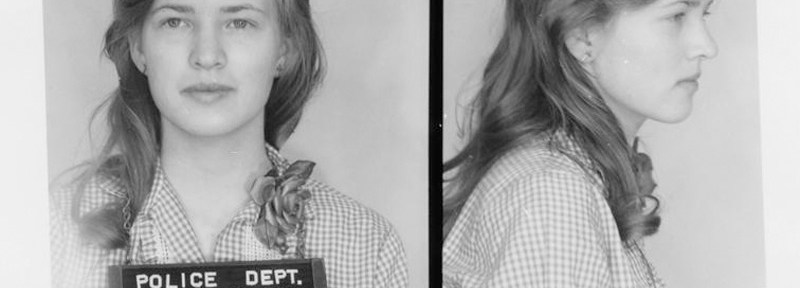
It took a visit to the Civil Rights Museum in Greensboro, NC to learn about a hometown hero. Joan Trumpauer Mulholland, a civil rights activist and a Freedom Rider, attended Nottingham Elementary and spent much of her adult life in the Barcraft neighborhood. 

Joan Trumpauer’s mother was a segregationist from Georgia who sent Joan to Duke University, which, in 1960, was segregated and seeped in southern culture. But early on Joan rebelled against white supremacy. She joined the lunch counter sit-ins in 1961 (first started in 1960 in the Greensboro Woolworth by four Black men from North Carolina A&T University) and then dropped out of Duke after being pressured to stop her activism. She was the first white woman to enroll at Tougaloo College, a historically black college in Mississippi, graduating in 1964. 

Joan returned to this area and worked with activists like Stokely Carmichael on the Freedom Rides, in which Black and white activists traveled together to challenge the segregated buses and bus stations of the South. She also participated in the 1965 Selma to Montgomery march. 

To end segregation in Arlington, Joan joined Howard University students in trying to integrate the lunch counter of the Drug Fair drugstore in Cherrydale, at Peoples Drug at the corner of Lee Highway and Old Dominion Drive, and at a Woolworth’s in Shirlington. 

Joan and her fellow protestors faced violent white mobs and incarceration for their peaceful efforts to end systemic racism. An iconic photograph shows enraged whites reacting to Joan and other protesters (including one of Joan’s professors from Tougaloo) while the protestors sat calmly at a lunch counter. According to one account, the protesters were “doused in food, cut with broken glass, hit with brass knuckles, and burned with cigarettes. The police stood by while men were kicked and punched, and women were yanked from the counter by their hair.” 

In connection with the Freedom Riders, Joan and others were arrested and incarcerated for two months in cells previously occupied by Death Row inmates at the notorious Parchman Farm at the Mississippi State Penitentiary. In Arlington, she and fellow protestors were shot at by angry mobs and were counterpicketed by local Nazis wearing swastikas. She and her fellow protestors were hunted by the Ku Klux Klan and at one point, Joan was deemed mentally ill for trying to eliminate white supremacy. Joan eventually worked and raised five sons on Taylor Street in the Barcroft area. She has been the subject of many documentaries and articles, but perhaps this local hero deserves more recognition from the governments of Arlington County and the Commonwealth.