What is a Semiquincentennial? It’s a fancy and hard-to-spell way of saying “half of 500 years,” and it describes the 250th Anniversary of the founding of our country (1776–2026). As the United States starts to focus on the upcoming milestone in 2026, Virginia is already off and running, and Arlington is playing a big role in the celebration.
ArlingtonVA250 leadership, headed by Annette Benbow of the Arlington Historical Society, launched the process with a county-wide organizing meeting in November, which included an impressive cross-section of Arlington organizations and interest groups, from civic associations to historical groups, performing arts and military associations. As the planning gets underway, ArlingtonVA250 invites all who are interested in exploring and honoring our history to get involved.
Here are a few key points that emerged from the meeting:
– The vision includes many types and themes of events, not limited to just the Revolutionary War era.
– Events can commemorate any or all of America’s successes, failures, and continuing challenges.
– Events should reflect the many voices in Arlington’s diverse population.
– Events are welcome through 2031 (250 years after the battles ended).
– There are state resources and grant opportunities available.
– The celebrations will likely include historical reenactments, visual and performing arts, highlighting historical places and artifacts, and community gatherings, parades, and more.
– Arlington will have a web page on the VA250 website outlining: What is Arlington’s Story; Places to See; and Events in Arlington.
Fifty years ago, the Bicentennial (1776–1976) ignited a renewed commitment to civic engagement, historical discovery, and appreciation for our nation’s great strengths and awareness of its weaknesses. The Lyon Park newsletter was started in 1976 to connect and inform neighbors of the important issues affecting the community. It will be exciting to see how Lyon Park chooses to commemorate another 50 years of “the great experiment” which dovetails with the centennial celebration of the Lyon Park Community Center, which was built of, by, and for the people of Lyon Park.
Planning will begin in earnest after the New Year, and meetings will be accessible via Zoom. Share your ideas at the January 10 LPCA meeting or contact elizabeth.r.sheehy@gmail.com.
Communities across the country have been experiencing issues with youth substance use and mental health issues, and Arlington can learn from their actions. One action is harm-reduction, which aims to stop or reduce the worst outcomes. Examples of this include conducting training on the use of naloxone (commonly known as Narcan) to reverse the effects of an opioid overdose, and providing fentanyl test strips so a substance may be tested for the existence of fentanyl in a variety of drugs and drug forms (pill, powder, and serums). Interventions to prevent substance abuse is another approach that must include the entire community – families, schools, and community-based organizations. A public service campaign to provide education and facts about the dangers of substance use, and to assist families in understanding the risk factors for substance use, and establishing healthy communication, rule-setting, and monitoring is an important first step. Likewise, community services that offer trauma-informed counseling programs, and activities widely available to youth as an alternative to drug use, are all elements of responsive community action.
The Arlington Schools Hispanic Parent Association (ASPHPA) has been advocating for action since last year. After a 9th grader died in February 2023, they held a march and sent letters to the County and the School Board to demand action. The County Council of PTAs held an expert forum in March to explore the breadth of the issue and suggested actions. ASHPA circulated a survey and received over 180 responses from immigrant and refugee families to identify the barriers to participation in Parks and Recreation programs. Following more overdoses in schools and the death of another student in September, an advocacy group—comprised of ASHPA, the County Council of PTAs (CCPTA), the local chapter of the League of United Latin American Citizens (LULAC), Virginians Organized for Interfaith Community Engagement (VOICE), and the Arlington Branch of the National Association for the Advancement of Colored People (NAACP)—have been engaging Arlington County (especially human services, parks and recreation staff and the police) and Arlington Public Schools on this issue. This coalition has requested action on dropping barriers to participation in sports and recreation activities (in terms of costs, program limits, and web-based sign-ups), increased supervision at local community centers, and a drop-in teen center with programmed activities, skill-building, and sufficient transportation to and from neighborhood schools.
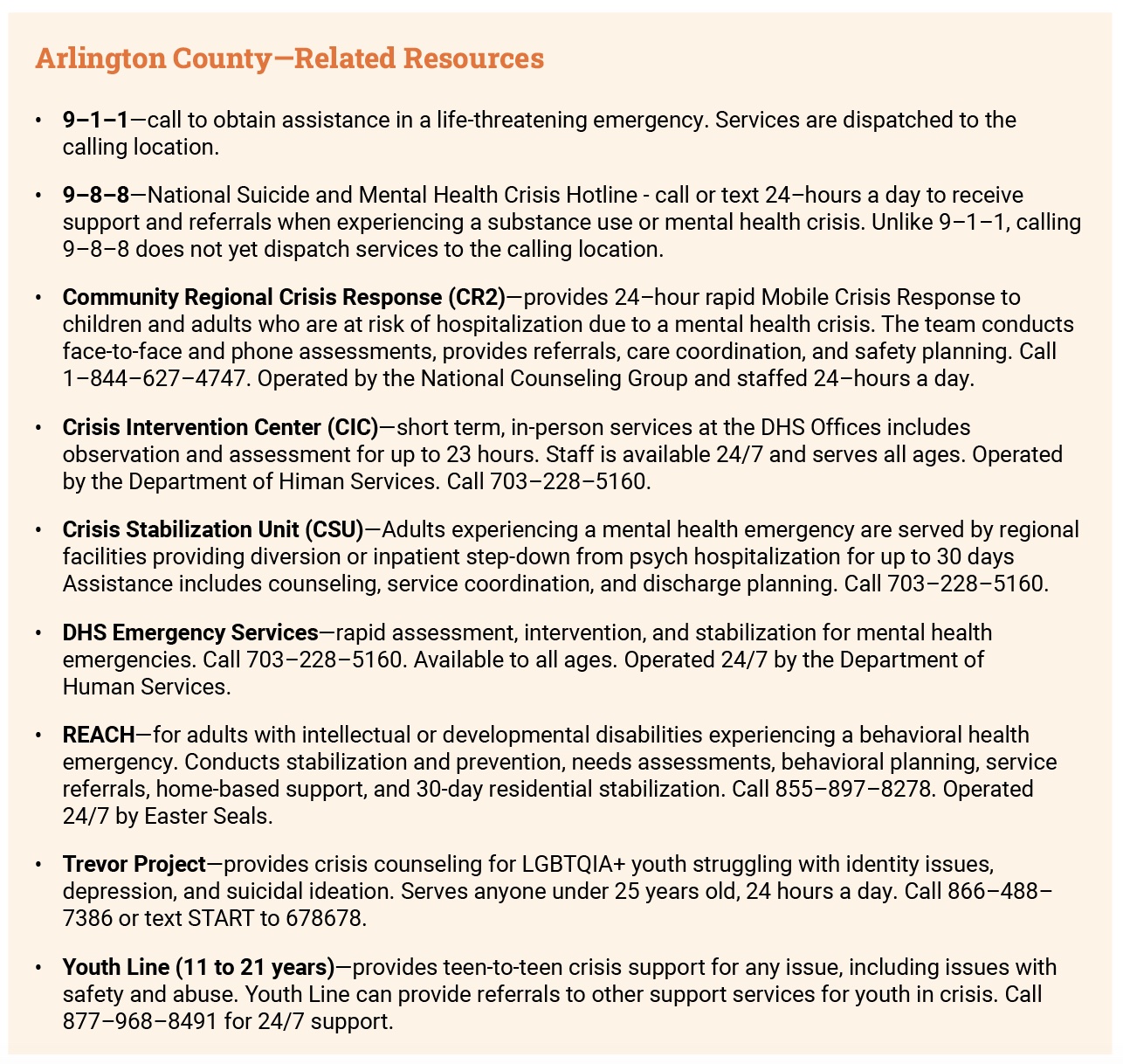
How has Arlington responded so far? The County’s Arlington Addiction Recovery Initiative (AARI) has been busy providing free training and distributing naloxone supplies throughout the community over the past year. This summer, Arlington Public Schools (APS) made naloxone doses and training available to teachers and staff. Narcan is available in the school nurses’ offices in our middle and high schools. In summer 2023, the School Board changed APS’ policy to allow students to carry naloxone in school. Also this summer, the Department of Human Services (DHS) on Washington Blvd opened and staffs a 24–hour drop-in Crisis Intervention Center to stabilize children and adults who are experiencing a substance use or mental health crisis. And at the County Board meeting held on November 14, 2023, the Board dedicated $750,000 in end-of-year closeout funds to fund some of the prevention ideas being suggested by advocates—including extending Parks and Recreation after-school programming to students and starting a public awareness campaign. These actions have been important first steps in addressing this growing crisis in our community.
If you have attended any event in Lyon Park, you’ve seen Paul and Sharon Showalter. They are involved with nearly every event that delights our neighborhood’s children. In 2020 when the pandemic prevented our annual holiday party and visit from Santa, Paul and Sharon brought Santa to the kids in a sleigh fashioned from their truck. After wending their way through Lyon Park and Ashton Heights, they traversed the neighborhoods along Columbia Pike to spread holiday cheer. It is a newer tradition that will be repeated again this year on December 10th.
Their story began in 1982, when Sharon was a freshman at Dartmouth and met Paul, who was living nearby. They were friends, but after Sharon graduated, she moved away, and they lost touch. In 1995, Sharon moved to Arlington, was recruited to join the Jaycees, and encountered Paul again who had started volunteering with the Jaycees the previous year. Through the Jaycees—a national organization that has been active for more than 100 years and provides young professionals with leadership training through community service—Paul and Sharon learned more about Arlington, made friends at the local, State, and National levels, and found that they had a common purpose in community volunteering. They married in 2000 and Sharon moved into another of Paul’s projects—updating the Lyon Park “fixer-upper” he purchased in 1993.
Paul chuckled when he noted that he and Sharon have definitely “aged out” of the target demographic for the Jaycees, but they have continued to be involved with the organization. Their support of the families and staff at Carlin Springs Elementary, which began when they reconnected via the Jaycees in 1995, continues to this day. Paul coordinates service opportunities for older Arlington teens and Sharon continues her volunteer work with AHC’s College Readiness program to assist students who live in affordable housing.
When I asked why they spend so much time volunteering, Paul replied that they share the same belief, that you must “do what you can with the time that you’ve got to make a difference in someone’s life.” Our community has been enriched by their example.
Zitkala-Ša’s Connection to the Latest Scorsese Movie
By Toby McIntosh
The new Martin Scorsese movie, Killers of the Flower Moon, highlights the investigations into the 60-plus murders during the “Osage Reign of Terror.” In 1923, while the violence was underway, former Lyon Park resident Zitkala-Ša traveled to Oklahoma to document the systemic exploitation of members of the Osage tribe.
Zitkala-Ša interviewed victims while two colleagues combed public records about the corrupt legal system created after the Osage became wealthy from oil found on tribal lands. “Guardians” were appointed for persons declared “incompetent,” mostly girls and women, thus controlling their assets and profiting from them. The guardians’ greed was described in the report: “Oklahoma’s Poor Rich Indians: An Orgy of Graft and Exploitation of the Five Civilized Tribes–Legalized Robbery.”
Particularly powerful are Zitkala-Ša’s empathetic descriptions of the treatment of Indigenous girls and women. Zitkala-Ša’s earlier writings had recounted her own traumatic experiences in boarding school. In Oklahoma, she gathered testimony, writing at one point:
“After a long private conference with this little girl, I grew dumb at the horrible things…. There was nothing I could say. Mutely I put my arms around her, whose great wealth made her a victim of an unscrupulous, lawless party, and whose little body was mutilated by a drunken fiend who assaulted her night after night.”
Of another situation, she wrote, “I felt an overwhelming indignation at the legal helplessness of a poor rich Indian woman.”
Investigating the conditions of Indigenous people was core to Zitkala-Ša’s life mission. In the summer of 1926, she and her husband took a 10,600-mile automobile trip to Oklahoma and South Dakota to promote their new advocacy group and investigate reservation conditions. Their findings were often stark. Before a Senate committee, Zitkala-Ša reported: “After these many years of control and management of the Indians and their property what do we find today? Many Indians landless, homeless, poor, raged, tubercular, sore-eyed, and their leadership broken.”
Zitkala-Ša, a Yankton Sioux, lived in Lyon Park from 1926 until her death in 1938. Arlington County renamed the park at N. Highland and 7th Streets in her honor in 2020. In 2024, a Zitkala-Ša quarter will be issued.
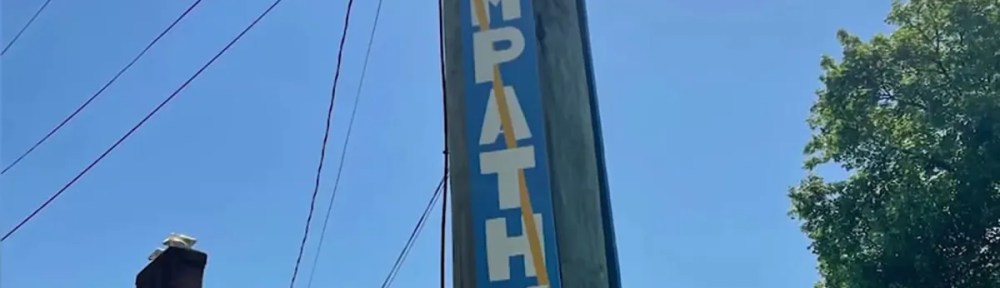
Have you noticed the “empathy” signs popping up on street poles throughout the area? There are now more than 500 in the D.C. area. I spoke with the one-man operation behind these signs. This Empathy Project is to encourage all who see his signs to try and understand others’ situations and perspectives.
He wishes to remain anonymous and mentioned that empathy is different from sympathy. According to Wikipedia, empathy may be defined as “…the capacity to understand or feel what another person is experiencing from within their frame of reference, that is, the capacity to place oneself in another’s position.”
He began the project two years ago as a response to the divisiveness in our society. The signs are to remind us to step out of our intellectual silos and to work together and solve interpersonal, local, national, and even global problems. He believes to find solutions we must first “stretch our minds to imagine how and why the other thinks and acts as they do.” To accomplish this, we must put away our immediate pre-suppositions and stop and listen, to hear and understand one other. We must lead with empathy.
The empathy signs are put up in pairs—one on either side of a pole to represent an empathetic connection between two people. Each pair is the mirror image of the other. No pairs are replicated. The primary design concept is simple, but the imagery can become complicated. He uses five colors – light blue, white, yellow, orange and red – and each holds significance. Light blue and white are the constants. As the founder describes it, “White represents the self, and blue is for reality or, for those who are religious, God. The other three colors (red, orange, and yellow) represent the other person.”
I believe the thought put into the design of each graphic qualifies it as art. Each time I drive by an empathy sign, or spot a new one, I smile and am reminded there is good in each of us, and sometimes it takes a simple reminder to be a better person, friend, colleague, and neighbor.
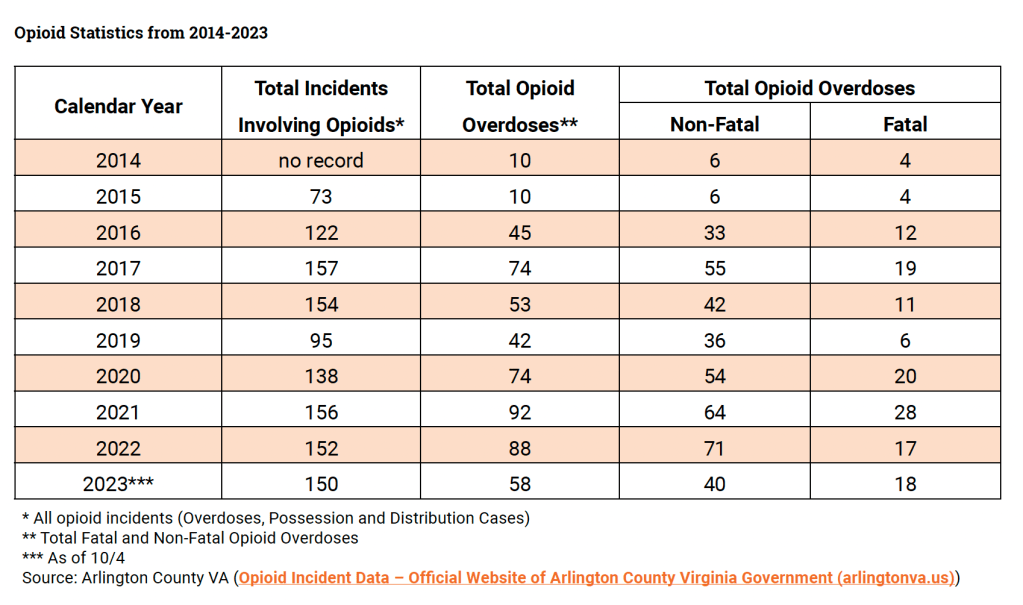
Arlington County is seeing an increase in the use of illegal substances among people under 20. The issue is not new to Arlington. It did not begin during COVID, though the rise in mental health issues related to the pandemic may well be a contributing factor in the increase of substance use. It is not isolated to a single school or neighborhood, though reports of at least seven overdose incidents and two student deaths in 2023 at one high school could give that impression.
I remember drug issues discussed by PTAs and communities in 2009, when our oldest son began at W-L. When drug-related arrests of students escalated in 2017, a public forum with County Police, the Commonwealth Attorney’s Office, the Behavioral Health Chief, and two parents whose high-school students had become addicted to opioids was held that October.1 In November of the same year, the Arlington Partnership for Children, Youth, and Families (APCYF) held a community forum to discuss the latest results of their Youth Risk and Behavior Survey (YRBS) which was administered in APS schools to 6th, 8th, 10th, and 12th graders between 2001 and 2017.2 The 2017 results noted an upswing in cases of kids being bullied, increased rates of depression, higher rates of self-harm, and high rates of marijuana and prescription drug use. The increase in the number of 6th grade students reporting the use of pills to get high increased from 2% In 2013 to over 11% in 2017. After 2017, the County switched to using the Virginia Youth Survey to allow for better comparison of future results across the Commonwealth. The 2019 data revealed an increase in Arlington students feeling physically unsafe and reported relatively the same level of alcohol, marijuana, and drug use as in 2017.
While opioid addiction has been a serious, nationwide issue for a couple of decades, the rise in the manufacturing and use of fentanyl since 2015 has led to a sharp increase in deaths. According to a CDC report, “U.S. drug overdose deaths increased 30% from 2019 to 2020 and 15% in 2021, resulting in an estimated 108,000 deaths in 2021. Among persons aged 14–18 years, overdose deaths increased 94% from 2019 to 2020 and 20% from 2020 to 2021 … among persons aged 10–19 years … from July–December 2019 to July–December 2021, median monthly overdose deaths increased 109%, and deaths involving IMFs [fentanyl] increased 182%.”
In Arlington, it is hard to gauge the extent and level of substance use by teens other than what they report on surveys. One key indicator would be the crime statistics reported by the Arlington County Police Department but they do not differentiate between adults and adolescents in their reporting.
After the death of Wakefield freshman Sergio Flores in February of this year, education and harm-reduction initiatives became a focus locally, and especially an increase in NARCAN administration training. The Arlington County Council of PTAs (CCPTA) hosted a forum on March 13th featuring several experts who discussed the increase in overdoses and made recommendations regarding trauma-informed responses to this epidemic. At the April LPCA meeting, the LPCA took advantage of County training efforts by hosting a representative of the Arlington Addiction Recovery Initiative (AARI). LPCA meeting attendees received details on how fentanyl users become addicted, and training on the administration of NARCAN.
In September, the second student death, that of high school student Jorge Chavarría Rodríguez, was reported. The Arlington Schools Hispanic Parent Association (ASHPA), and the local chapters of League of United Latin American Citizens (LULAC), and the NAACP have written letters and issued press releases, calling on school and county leaders to take action to address this growing crisis.
The causes of adolescent substance use are complex. The Centers for Disease Control and Prevention (CDC) lists several risk factors that substantially increase the likelihood that a young person will use substances and become addicted. Parents and caregivers should assess their child’s risk factors against the list below:
• Family history of substance use
• Favorable parental attitudes towards the behavior
• Poor parental monitoring
• Parental substance use
• Family rejection of sexual orientation or gender identity
• Association with delinquent or substance using peers
• Lack of school connectedness
• Low academic achievement
• Childhood sexual abuse
• Mental health issues
An adolescent’s level of connectedness to and support from their family, schools, and community is often cited as a protective factor in avoiding substance use.7 Parents and caregivers should openly discuss the facts about drug use with their children. If you don’t know the facts, then seek out sources with your child so you can learn together. The Drug Enforcement Agency (DEA) has a series of publications in English and Spanish, including Growing Up Drug Free: A Parent’s Guide to Substance Use Prevention. The Arlington CCPTA has also compiled a list of national and local resources. Visit their Substance Abuse Resources and Treatment Locators page for more information.
This is Part 1 of a two-part series on adolescent drug use in our community. Part 2 will focus on the actions taken to date by APS and Arlington County to combat the rise in adolescent substance use, feedback from Arlington students on what they have to say about what could help, and ways non-profit groups, advocacy organizations, and concerned neighbors can engage to combat this growing crisis.
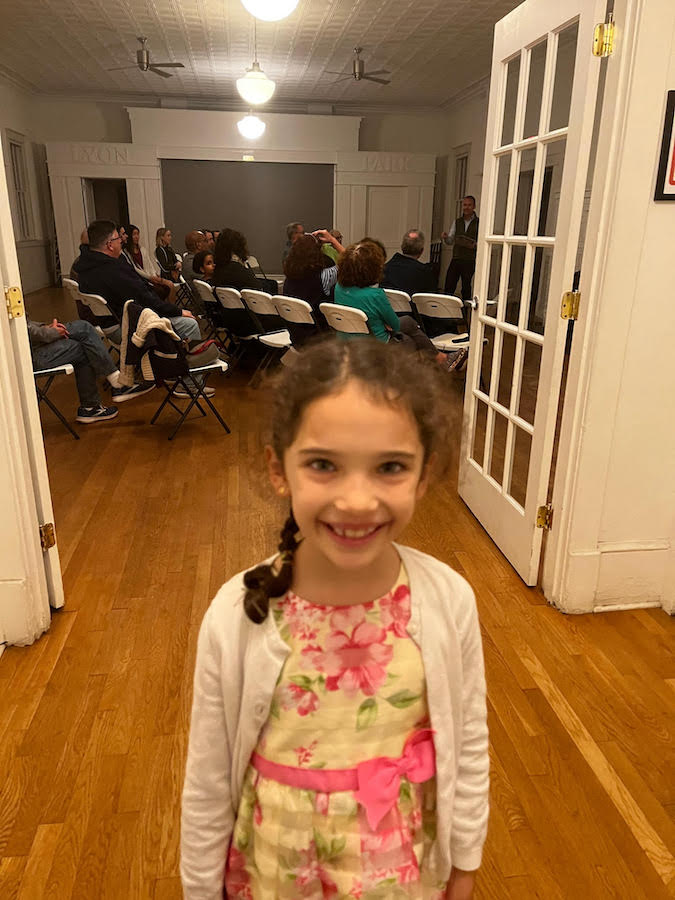
Dreaming of an inspiring display of youthful enthusiasm for environmental conservation, seven-year-old Sara Cakici has taken the initiative to organize a neighborhood parade with a heartfelt mission. Sara, a resident of Lyon Park and a first-grade student at the Arlington Traditional School (ATS), has a desire to motivate her community to recycle and protect the Earth. Sara presented her idea at the October LPCA meeting, and this idea has captured the hearts of neighbors and is already inspiring others to make a difference.
Sara’s inspiration came from her deep concern for the environment. Her idea is simple yet powerful: gather the community for a lively parade that celebrates recycling and emphasizes the importance of preserving the planet. She has spent days planning the event, designing colorful recycling-themed banners and writing eco-friendly messages. The event will consist of inviting kids and adults alike to design their own signs/banners with recyclable/recycled materials brought from home, followed by a parade, marching through the streets of Lyon Park with enthusiasm, holding their signs advocating for recycling, and sharing their commitment to sustainable living.
Sara hopes the impact will extend beyond the event itself, with many residents moved to become more conscious of their own recycling habits. Sara’s initiative is an example of how young voices can lead to significant change and inspire a community to come together for a common cause: protecting the Earth for future generations.
Save the date! Join us for this exciting recycling parade in proximity to Earth Day, on Saturday, April 20, 2024 at 10:30 a.m. at Lyon Park. You can start now by gathering a couple of recyclable materials from home to make your own recycling-themed banners and bring your young eco-enthusiasts to participate in this eco-friendly event that celebrates the importance of preserving the planet!.
Earlier this year, the Arlington County Board voted to implement a new Stormwater Utility Tax that will become effective in May 2024. The new tax is based on the amount of hard surfaces on a property such as buildings, roofs, driveways, and patios—anything that prevents water from seeping into the ground and creates runoff. The additional funds raised will pay for the maintenance of over 200 miles of sewer pipes, increases to system capacity, restoration projects, management of flood plains, and other needed improvements.
This new tax will replace the Sanitary District tax, which has been bundled within the County’s real estate taxes. The cost of this tax is $.017 for every $100 of assessed value. The new stormwater taxes will be listed separately on real estate tax bills after next May.
How can you tell what you may owe? The County used GIS-mapping to estimate that an average single-family home in Arlington has 2,400 square feet of impervious surface. This represents one ERU, or Equivalent Residential Unit, and there is a scaled system of billable units (see chart below) used to calculate the tax for each property. Initial estimates are that an ERU has a sample value of $230–250, though the rate will not be set until the County Board votes this Fall, and is dependent on the adopted budget.
Why is the County moving to this new tax structure? There have been additional demands on the stormwater system, and the County needs to raise additional revenue to pay for planned improvements, The shift to the Stormwater Utility tax is considered to be a fairer way to assess cost because it is based on the amount of impervious lot coverage, rather than a property’s value. The new fee is demand-based: the larger a property’s impervious surfaces, the more that property contributes to runoff and puts pressure on the system. There are some properties (places of worship, non-profits, and Federal buildings) that currently don’t pay the sanitary district tax. Those properties will likely be impacted by this new stormwater tax.
The County acknowledges that property owners will be paying more under this tax structure, but there is a way owners can qualify for credits. Between November 1, 2023 and January 15, 2024, property owners are able to reduce the tax amount by making specific improvements to their properties in 2023 that reduce runoff. Additional information on the credit program, a (not-very-user-friendly) fee estimator by property, and FAQs may be found on the County’s Stormwater Utility Implementation page (go to https://www.arlingtonva.us and search for stormwater utility).
I am a biker. My health and the planet’s health are two reasons I choose to cycle. And it isn’t just for my physical health. Psychologically, it is a great way to start my day by commuting to work. If the day goes poorly, I hop on my bike and not only get to work out the stress on the ride home, but I get an endorphin hit, fresh air in my lungs, and time to reflect and de-stress before I’m home.
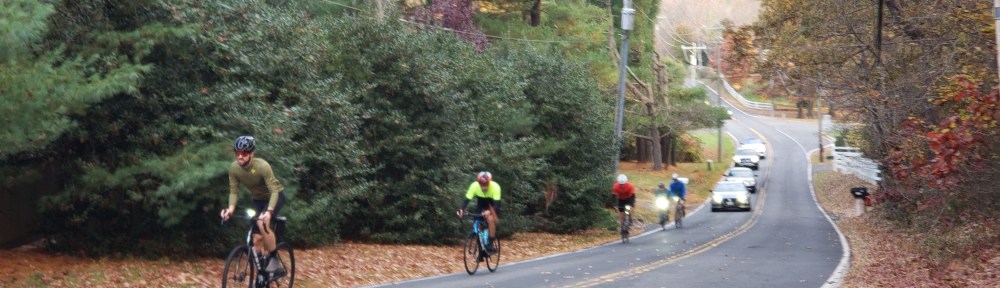
I want to share with you why it’s so awesome to be on a bike in this area—for commuting and recreation — and why you should do it, too! When we drive, we’re sealed inside a box with limited visibility, focused on quickly reaching our destination. When we walk, we’ve got full visibility, we experience the weather, and we can enjoy the beautiful houses, trees, and gardens of our neighborhoods but we cover less ground. Cycling is the sweet spot between these two. Instead of exploring a few new blocks while out walking, you can explore entire neighborhoods. You decide when to roll slowly, and when to push yourself on a climb. Those with electric assist get even more choices in how much they want to sweat.
During the pandemic, I rode 2/3 of all streets in Arlington, and 1/3 of all streets in DC. I found some ridiculous hills, very odd homes, amazing views, surprising history, and a great diversity of neighborhoods. Biking has helped me appreciate how wonderful it is to live in the DC area.
Though I love solo explorations, in the past year I’ve begun riding with some neighbors. This is not only fun but also motivating! It pushes us all to do more and explore more. We love riding in the hills of North Arlington and heading across the river for popular routes like MacArthur Blvd out to Great Falls, Rock Creek Park, Beach Drive, Sligo Creek and Anacostia Trail. We have biked the ever-popular Custis, Mt. Vernon, W&OD, C&O, and Capital Crescent trails. Beautiful tree-covered trails, iconic views, and robust exercise keep us pedaling through all four seasons.
Looking for support or inspiration? Arlington has some great resources.
Bike Arlington (bikearlington.com has some nice route suggestions and tools, including a “Bicycle Comfort Map” that helps you find routes appropriate for you and your family to get around Arlington.
The Washington Area Bicycle Association (waba.org) is a great education and advocacy group, and organizer of big rides. Many bike shops in the area organize group rides for various levels.
Capital Bikeshare is a great way to start. We have 3 stations in Lyon Park, and their e-bikes are really easy to use.
Our new bike shop, Vélocity Bike Co-op, on Pershing Drive can help get your bike back in shape, or help you find a new one.
I recently joined the county’s Bicycle Advisory Committee to encourage the county to make cycling safer and more accessible for residents, and because I would like to see more bike infrastructure in Arlington County. If you have suggestions or improvements you would like to see made, please reach out to me and I will submit them for discussion at a meeting. And if you want encouragement, ideas, or are interested in joining me for a weekend ride, email me at ajschuetz@yahoo.com. You can also follow me on Strava.
I hope to see more neighbors biking around the community on these beautiful fall days. And if you drive, thanks for sharing the road! Cycle on!
Respiratory virus season is this fall and winter, and new protections are available against three of the most common causes of hospitalization: COVID-19, influenza (flu), and respiratory syncytial virus (RSV). Protect yourself, your loved ones, and your community by getting your recommended vaccinations.
The distribution of COVID-19 vaccines changed this September as these products moved onto the commercial market and an updated version was released. These new vaccines are well adapted for currently circulating variants, such as XBB sub lineages. The new COVID-19 vaccines are available at no cost for most people through their private health insurance, Medicare, and Medicaid plans. Adults without health insurance and adults with insurance that does not cover COVID-19 vaccines are also eligible for free COVID-19 vaccinations. Visit vaccines.gov to find a provider that offers no-cost COVID-19 vaccines. Options in Arlington County to get your COVID-19 vaccine include your healthcare provider, federally qualified health centers, CVS, and Walgreens.
The flu virus evolves and everyone over 6 months old, with rare exceptions, should get a flu vaccine annually. Each year different strains of the virus circulate, and the flu vaccine is updated. Flu vaccines are available in Arlington County. RSV is a common respiratory virus. While most cases are mild, RSV can be serious. Infants and adults over 60 years of age are at higher risk from RSV. The CDC recently approved the RSV vaccine for people over 60 and pregnant people. Additionally, a monoclonal antibody called nirsevimab is approved for children 8–19 months to protect against the worst outcomes of RSV. Learn more on the CDC website: http://www.cdc.gov/respiratory-viruses/index.html.
We can protect ourselves and each other from these three vaccine-preventable diseases this season. You may get these vaccines at the same appointment. Schedule your appointment today!










 lyonpark.org