By F. Gray Handley
If you visited Lyon Park about 450 years ago, before the Europeans arrived, you’d be in the middle of a majestic forest that sloped down to the Patawomeck River, the fourth largest along the East Coast. That forest included giant oaks, maples and hickories—and it was dominated by massive chestnuts which were comparable to the redwoods of California. These chestnuts, growing at the eastern edge of their range, were a keystone species providing nutritious food for animals and humans, building soil and helping create a remarkably diverse ecosystem. They dominated and shaped the hills around Lyon Park itself, and you might have rested in the shade of a chestnut to drink fresh-flowing spring water near where our playground is today. If you sat there quietly you might have been joined by forest bison, elk and wolves stopping by for a cautious sip.
Of course, all that changed as European settlers moved in to clear fields, build houses and make roads out of native pathways to carry their farm products to ports along the river. Many of these new settlements used the abundant chestnut, a durable hardwood resistant to rot and insects, for fences and buildings. In a remarkably short time, the seemingly endless old growth forest was displaced by farms, towns and neighborhoods like ours. Chestnuts were still welcomed and widely planted for their protective shelter, vigorous growth, high-quality wood and abundant delicious nuts. Both in the countryside and in remaining mountain forests, the chestnut was still a predominant, critically important species.
Then, early in the 20th Century, Chestnut Blight (a fatal fungal disease to which American Chestnuts have no resistance) arrived with the commercial import of Japanese Chestnuts. Within 30 years nearly four billion American Chestnuts died in one of the largest and fastest species extinctions ever recorded. This loss dramatically altered entire ecosystems. But there was a glimmer of hope in that the blight did not completely kill the roots of some native chestnuts. To this day, living stumps send up shoots, some of which survive for years. In addition, remnant groves and individual trees have been found in pockets of its natural range and in other areas isolated from blight exposure. Now, with the advancement of genetic technologies, blight resistant Japanese and Chinese Chestnut genes are being experimentally incorporated into the genome of American Chestnuts to increase their blight resistance. This strategy and others being studied in universities and by the American Chestnut Foundation (TACF) offer hope that the American Chestnut may eventually return to our native forests.
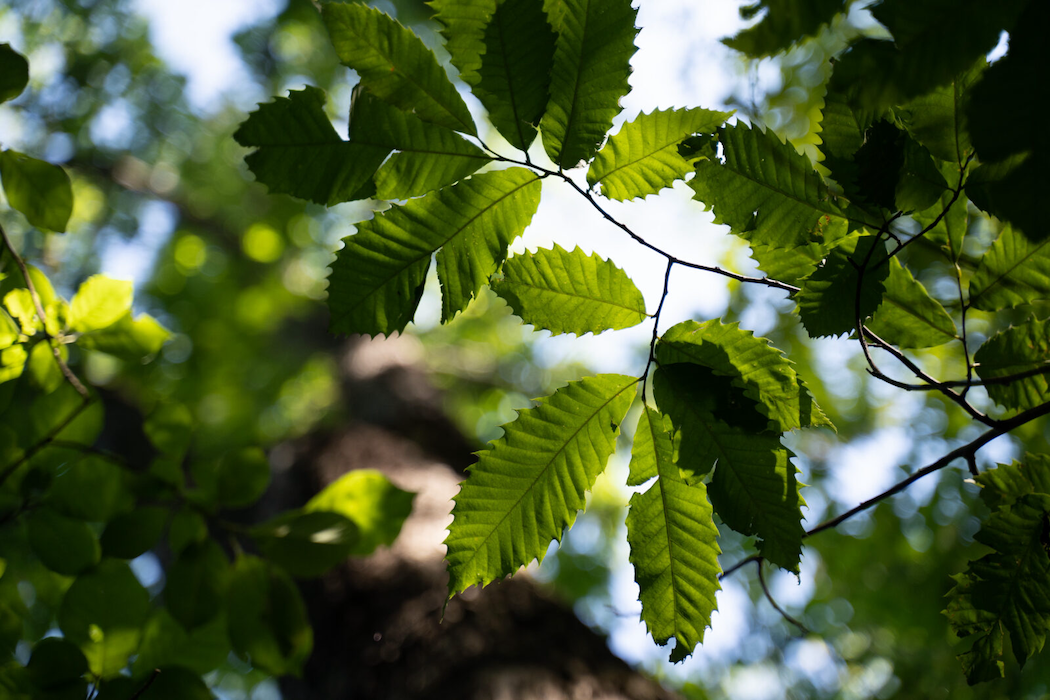
In 2020 and 2021, as part of Lyon Park’s centennial commemorations, members of our community worked with TACF to plant four American Chestnut saplings in our “urban forest” within Lyon Park—which, for the first time, returned the species to this part of its ancestral range while also enhancing our park with a remarkable native that vanished over a century ago. These saplings, two of which have survived lawn mowers and other threats, are among the first hybrids made available for public planting by TACF. Soon after our trees were planted, a small grove of their siblings was donated to the National Arboretum. Over the next decade or so, with a bit of luck, these “returning” American Chestnuts will resist the blight to reach full maturity.
If you want to say hello to the Lyon Park Chestnuts, they are in the area of the park that is bounded by Fillmore and 4th – one is about 15 feet tall and the other, planted a year later, is two feet tall. Most exciting, the older one produced nuts in 2023! Our volunteer arborists hope to see more of this prickly output in 2024 and they may even try to sprout some for others to plant. Please help us keep these very special trees healthy as our community makes a small but historic contribution to the return of the Patawomack Forest.
 lyonpark.org