By Kathleen McSweeney
Did you know that every jurisdiction is required to have a comprehensive plan to guide its current and long-range development? According to Article 3, Section 15.2-2223 of the Virginia code, the Planning Commission in each jurisdiction has the duty to prepare and recommend the comprehensive plan elements, and the governing body—in our case, the Arlington County Board—has the responsibility of adopting the plan for the County. Sections of the code define the required plan elements and outline guidelines for a Transportation Plan that designates a system of transportation infrastructure, and “…shall include, as appropriate, but not be limited to, roadways, bicycle accommodations, pedestrian accommodations, railways, bridges, waterways, airports, ports, freight corridors, and public transportation facilities.” (Source: Code of Virginia, Section 15.2-2223.B.1.) The code also mandates specific elements be included, such as a zoning ordinance, public and private development (including commercial, general residential, and affordable housing development), community services and facilities, historic areas, groundwater and sewer treatment, and consider strategies to address social well-being, health, the economy, and the environment.
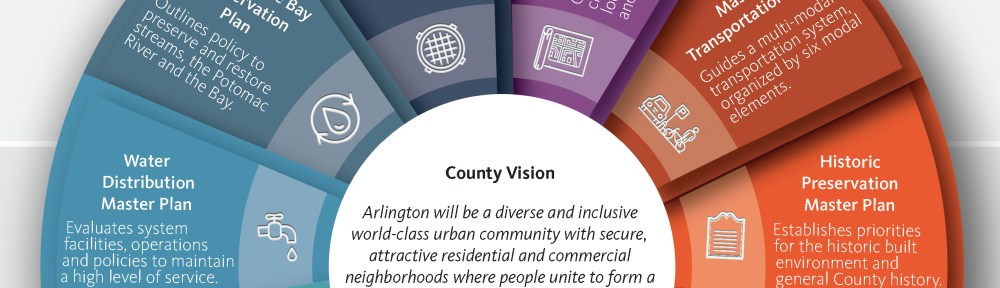
Comprehensive Plan elements are publicly reviewed and updated at least every five years. Prior to December 2023, Arlington’s Comprehensive Plan contained eleven elements: the General Land Use Plan (GLUP), Master Transportation Plan, Historic Preservation Master Plan, Affordable Housing Master Plan, Sanitary Sewer Master Plan, Recycling Program Master Plan, Community Energy Plan, Public Spaces Master Plan (which included three sub-plans: the Urban Forest, Public Arts, and Natural Resources Master Plans), Water Distribution Master Plan, Chesapeake Bay Preservation Master Plan, and the Stormwater Master Plan. Each plan element has a network of commissions and interested citizen advocates that contribute to updates and revisions during the plans’ scheduled public update cycle.

At the December 2023 Board meeting, the Forestry and Natural Resource Plan (FNRP) became the 12th element of the County’s Comprehensive Plan. This was the result of a three-year process. In 2020, a joint citizen advisory group was formed (with representatives from the Energy commissions) to review and update the Urban Forestry and Natural Resources plan elements. The Advisory Group recommended that the two plans be combined into a single Forestry and Natural Resource Plan (FNRP), the Planning Commission endorsed it, and approval of the FNRP was added to the County Board’s December meeting agenda. Upon approval, the Board commented that “The FNRP is intended to be a holistic long-term planning tool that outlines over 80 policy recommendations organized into four interconnected Strategic Directions: Conservation; Climate Mitigation, Adaption, and Resilience; Biodiversity; and Operations.”
 lyonpark.org