
By Kathleen McSweeney
Arlington County is seeing an increase in the use of illegal substances among people under 20. The issue is not new to Arlington. It did not begin during COVID, though the rise in mental health issues related to the pandemic may well be a contributing factor in the increase of substance use. It is not isolated to a single school or neighborhood, though reports of at least seven overdose incidents and two student deaths in 2023 at one high school could give that impression.
I remember drug issues discussed by PTAs and communities in 2009, when our oldest son began at W-L. When drug-related arrests of students escalated in 2017, a public forum with County Police, the Commonwealth Attorney’s Office, the Behavioral Health Chief, and two parents whose high-school students had become addicted to opioids was held that October.1 In November of the same year, the Arlington Partnership for Children, Youth, and Families (APCYF) held a community forum to discuss the latest results of their Youth Risk and Behavior Survey (YRBS) which was administered in APS schools to 6th, 8th, 10th, and 12th graders between 2001 and 2017.2 The 2017 results noted an upswing in cases of kids being bullied, increased rates of depression, higher rates of self-harm, and high rates of marijuana and prescription drug use. The increase in the number of 6th grade students reporting the use of pills to get high increased from 2% In 2013 to over 11% in 2017. After 2017, the County switched to using the Virginia Youth Survey to allow for better comparison of future results across the Commonwealth. The 2019 data revealed an increase in Arlington students feeling physically unsafe and reported relatively the same level of alcohol, marijuana, and drug use as in 2017.
While opioid addiction has been a serious, nationwide issue for a couple of decades, the rise in the manufacturing and use of fentanyl since 2015 has led to a sharp increase in deaths. According to a CDC report, “U.S. drug overdose deaths increased 30% from 2019 to 2020 and 15% in 2021, resulting in an estimated 108,000 deaths in 2021. Among persons aged 14–18 years, overdose deaths increased 94% from 2019 to 2020 and 20% from 2020 to 2021 … among persons aged 10–19 years … from July–December 2019 to July–December 2021, median monthly overdose deaths increased 109%, and deaths involving IMFs [fentanyl] increased 182%.”
In Arlington, it is hard to gauge the extent and level of substance use by teens other than what they report on surveys. One key indicator would be the crime statistics reported by the Arlington County Police Department but they do not differentiate between adults and adolescents in their reporting.
After the death of Wakefield freshman Sergio Flores in February of this year, education and harm-reduction initiatives became a focus locally, and especially an increase in NARCAN administration training. The Arlington County Council of PTAs (CCPTA) hosted a forum on March 13th featuring several experts who discussed the increase in overdoses and made recommendations regarding trauma-informed responses to this epidemic. At the April LPCA meeting, the LPCA took advantage of County training efforts by hosting a representative of the Arlington Addiction Recovery Initiative (AARI). LPCA meeting attendees received details on how fentanyl users become addicted, and training on the administration of NARCAN.
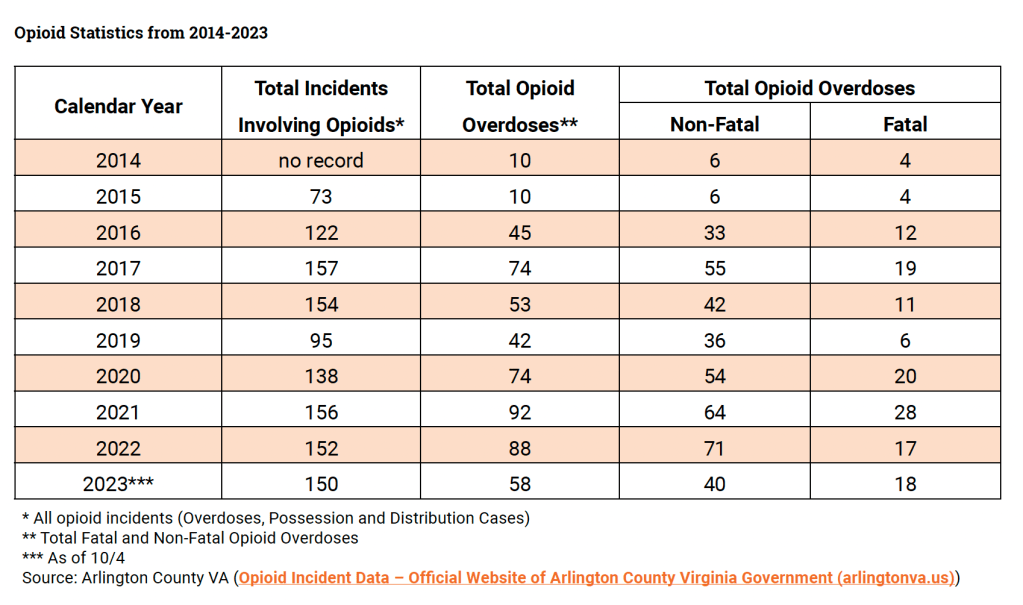
In September, the second student death, that of high school student Jorge Chavarría Rodríguez, was reported. The Arlington Schools Hispanic Parent Association (ASHPA), and the local chapters of League of United Latin American Citizens (LULAC), and the NAACP have written letters and issued press releases, calling on school and county leaders to take action to address this growing crisis.
The causes of adolescent substance use are complex. The Centers for Disease Control and Prevention (CDC) lists several risk factors that substantially increase the likelihood that a young person will use substances and become addicted. Parents and caregivers should assess their child’s risk factors against the list below:
• Family history of substance use
• Favorable parental attitudes towards the behavior
• Poor parental monitoring
• Parental substance use
• Family rejection of sexual orientation or gender identity
• Association with delinquent or substance using peers
• Lack of school connectedness
• Low academic achievement
• Childhood sexual abuse
• Mental health issues
An adolescent’s level of connectedness to and support from their family, schools, and community is often cited as a protective factor in avoiding substance use.7 Parents and caregivers should openly discuss the facts about drug use with their children. If you don’t know the facts, then seek out sources with your child so you can learn together. The Drug Enforcement Agency (DEA) has a series of publications in English and Spanish, including Growing Up Drug Free: A Parent’s Guide to Substance Use Prevention. The Arlington CCPTA has also compiled a list of national and local resources. Visit their Substance Abuse Resources and Treatment Locators page for more information.
This is Part 1 of a two-part series on adolescent drug use in our community. Part 2 will focus on the actions taken to date by APS and Arlington County to combat the rise in adolescent substance use, feedback from Arlington students on what they have to say about what could help, and ways non-profit groups, advocacy organizations, and concerned neighbors can engage to combat this growing crisis.
- County to Host Town Hall Discussion on Drug Awareness Next Month | ARLnow.com
- Youth Risk Behavior Survey – 2017 (Spring) Results – Official Website of Arlington County Virginia Government (arlingtonva.us)
- VYS 2019 Results – Official Website of Arlington County Virginia Government (arlingtonva.us)
- Tanz LJ, Dinwiddie AT, Mattson CL, O’Donnell J, Davis NL. Drug Overdose Deaths Among Persons Aged 10–19 Years — United States, July 2019–December 2021. DOI: http://dx.doi.org/10.15585/mmwr.mm7150a2. From the CDC’s Weekly Morbidity and Mortality Report, December 16, 2022: DrugOverdoseDeathsAmongPersonsAged10–19Years—UnitedStates,July2019–December2021| MMWR(cdc.gov)
- Arlington County Council of PTAs – Outreach (arlingtonccpta.org)
- High Risk Substance Use in Youth | Adolescent and School Health | CDC
- High Risk Substance Use in Youth | Adolescent and School Health | CDC, and panelists’ comments from the video and discussion found on Arlington County Council of PTAs – Outreach (arlingtonccpta.org)
 lyonpark.org